Gujarat Trains Lakhs of Artisans Under PM Vishwakarma Scheme
Source:The Hindu ↗
Why It Matters
The article highlights a practical implementation of government policy aimed at formalizing the informal economy, providing credit access to marginalized artisans, and boosting the MSME sector. These are core themes in GS3 (Economy and Employment). It also provides excellent fodder for answers on welfare schemes (GS2) and the preservation of India's diverse traditional crafts (GS1).
Summary
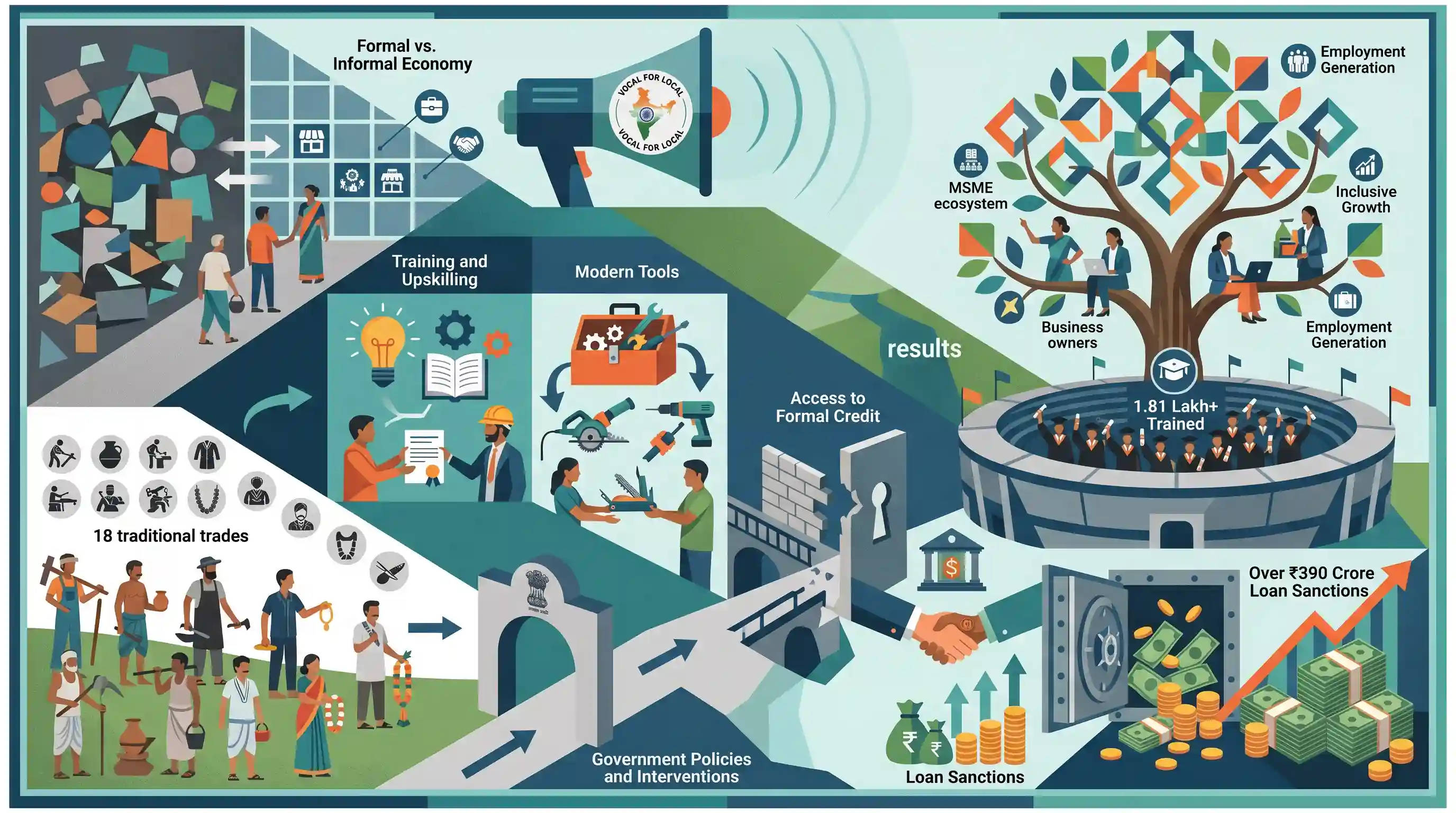
The PM Vishwakarma Scheme has seen significant success in Gujarat, where over 1.81 lakh artisans from 18 traditional trades have been trained over the past two years. Launched to preserve traditional crafts and upskill artisans, the scheme provides training, modern tools, and crucial access to formal credit. In Gujarat alone, loan sanctions have exceeded ₹390 crore for over 43,000 beneficiaries. By reducing barriers to formal credit for informal sector workers, the scheme bolsters the MSME ecosystem, aligns with the "Vocal for Local" initiative, and supports the economic empowerment of marginalized rural artisans.
Key Points
- Gujarat has successfully trained over 1.81 lakh artisans across 18 traditional trades under the PM Vishwakarma Scheme over two years.
- The scheme has facilitated formal credit access for informal sector workers, with loan sanctions exceeding ₹390 crore for more than 43,000 beneficiaries in the state.
- It provides end-to-end support to artisans, including skill up-gradation, modern tools, and market linkages to integrate them into the broader economy.
- The initiative focuses on preserving heritage crafts while empowering marginalized rural artisans, aligning with broader MSME sector goals and the 'Vocal for Local' campaign.
Important Terms
PM Vishwakarma Scheme

A Central Sector Scheme launched in 2023 to provide end-to-end support, including skill training, toolkits, and collateral-free credit, to traditional artisans across 18 specified trades.
UPSC context
GS Paper 2 (Govt Policies) and Paper 3 (Employment). Tests knowledge of social security and rural economy formalization.
Vocal for Local
A national initiative promoting indigenous products to bolster domestic manufacturing. It aligns with the Atmanirbhar Bharat mission, encouraging citizens to prioritize locally-made goods to support grassroots entrepreneurship.
UPSC context
GS Paper 3 (Industrial Growth). Tests understanding of domestic market strategies and economic empowerment of local industries.
Ministry of Micro, Small and Medium Enterprises (MSME)
The apex Union ministry responsible for formulating rules and laws for small-scale industries. It manages schemes that improve competitiveness, employment, and credit flow for micro-entrepreneurs.
UPSC context
GS Paper 3 (Economy). Tests knowledge of institutional frameworks supporting employment generation and small-scale industries.
Formal Credit
Financial assistance provided by regulated institutions like banks and NBFCs. It is characterized by standardized interest rates and legal protections, facilitating the transition of informal workers to the formal economy.
UPSC context
GS Paper 3 (Inclusive Growth). Tests understanding of financial inclusion and credit accessibility for the informal sector.
Central Sector Scheme
A government program 100% funded and implemented by the Union Government. These focus on subjects in the Union List, unlike Centrally Sponsored Schemes which share costs with states.
UPSC context
GS Paper 2 (Federalism). Tests technical knowledge of fiscal relations and administrative structures in Indian governance.
Prelims Trap
"PM Vishwakarma is a Centrally Sponsored Scheme implemented by the Ministry of Skill Development."
It is a Central Sector Scheme (100% funded by GoI) with the Ministry of MSME as the nodal ministry, not Skill Development.
Static Concepts Connected
What distinguishes Central Sector Schemes from Centrally Sponsored Schemes?
- Funding Mechanism: Central Sector Schemes are 100% funded by the Union government, whereas Centrally Sponsored Schemes have a shared funding ratio (e.g., 60:40) between the Centre and States.
- Implementation Authority: Central Sector Schemes are implemented directly by Central agencies, while Centrally Sponsored Schemes are implemented by State governments.
- Constitutional Jurisdiction: Central Sector Schemes generally correspond to subjects in the Union List, whereas Centrally Sponsored Schemes target State List subjects to supplement state efforts.
How do micro-credit schemes integrate informal workers into the formal economy?
- Collateral-Free Credit: Providing loans without requiring physical assets overcomes the biggest hurdle informal artisans face with traditional banking.
- Interest Subvention: Government covers a portion of the interest (e.g., 5% concessional rate), lowering the cost of capital and deterring reliance on local moneylenders.
- Financial Formalization: Registering for these loans links informal trades to banking systems, building a credit history that allows for larger future enterprise loans.
Cross-Topic Patterns
Intangible Heritage + MSME formalization
Preserving the Guru-Shishya parampara of informal artisans links cultural heritage preservation directly with economic formalization and MSME credit integration.
Welfare scheme deduplication
UPSC often tests cross-scheme eligibility constraints. PM Vishwakarma explicitly excludes individuals who recently availed PM SVANidhi or PMEGP to prevent overlapping credit subsidies.

A 2026 prelims question will likely test PM Vishwakarma's strict eligibility (one per family, PMEGP exclusion) and nodal MoMSME.
Linked PYQs · 5
Linked PYQs · 5
- 2023MainsGS3
Faster economic growth requires increased share of the manufacturing sector in GDP, particularly of MSMEs. Comment on the present policies of the Government in this regard.
- 2022MainsGS2
Besides the welfare schemes, India needs deft management of inflation and unemployment to serve the poor and the underprivileged sections of the society. Discuss.
- 2016MainsGS3
How globalization has led to the reduction of employment in the formal sector of the Indian economy? Is increased informalization detrimental to the development of the country?
- 2023PrelimsGS1
Consider the following statements with reference to India: 1. According to the 'Micro, Small and Medium Enterprises Development (MSMED) Act, 2006', the 'medium enterprises' are those with investments in plant and machinery between ₹ 15 crore and ₹ 25 crore. 2. All bank loans to the Micro, Small and Medium Enterprises qualify under the priority sector. Which of the statements given above is/are correct?
- 2018PrelimsGS1
Consider the following pairs: Craft Heritage of 1. Puthukkuli shawls Tamil Nadu 2. Sujni embroidery Maharashtra 3. Uppada Jamdani saris Karnataka Which of the pairs given above is/are correct?
