Gujarat Tops NITI Aayog Investment Index
Source:newsonair ↗
આ શા માટે મહત્વનું છે
Indices released by NITI Aayog are frequently tested in GPSC Prelims. Understanding the parameters (8 pillars), state rankings, and categories within this newly launched investment index is essential for economy and governance questions.
સારાંશ
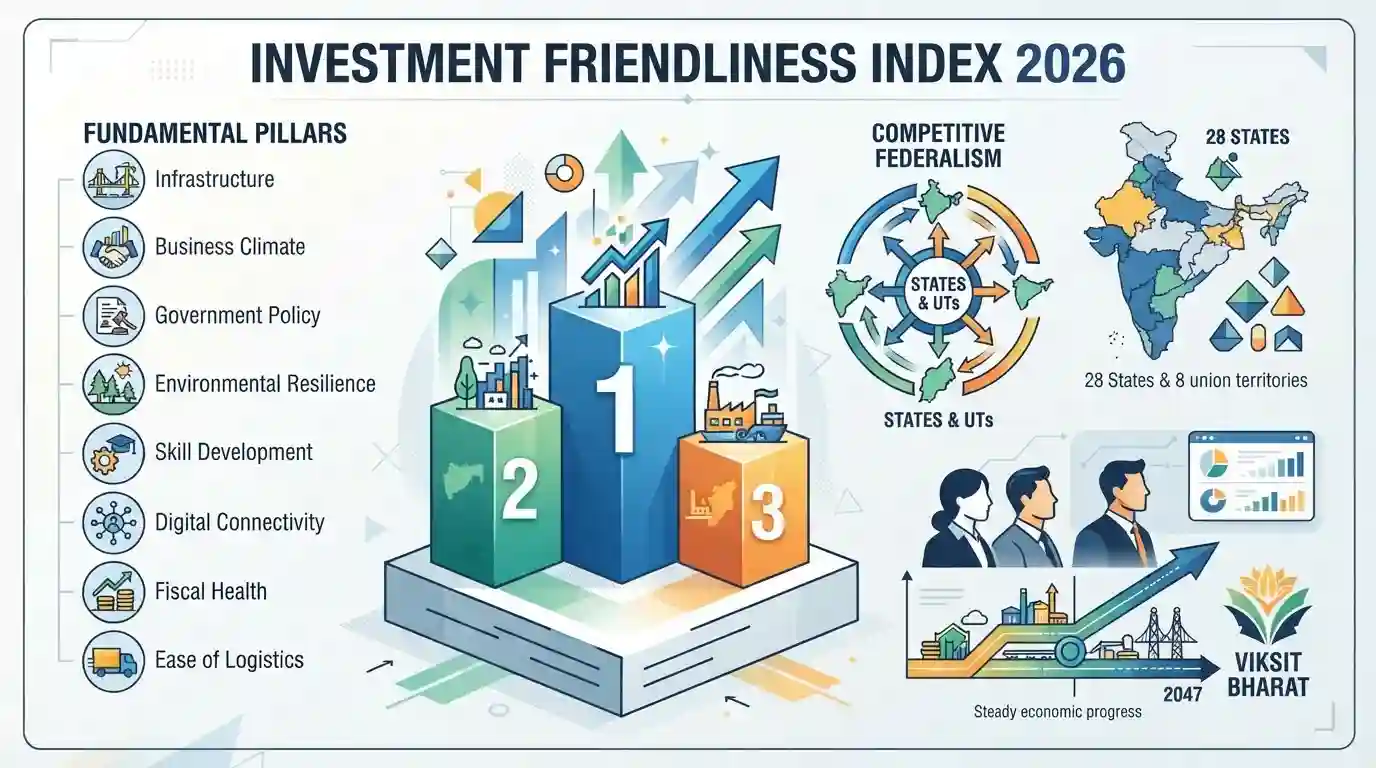
Gujarat has emerged as the best place to attract investments in India, topping NITI Aayog's Investment Friendliness Index 2026. Maharashtra and Tamil Nadu secured the second and third positions, respectively. The comprehensive index assesses 28 states and 8 Union Territories on eight fundamental pillars such as infrastructure, business climate, government policy, and environmental resilience. The initiative aims to stimulate competitive federalism among Indian states, crucial for attaining the goal of a 'Viksit Bharat' by 2047, as noted by NITI Aayog's leadership, including CEO Nidhi Chhibber and Vice Chairman Ashok Kumar Lahiri.
મુખ્ય મુદ્દા
- Gujarat has topped NITI Aayog's Investment Friendliness Index 2026, followed by Maharashtra, Tamil Nadu, Goa, and Odisha.
- The index evaluated 28 states and 8 Union Territories across 8 pillars, including infrastructure, business climate, regulatory ease, and environmental resilience.
- States and UTs were classified into four categories: Top Performers, Frontrunners, Emerging Performers, and Aspiring States.
- The index fosters competitive federalism to help achieve the vision of a 'Viksit Bharat' (Developed India) by 2047.
- NITI Aayog CEO Nidhi Chhibber and Vice Chairman Ashok Kumar Lahiri emphasized the index's role in driving economic growth and attracting investments.
મહત્વપૂર્ણ શબ્દો
Investment Friendliness Index 2026

A comprehensive framework by NITI Aayog assessing states and UTs on parameters like infrastructure, business climate, and policy to gauge their readiness to attract, facilitate, and sustain domestic and foreign investments.
UPSC context
Important for GS-3 (Economy) and GS-2 (Governance). Tests knowledge of index parameters, competitive federalism, and state-led economic growth strategies.
Viksit Bharat
The Government of India's long-term vision to transform the country into a developed, self-reliant $30–40 trillion economy by 2047—the centenary of its independence—focusing on inclusive growth and governance.
UPSC context
Crucial for Essay and GS-3. Tests long-term national development goals, sustainable economic milestones, and targeted welfare for key demographics.
NITI Aayog
The Indian government's premier public policy think tank. Established in 2015 to replace the Planning Commission, it designs strategic frameworks, promotes bottom-up development, and fosters cooperative and competitive federalism.
UPSC context
Core for GS-2 (Polity and Governance). Evaluates knowledge of non-constitutional bodies, decentralized policy formulation, and center-state intergovernmental relations.
Competitive Federalism
A governance model where states actively compete against one another to attract capital, industry, and talent by demonstrating superior regulatory environments, better infrastructure, and improved policy outcomes.
UPSC context
Highly relevant for GS-2 (Polity). Tests understanding of inter-state dynamics, performance-based benchmarking, and the shift from centralized planning.
પ્રિલિમ્સ ટ્રેપ
"The Investment Friendliness Index is released by the DPIIT to promote ease of doing business."
Aspirants confuse this with DPIIT's Business Reforms Action Plan (BRAP). The Investment Friendliness Index is explicitly a NITI Aayog initiative to foster competitive federalism.
સંલગ્ન સ્થિર ખ્યાલો
What is Competitive Federalism in the Indian context?
- Core Idea: States compete against each other for funds and investments, driving administrative efficiency and economic growth.
- NITI Aayog's Role: Acts as a catalyst by ranking states on various indices (health, water, investment) to spur healthy competition.
What is the composition of the NITI Aayog Governing Council?
- Chairperson: The Prime Minister of India heads the institution as its Chairperson.
- Members: Includes Chief Ministers of all States and UTs with legislatures, and Lt. Governors of other UTs.
- Special Invitees: Eminent experts, specialists, and practitioners with relevant domain knowledge, nominated by the Prime Minister.
આંતર-વિષય પેટર્ન
Environment as a capital magnet
Including 'environmental resilience' as a pillar shifts ecological policies from compliance burdens to core drivers of state-level foreign and domestic investments.
Competitive Federalism vs Regional Disparity
While indexes spur growth, historically industrialized states (Gujarat, MH, TN) consistently top, raising concerns about widening economic disparities with 'Aspiring' states.

Expect a 2026 Prelims question contrasting NITI's Investment Index with DPIIT's Ease of Doing Business, testing the 4 tiers.
સંલગ્ન PYQ · 3
સંલગ્ન PYQ · 3
- 2025GPSC_PRELIMSGS1
Consider the following statements: 1. Planning Commission had no provision for part-time members 2. NITI Aayog has a number of part-time members 3. Planning Commission framed policies for states 4. NITI Aayog does not have the powers to frame policies for the states Which of the statements given above is/are correct?
- 2026GPSC_PRELIMSGS1
Consider the following statements regarding the role of institutions in the formulation and implementation of 'Public Policy' in India: 1. The Cabinet Secretariat works directly under the leadership of the Prime Minister and is the main center of policy coordination. 2. The 'Governing Council' of NITI Aayog has completely replaced the National Development Council. 3. Private sector experts are involved in government policy formulation through 'Lateral Entry'. 4. Parliamentary Standing Committees conduct detailed examinations of ministries' policies and expenditures. Which of the above statements are correct?
- 2025GPSC_PRELIMSGS1
In the Union Budget 2025-26, presented by Finance Minister, Nirmala Sitharaman, the limit of the Foreign Direct Investment (FDI) in the insurance sector has been raised from ______ to ______.
