NITI Aayog Investment Friendliness Index methodology and rank
Source:The Hindu ↗
Why It Matters
Understanding new state ranking indexes introduced by NITI Aayog is highly relevant for GPSC and UPSC prelims, specifically regarding competitive federalism, ease of doing business, fiscal prudence, and Gujarat's major industrial/infrastructure growth.
Summary
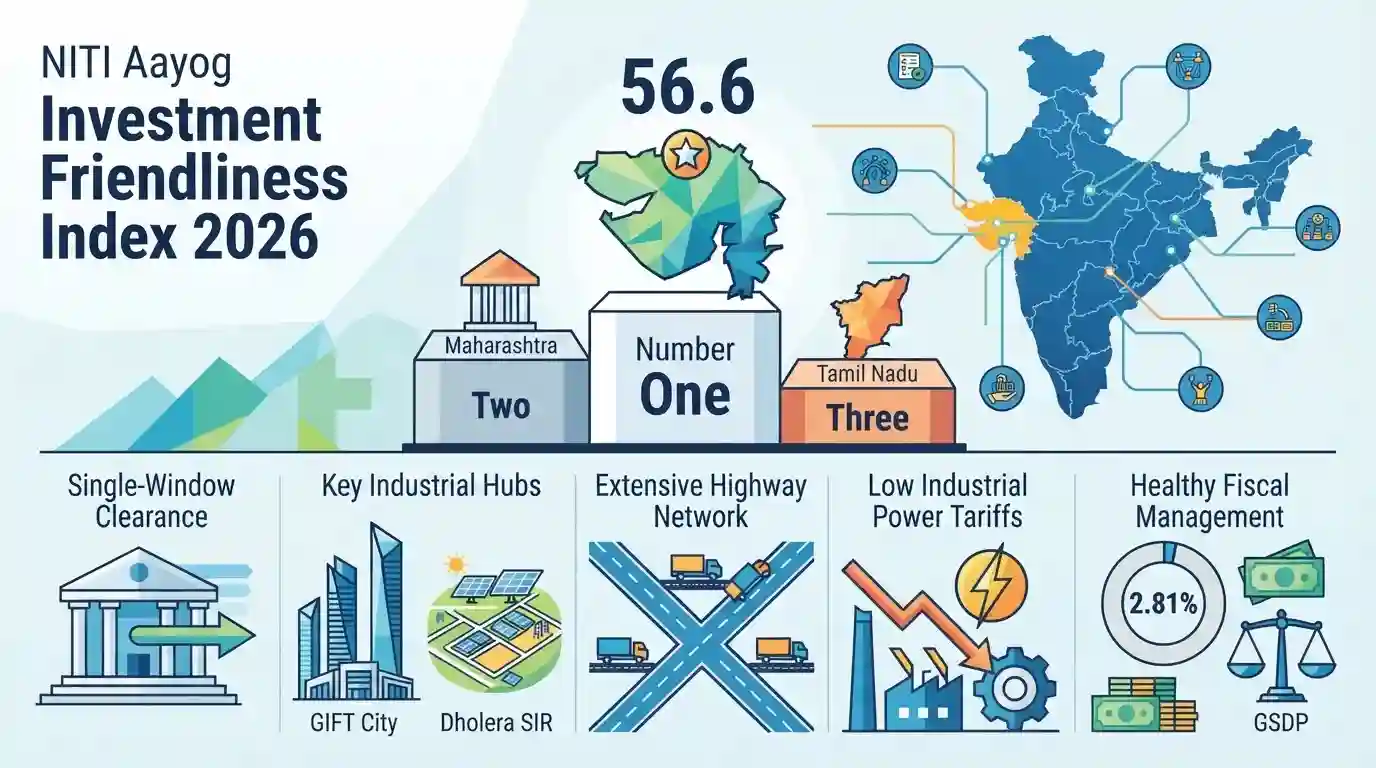
In NITI Aayog’s inaugural Investment Friendliness Index 2026, Gujarat has topped the rankings among major states with a score of 56.6, outperforming Maharashtra and Tamil Nadu. The index measures states across eight pillars and 84 performance indicators. Gujarat’s strong showing is backed by its efficient single-window clearance (via iNDEXTb), key industrial hubs (such as GIFT City and Dholera SIR), extensive highway network, low industrial power tariffs, and healthy fiscal management, with its fiscal deficit maintained at 2.81% of GSDP.
Key Points
- NITI Aayog launched its first Investment Friendliness Index 2026, evaluating 17 major states across 84 indicators grouped under eight pillars.
- Gujarat ranked first with a score of 56.6, followed by Maharashtra (53.7) and Tamil Nadu (53.3).
- Key drivers for Gujarat's top ranking include a streamlined single-window clearance portal managed by the Industrial Extension Bureau (iNDEXTb) and specialized plug-and-play industrial hubs like Dholera SIR, Sanand, Dahej, Jhagadia, and Saykha.
- In infrastructure, Gujarat holds 10% of India's State Highway network, the highest estimated expressway length (635 km), and offers highly competitive industrial power tariffs (29% below national average) with near 24-hour supply.
- The state contributes 31% of India's merchandise exports and exhibits strong fiscal indicators, maintaining a fiscal deficit of 2.81% of GSDP and outstanding liabilities at ~18% of GSDP.
- The index also highlights Gujarat's innovation ecosystem, supported by 614 Atal Tinkering Labs (ATLs) established by FY2025 under the Atal Innovation Mission.
Important Terms
Investment Friendliness Index 2026

NITI Aayog's new evidence-based framework evaluating Indian states and UTs across eight pillars (such as infrastructure and regulatory ease) and 84 indicators to measure their capacity to attract and sustain investments.
UPSC context
GS Paper 3 (Economy) and GS Paper 2 (Governance). Tests knowledge of investment models and competitive federalism.
NITI Aayog
India's apex public policy think tank established in 2015 to replace the Planning Commission. It formulates long-term developmental strategies and fosters cooperative federalism by directly involving states in national policymaking.
UPSC context
GS Paper 2 (Governance). Tests understanding of India's policy architecture, extra-constitutional bodies, and cooperative federalism.
GIFT City
The Gujarat International Finance Tec-City is India’s first operational smart city and exclusive International Financial Services Centre (IFSC). It functions as a multi-services SEZ to attract global financial and IT operations.
UPSC context
GS Paper 3 (Economy - Infrastructure & Investment Models). Tests awareness of global financial integration and Special Economic Zones.
Industrial Extension Bureau (iNDEXTb)
The official investment promotion and facilitation agency of the Gujarat government. It functions as a centralized single-window clearance mechanism to streamline regulatory approvals, improve business climate, and accelerate industrial development.
UPSC context
GS Paper 3 (Economy). Serves as a practical example of state-level governance reforms enhancing the ease of doing business.
Prelims Trap
The index is released by DPIIT, and top-performing states achieved scores above 90 out of 100.
It is released by NITI Aayog (with CRISIL), not DPIIT. Furthermore, NO state scored above 60/100, which sounds like an incorrect absolute statement but is true.
Static Concepts Connected
How does this Index differ from DPIIT’s Ease of Doing Business (BRAP) ranking?
- DPIIT BRAP: BRAP evaluates states primarily on procedural compliance and regulatory simplification (single-window systems, eliminating red tape).
- NITI Aayog Index: This new index evaluates long-term investment sustainability, structural infrastructure, macro-fiscal health, and innovation ecosystems.
What are the fiscal deficit limits imposed on Indian States?
- FRBM Limits: Under the FRBM Act framework and Finance Commission guidelines, states are generally anchored to a fiscal deficit limit of 3% of GSDP.
- Conditional Borrowing: The Centre often allows an additional 0.5% borrowing space tied to specific performance milestones, such as power sector reforms.
Cross-Topic Patterns
Competitive Federalism & FDI Skew
NITI Aayog's indices promote competitive federalism to address India's severe FDI concentration, where just five industrialized states currently corner 85% of total foreign direct investment inflows.
SEZs to Plug-and-Play Hubs
Gujarat's success with Dholera SIR and GIFT City reflects a national policy shift away from tax-arbitrage SEZs toward holistic, infrastructure-led 'plug-and-play' greenfield industrial nodes.

Expect a 2026 Prelims question contrasting NITI Aayog’s new Investment Friendliness Index with DPIIT’s Business Reforms Action Plan (BRAP).
Linked PYQs · 3
Linked PYQs · 3
- 2019GPSC_PRELIMSGS1
Which of the following statements are correct, according to the 2ⁿᵈ Health Index (2017-18) published by NITI Aayog? 1. Uttar Pradesh ranks lowest in terms of overall health performance 2. For the Second time in row Kerala has become number one in overall Health Index 3. Gujarat stood at the fourth place in the Index 4. Punjab and Himachal Pradesh stood at 7th and 8th spots
- 2025GPSC_PRELIMSGS1
______ is one of the cities chosen by the NITI Aayog for its Growth Hub (G-HUB) programme to boost their economic growth.
- 2026GPSC_PRELIMSGS1
______________ is defined as the measure in monetary terms of the volume of all goods and services produced within the geographical boundary of the State during a given period of time.
