Gujarat establishes rural biogas plants under GOBARDhan scheme
Source:ianslive ↗
Why It Matters
Questions about government flagship initiatives related to 'waste to wealth' (like SATAT and GOBARDhan), clean energy transitions, and rural development feature prominently in GPSC prelims. Understanding how cooperative societies execute state-backed clean energy schemes provides insight into Gujarat's unique rural empowerment model.
Summary
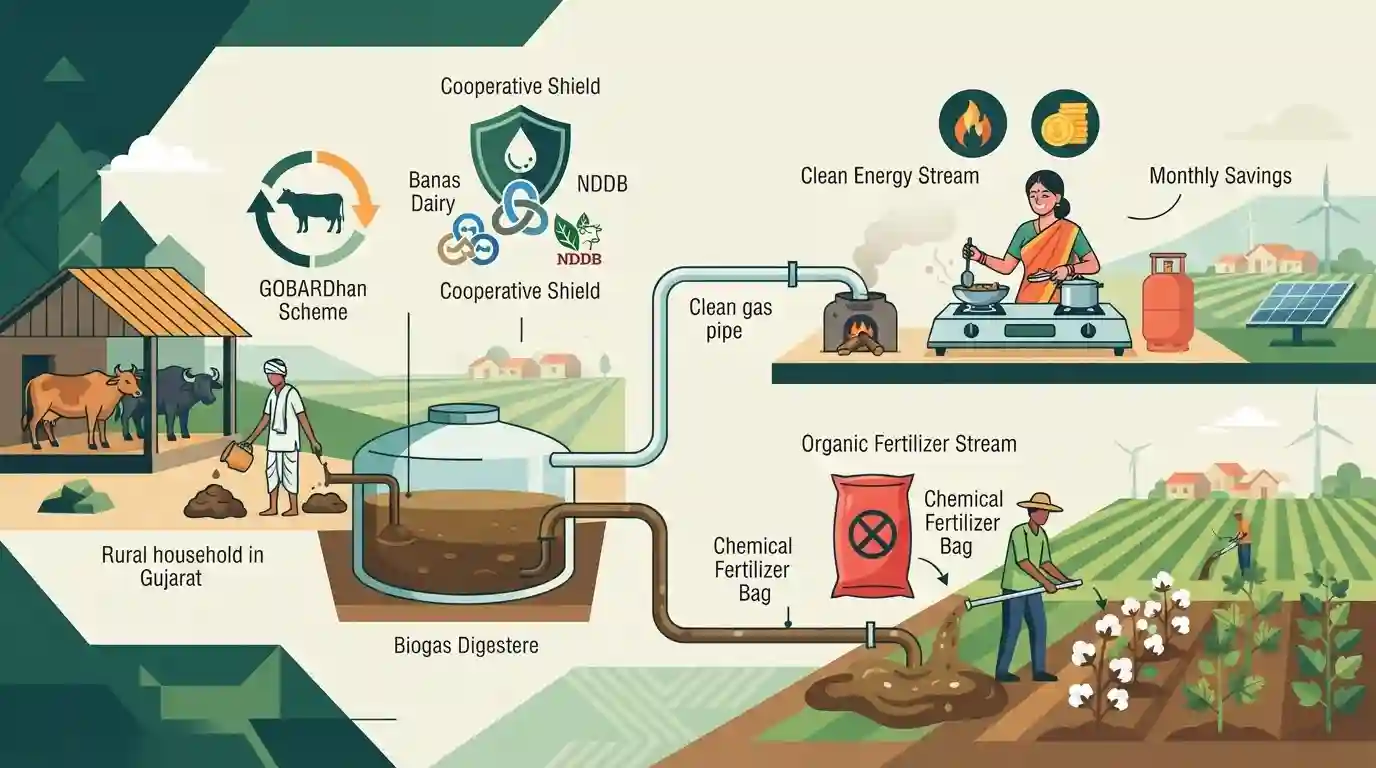
Under the GOBARDhan scheme, part of Swachh Bharat Mission Grameen Phase II, Gujarat plans to construct 20,000 new household biogas plants in rural areas for the 2026-27 fiscal year. Driven by a cooperative framework involving Banas Dairy, GCMMF, and NDDB, the initiative aims to promote a circular rural economy. The decentralized biogas units will process livestock dung to supply clean cooking fuel, reducing reliance on firewood and LPG and generating monthly savings for rural families. Additionally, the byproduct—bio-slurry—will be utilized as organic fertilizer, lowering chemical fertilizer usage and improving agricultural sustainability.
Key Points
- Gujarat is targeting the establishment of 20,000 new family-size biogas plants in rural areas during the 2026-27 fiscal year.
- The initiative operates under the GOBARDhan scheme, a key component of the Swachh Bharat Mission Grameen Phase II, which aims to convert livestock and organic waste into wealth.
- Each biogas plant is expected to produce 2 to 3 cubic meters of clean cooking gas daily, replacing traditional fuels like firewood and LPG, and saving households approximately ₹2,500 per month.
- The process generates nutrient-rich bio-slurry as a byproduct, which serves as a potent organic fertilizer, reducing farmers' dependency on costly chemical fertilizers and enhancing soil health.
- Banas Dairy is leading the implementation at the grassroots level, supported by the Gujarat Cooperative Milk Marketing Federation (GCMMF) and the National Dairy Development Board (NDDB), showcasing the strength of the cooperative model in sustainable rural development.
Important Terms
GOBARDhan (Galvanizing Organic Bio-Agro Resources Dhan)

A national bioenergy scheme converting agricultural waste and cattle dung into compressed biogas (CBG) and organic manure. It establishes a circular rural economy by generating clean fuel and additional income for farmers.
UPSC context
Tests knowledge of rural development schemes, renewable energy targets, and waste-to-wealth initiatives under GS Paper 2 and GS Paper 3.
Swachh Bharat Mission Grameen (SBM-G) Phase II
The second phase of India's rural sanitation mission. It focuses on sustaining Open Defecation Free (ODF) status and upgrading villages to "ODF Plus" through effective solid and liquid waste management.
UPSC context
Highly relevant for GPSC GS Paper 2 (Government Schemes) and GS Paper 3 (Environment & Public Health).
National Dairy Development Board (NDDB)
An apex institution created to boost India's dairy sector. It provides technical support to cooperatives and is pioneering large-scale compressed biogas (CBG) projects to empower rural farmers with clean energy.
UPSC context
Important for Agriculture, Cooperative Sector, and Rural Economy topics in GPSC GS Paper 3.
Gujarat Cooperative Milk Marketing Federation (GCMMF)
India's largest food product marketing organization and the apex body of Gujarat's dairy cooperatives. Famous for the "Amul" brand, it operates as a democratic, farmer-owned model driving rural prosperity.
UPSC context
Essential for GPSC GS Paper 3 (Economy/Agriculture) regarding the success of the cooperative movement in Gujarat.
Banas Dairy
Based in Banaskantha, it is Asia's largest dairy cooperative. It actively pioneers sustainable rural energy by establishing large-scale bio-CNG plants that convert livestock dung into vehicle fuel and organic fertilizers.
UPSC context
Excellent case study for GPSC GS Paper 3 (State Economy & Renewable Energy) on cooperative-led circular economies.
Prelims Trap
The GOBARDhan scheme is a renewable energy initiative administered by the Ministry of New and Renewable Energy.
Although it generates biogas, GOBARDhan is part of Swachh Bharat Mission Grameen Phase II, making it a sanitation initiative under the Ministry of Jal Shakti.
Static Concepts Connected
What is the chemical composition and generation process of biogas?
- Composition: Predominantly methane (50-75%) and carbon dioxide (25-50%), with traces of hydrogen sulfide and moisture.
- Anaerobic digestion: Produced when microorganisms break down organic waste like cattle dung in the absence of oxygen.
- Bio-slurry: The nutrient-dense digestate left over acts as a potent organic fertilizer, enhancing soil health.
How does the Anand Pattern cooperative model function in Gujarat?
- Three-tier structure: Comprises village-level dairy societies, district-level milk unions (e.g., Banas Dairy), and state-level federations (GCMMF).
- Economic empowerment: Spearheaded by NDDB, it empowers farmers by eliminating middlemen, ensuring they receive maximum consumer rupee share.
Cross-Topic Patterns
Cooperatives beyond dairy logistics
Gujarat's traditional milk cooperatives (GCMMF/Banas Dairy) are diversifying their mandate, shifting from simple milk procurement to leading rural energy transitions and decentralized waste management infrastructure.
Sanitation meets Circular Economy
GOBARDhan links rural sanitation (SBM-G Phase II's ODF Plus goal) with sustainable agriculture, as nutrient-rich bio-slurry from waste management replaces costly chemical fertilizers.

Expect a multi-statement question mixing GOBARDhan's nodal ministry (Jal Shakti) with the chemical composition of biogas and ODF Plus goals.
Linked PYQs · 4
Linked PYQs · 4
- 2022GPSC_PRELIMSGS1
What is "A Step Towards a Sustainable Future (STAT)" Scheme?
- 2026GPSC_PRELIMSGS1
Consider the following statements regarding 'Nano Urea' recently promoted by the Government of India for agricultural use: 1. It replaces the need for Phosphorus and Potash fertilizers entirely, simplifying the fertilizer application process for farmers. 2. It has a higher nutrient use efficiency compared to conventional granular urea, leading to reduced soil degradation and water pollution. Which of the above statement(s) is/are correct?
- 2018GPSC_PRELIMSGS1
Sikshit Bharat - Swasth Bharat - Swachh Bharat - Swavalambi Bharat - Sampann Bharat is the Tagline of ________________.
- 2025GPSC_PRELIMSGS1
Which of the following statements is/are correct regarding the G-SAFAL scheme?
