Gujarat plans twenty thousand biogas plants under GOBARdhan scheme
Source:ommcomnews ↗
Why It Matters
The scheme effectively intersects renewable energy generation, rural development, environmental sustainability, and agricultural productivity. It provides a real-world example of India's 'waste-to-wealth' and circular economy strategies, highly testable in contexts relating to bio-energy transitions and rural sanitation initiatives.
Summary
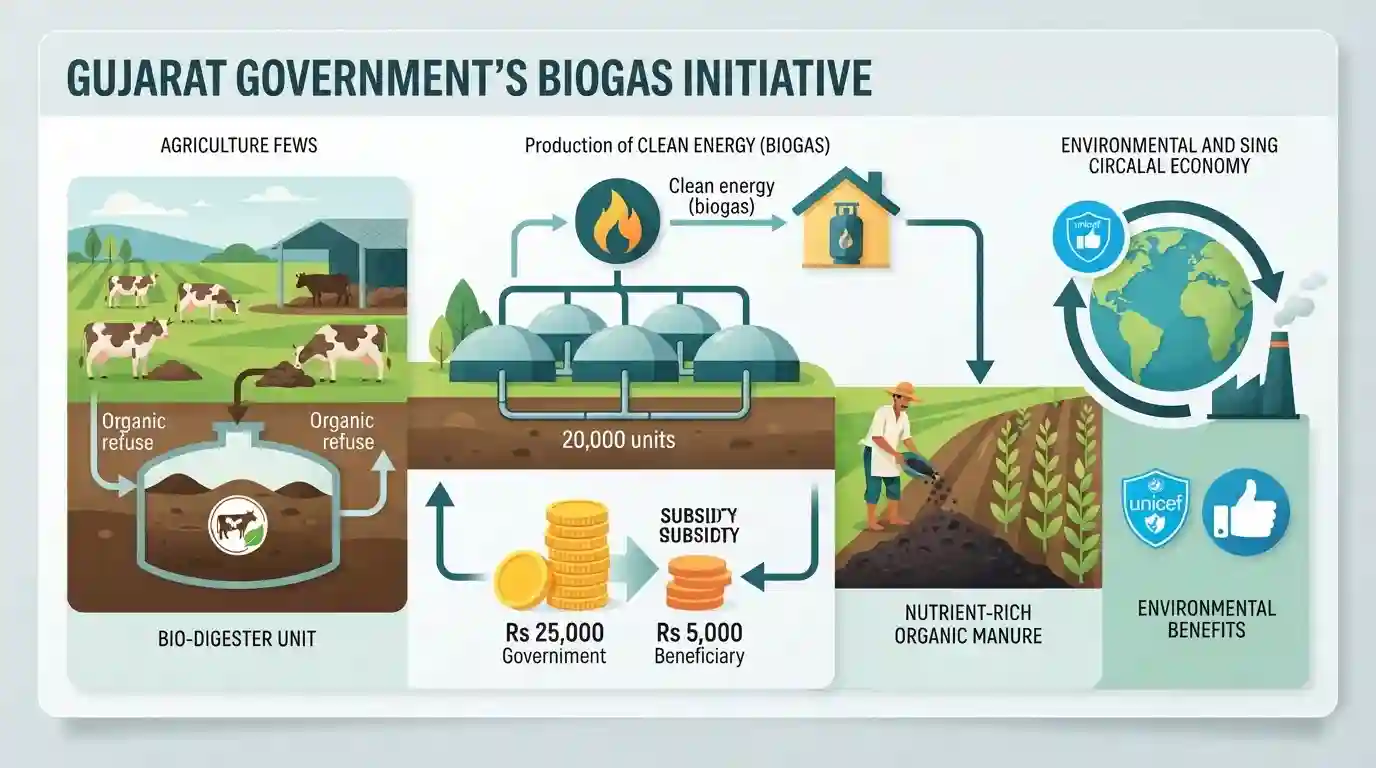
The Gujarat government has announced a major initiative to install 20,000 biogas plants in 2026-27 under the GOBARdhan scheme, an extension of the Swachh Bharat Mission (Gramin). The scheme aims to convert cattle waste and organic refuse into clean energy (biogas) and organic manure (bio-slurry), advancing a circular economy and 'waste-to-wealth' objectives. To ensure wide adoption, the government provides a Rs 25,000 subsidy per 2-cubic-meter HDPE biogas plant, with the beneficiary contributing Rs 5,000. Implemented via a cluster-based approach in collaboration with dairy cooperatives like NDDB and Amul, this initiative promises to reduce rural dependence on LPG and chemical fertilizers while significantly cutting carbon emissions, as verified by UNICEF surveys.
Key Points
- Gujarat plans to set up 20,000 biogas plants under the GOBARdhan scheme during the 2026-27 fiscal year.
- The scheme operates under the Swachh Bharat Mission (Gramin) to promote scientific management of livestock waste and crop residue.
- It focuses on generating clean energy, providing organic manure, reducing dependence on chemical fertilizers, and lowering CO2 emissions.
- Implementation uses a cluster-based approach with local dairy cooperatives like Amul and Banas Dairy.
- Beneficiaries receive Rs 25,000 for installation, contributing only Rs 5,000 as their share.
Important Terms
GOBARdhan Scheme

A government initiative converting biodegradable waste—like cattle dung and agricultural residue—into Compressed Biogas (CBG) and organic manure, promoting a circular 'waste-to-wealth' rural economy.
UPSC context
GS3 (Environment/Economy). Tests knowledge of waste-to-wealth initiatives, renewable energy transition, and rural livelihood enhancement.
National Circular Bioenergy Scheme
An overarching ₹23,731 crore umbrella scheme approved in 2026, integrating GOBARdhan, to massively scale up Compressed Biogas (CBG) production and build a sustainable circular bioeconomy in India.
UPSC context
GS3 (Energy/Environment). Tests awareness of recent cabinet approvals, renewable energy goals, and India's net-zero targets.
Swachh Bharat Mission (Gramin)
A national flagship campaign managed by the Ministry of Jal Shakti to achieve universal rural sanitation, maintain Open Defecation Free (ODF) status, and implement solid and liquid waste management.
UPSC context
GS2 (Social Justice/Governance). Tests understanding of rural sanitation schemes, public health improvements, and behavioral change campaigns.
National Dairy Development Board (NDDB)
A statutory body established in 1965 under the Ministry of Fisheries, Animal Husbandry and Dairying. It promotes and finances producer-owned dairy cooperatives to strengthen India's rural dairy sector.
UPSC context
GS3 (Agriculture). Tests knowledge of statutory bodies, India's dairy economy, the White Revolution, and cooperative development.
Gujarat Cooperative Milk Marketing Federation (GCMMF)
India's largest apex dairy cooperative federation, which markets the Amul brand. It connects millions of rural farmers to markets, exemplifying a successful democratic, member-owned cooperative model.
UPSC context
GS2/GS3 (Governance/Agriculture). Tests understanding of successful cooperative societies, rural empowerment, value addition, and inclusive growth.
Prelims Trap
GOBARdhan is a flagship initiative of the Ministry of New and Renewable Energy.
GOBARdhan is actually implemented by the Department of Drinking Water and Sanitation (Ministry of Jal Shakti) under Swachh Bharat Mission (Gramin) Phase II.
Static Concepts Connected
What are the chemical components and production mechanism of biogas?
- Anaerobic Digestion: Produced when microorganisms break down organic matter (cattle dung, crop residue) in the absence of oxygen.
- Primary Gases: Composed mainly of Methane (50-70%) and Carbon Dioxide (30-40%), with trace amounts of hydrogen sulfide and moisture.
- Bio-slurry Byproduct: The leftover digested sludge is rich in nitrogen, phosphorus, and potassium, serving as a high-quality organic fertilizer that replaces chemical variants.
What are the core pillars of the ODF-Plus strategy under SBM-Gramin Phase II?
- ODF Sustainability: Focuses on sustaining the Open Defecation Free (ODF) status achieved in Phase I through continued behavioral change and infrastructure maintenance.
- SLWM Integration: Mandates Solid and Liquid Waste Management (SLWM) in villages, which encompasses biodegradable waste management (like GOBARdhan), plastic waste management, and greywater management.
Cross-Topic Patterns
Cooperatives driving rural bio-energy
Using dairy cooperatives like NDDB for biogas clusters blends GS2 (cooperatives) with GS3 (renewable energy), a model often tested in Mains for rural economy solutions.
Bio-energy intersecting with sanitation
Treating biogas not just as a renewable energy issue but as a rural sanitation (SBM-G) mechanism represents the inter-ministerial synergy UPSC often targets in Prelims.

Expect a 2026 Prelims question mixing GOBARdhan's Jal Shakti sanitation mandate (SBM-G) with biogas chemical composition and SATAT scheme.
Linked PYQs · 2
Linked PYQs · 2
- 2025GPSC_PRELIMSGS1
Which of the following statement(s) is/are true focusing the establishment of an ethanol plant in Haryana for utilizing agricultural residue which is set to revolutionize India's 'waste-to-wealth' efforts? (i) About 2 lakh tonnes of rice straw (parali) will be used to generate 3 crore litres of ethanol annually (ii) Considering the Ethanol Blending Program, this ethanol will reduce greenhouse gases equivalent to about three lakh tonnes of CO₂ equivalent emissions per annum.
- 2018GPSC_PRELIMSGS1
Sikshit Bharat - Swasth Bharat - Swachh Bharat - Swavalambi Bharat - Sampann Bharat is the Tagline of ________________.
