Gujarat to Launch AI Wildlife Surveillance Centre for Lions
Source:plutusias ↗
Why It Matters
The integration of Artificial Intelligence into wildlife conservation marks a paradigm shift in how states manage endangered endemic species like the Asiatic lion, offering lessons for technology-driven environmental management and mitigation of human-wildlife conflicts.
Summary
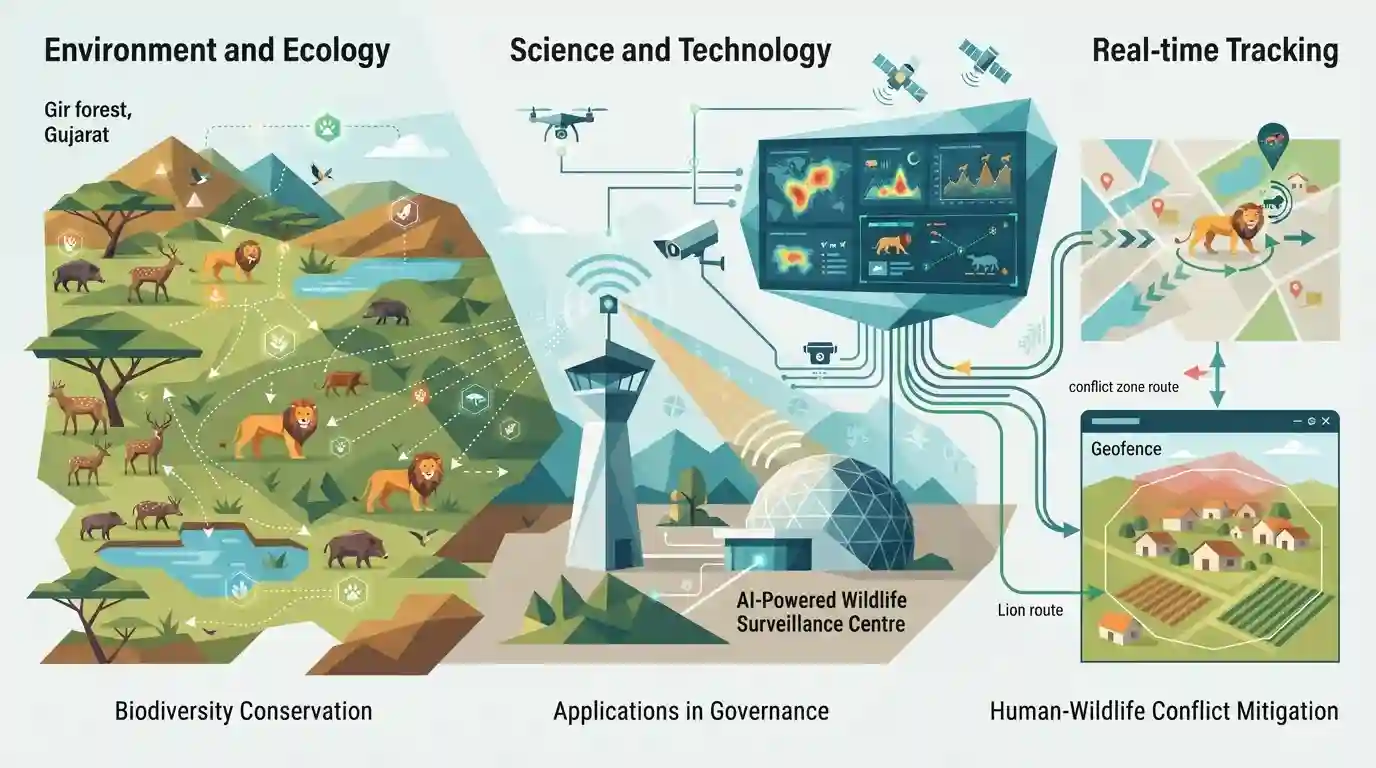
The Gujarat government is setting up an AI-powered wildlife surveillance centre to strengthen the conservation and monitoring of Asiatic lions and other wildlife species in the region, using cutting-edge technology for real-time tracking and human-wildlife conflict mitigation.
Key Points
- Gujarat is launching an AI-powered wildlife surveillance centre to monitor Asiatic lions and other wildlife.
- The initiative aims to enhance wildlife management, track animal movements, and curb human-wildlife conflict using advanced technology like artificial intelligence and computer vision.
- Focuses primarily on the Gir National Park and surrounding Saurashtra region where the Asiatic lion population resides.
Important Terms
AI-Powered Wildlife Surveillance Centre

A ₹150-crore centralised facility in Gandhinagar integrating CCTV networks, drones, and AI algorithms to provide real-time tracking, live data streaming, and early warning alerts for wildlife conservation and man-animal conflict mitigation across Gujarat.
UPSC context
GPSC Paper 3 (Science & Tech applications in governance, Environment & Biodiversity): Tests technological interventions in wildlife management and conservation governance.
SIMBA (Software with Intelligent Marking Based Identification of Asiatic Lions)
An advanced AI tool adopted by the Gujarat Forest Department to identify individual Asiatic lions by analyzing their unique, unchanging whisker spot patterns, thereby assisting population estimation and demographic studies.
UPSC context
GPSC Paper 3 (Environment & Ecology): Tests species conservation strategies, AI applications in wildlife monitoring, and the protection of endemic fauna in Gujarat.
Greater Gir Landscape
The exclusive habitat of the Asiatic lion (Panthera leo leo), spanning several districts of Saurashtra, Gujarat, characterized by dry deciduous forests and pastoral ecosystems requiring specialized management.
UPSC context
GPSC Paper 3 (Biodiversity Conservation): Tests knowledge of protected areas, endemic wildlife habitats, and regional conservation challenges in Gujarat.
Gujarat Forest Department
The state agency responsible for implementing conservation policies, managing protected areas, preventing wildlife crimes, and deploying technological tools to mitigate human-wildlife conflicts across Gujarat.
UPSC context
GPSC Paper 3 / General Administration: Tests institutional mechanisms, environmental governance, and state-level implementation of biodiversity protection schemes.
Prelims Trap
Asiatic lions are distributed across multiple national parks in Western and Central India.
Aspirants often assume Asiatic lions are found in multiple states or African sanctuaries, whereas Gir in Gujarat is their sole natural habitat globally.
Static Concepts Connected
What are the key legal protections and conservation categories for the Asiatic Lion in India?
- Wildlife Act: Protected under Schedule I of the Wildlife (Protection) Act, 1972, affording it the highest level of legal protection in India.
- IUCN Status: Listed as Endangered on the IUCN Red List, restricted primarily to Gujarat's Gir National Park and surrounding Saurashtra districts.
Cross-Topic Patterns
Asiatic Lion Habitat & Geography
Gir National Park spans the Saurashtra region across Junagadh, Gir Somnath, and Amreli districts, serving as the sole home of the Asiatic lion.

AI-based wildlife monitoring in Gir National Park and the Wildlife Protection Act, 1972 provisions will likely be tested together.
Linked PYQs · 3
Linked PYQs · 3
- 2026GPSC_PRELIMSGS1
The 'Great Indian Bustard (GIB)' (Ghorad) is frequently seen in the news in the context of wildlife conservation efforts in western India. Consider the following statements regarding this species: 1. Currently, the highest surviving wild population of the Great Indian Bustard in India is located in the semi-arid grasslands of Gujarat. 2. It is a long-distance migratory bird that travels from Central Asia to the Indian subcontinent to escape harsh winters. Which of the above statement(s) is/are correct?
- 2025GPSC_PRELIMSGS1
The Aravali Safari Park project proposed to be the world's largest safari park, will be developed in _________________.
- 2026GPSC_PRELIMSGS1
Consider the following statements regarding the objectives of Forest Policy, 2018: 1. Controlling animal grazing in forests. 2. Promoting government and private partnership where forests have been destroyed. 3. Promoting greenbelts in cities. Which of the above statement/s is/are correct?
