Gujarat Launches Narmada Luxury Cruise for River Tourism
Source:ibef ↗
Why It Matters
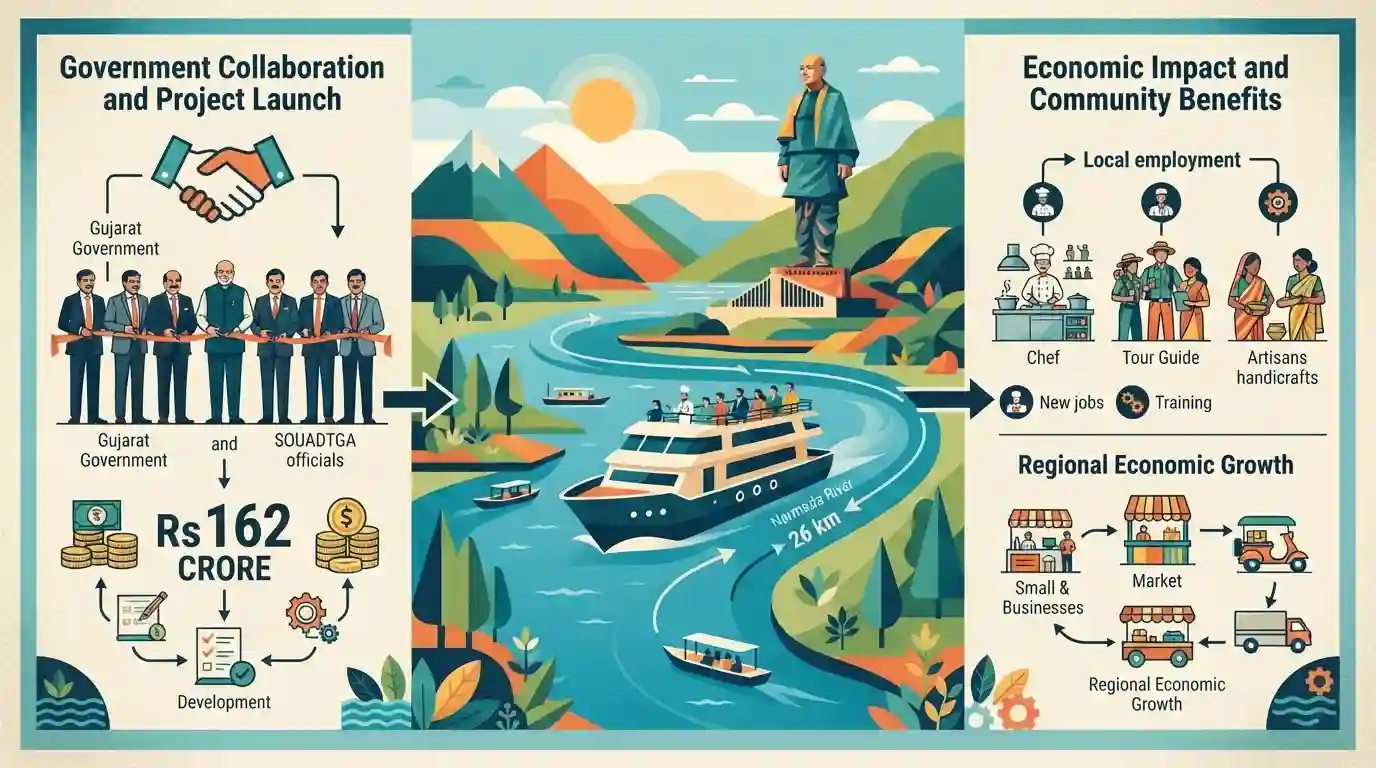
It highlights critical tourism infrastructure developments in Gujarat, emphasizing the state's focus on leveraging geographical assets (Narmada River, Statue of Unity) for regional economic growth and employment generation. Relevant for questions on Gujarat's geography, economy, and tourism initiatives.
Summary
The Gujarat government, in collaboration with the Statue of Unity Area Development and Tourism Governance Authority (SOUADTGA), has launched a luxury cruise service on the Narmada River at Ekta Nagar. Operating along a 26 km stretch near the Statue of Unity, the Rs 162-crore project aims to significantly enhance river tourism, create local employment, and stimulate the regional economy while maintaining a focus on ecological balance.
Key Points
- The Gujarat government has introduced a 600-passenger luxury cruise named 'Narmada Queen' on the Narmada River near the Statue of Unity.
- Developed at a cost of Rs 162 crore by the Statue of Unity Area Development and Tourism Governance Authority (SOUADTGA).
- The cruise will operate on a 26 km stretch from the Shreshtha Bharat Bhavan to the Sardar Sarovar Dam, enhancing river tourism in Ekta Nagar.
- The project aims to boost regional economic growth and tourism while ensuring ecological preservation.
Important Terms
Statue of Unity Area Development and Tourism Governance Authority (SOUADTGA)

A statutory body created under Gujarat's 2019 Act to execute urban planning, infrastructure development, and tourism management around the Statue of Unity in Ekta Nagar.
UPSC context
GS Paper II: Statutory Bodies, governance, and conflicts with the PESA Act / Fifth Schedule governance.
Statue of Unity
The world's tallest statue (182 metres), honoring Indian freedom fighter and statesman Sardar Vallabhbhai Patel, located on Sadhu Bet island in Gujarat's Narmada River.
UPSC context
GS Paper I: Modern History (Sardar Patel's role) and GS Paper III: Tourism Infrastructure.
Narmada River
A major west-flowing river in central India that flows through a rift valley between the Vindhya and Satpura ranges before emptying into the Arabian Sea.
UPSC context
GS Paper I: Indian Physical Geography (drainage system) and GS Paper III: Environmental water issues.
PESA Act, 1996
The Panchayats (Extension to Scheduled Areas) Act is a central law extending local self-governance to tribal populations in Fifth Schedule areas, empowering Gram Sabhas.
UPSC context
GS Paper II: Indian Polity, local self-governance, and Scheduled Area tribal rights.
Ekta Nagar
Formerly Kevadia, a high-growth tourism town in Gujarat's Narmada district, designated as an eco-friendly transport zone and home to the Statue of Unity.
UPSC context
GS Paper III: Sustainable Tourism, Urban Planning, and Regional Infrastructure.
Prelims Trap
The Narmada River forms a fertile, sediment-rich delta at its mouth, which facilitates smooth, shallow-water cruise navigation.
Narmada flows through a hard rocky rift valley and has a high gradient, preventing sediment accumulation. It forms a deep estuary at its mouth near the Gulf of Khambhat, not a delta.
Static Concepts Connected
Why do Narmada and Tapi flow west and form estuaries rather than deltas?
- Rift Valley Origin: They flow through structural rift valleys formed by tectonic subsidence between the Vindhya and Satpura ranges.
- Lack of Sediment: The riverbeds run over hard basaltic rocks, yielding minimal silt and sediment load necessary for delta formation.
- Estuarine Outflow: High gradients cause rapid flow into the Arabian Sea, creating deep tidal estuaries instead of depositing sediment.
What is the federal and engineering significance of the Sardar Sarovar Dam?
- Dam Structure: It is a concrete gravity dam (world's second largest by volume) built on the Narmada River in Gujarat.
- Inter-State Sharing: It is a shared multi-purpose project benefiting four partner states: Gujarat, Madhya Pradesh, Maharashtra, and Rajasthan.
Cross-Topic Patterns
Inland Navigation vs Riverine Ecology
Balancing Maritime India Vision 2030's inland waterway expansion with the carrying capacity and ecological conservation of fragile river basins like the Narmada.
Mega-Tourism vs Tribal Rights
Examining the socio-economic impacts of massive tourism-driven land acquisition on indigenous tribal communities in the Narmada basin.

West-flowing river geomorphology paired with inland water transport policy (Maritime India Vision 2030) likely to feature in 2026.
Linked PYQs · 2
Linked PYQs · 2
- 2021GPSC_PRELIMSGS1
Match the column: | Waterfall | District | |---|---| | 1. Zanzhari Waterfall | a. Narmada | | 2. Zharwani Waterfall | b. Aravalli | | 3. Girmall Waterfall | c. Tapi | | 4. Chimer Waterfall | d. Dangs | Code:
- 2025GPSC_PRELIMSGS1
Which of the following statements are correct regarding the importance of fairs and festivals in the contemporary context of Gujarat? 1. Gujarat's fair and festivals serve as a platform for showcasing traditional crafts, agricultural products and livestock trade, continuing the historical tradition of economic and cultural exchange. 2. Events like Rann Utsav, Tarnetar Fair and Bhavnath Fair bring together diverse religious communities, artisans and craftsmen from across India. 3. The International Kite Festival (Uttarayan) and Modhera Dance Festival highlight Gujarat's ability to blend tradition with modern trends, attracting global tourists and fostering cultural diplomacy. 4. In modern Gujarat, fairs and festivals continue to be a driving force for tourism and local economic growth, preserving cultural heritage while adapting to contemporary trends.
