Gujarat Maritime Projects Approved Under Shipbuilding Scheme
Source:the-week ↗
Why It Matters
The development highlights crucial state interventions via the Shipbuilding Development Scheme (SbDS) to build indigenous maritime manufacturing capacity, reduce reliance on foreign shipyards, and generate local employment in coastal states like Gujarat.
Summary
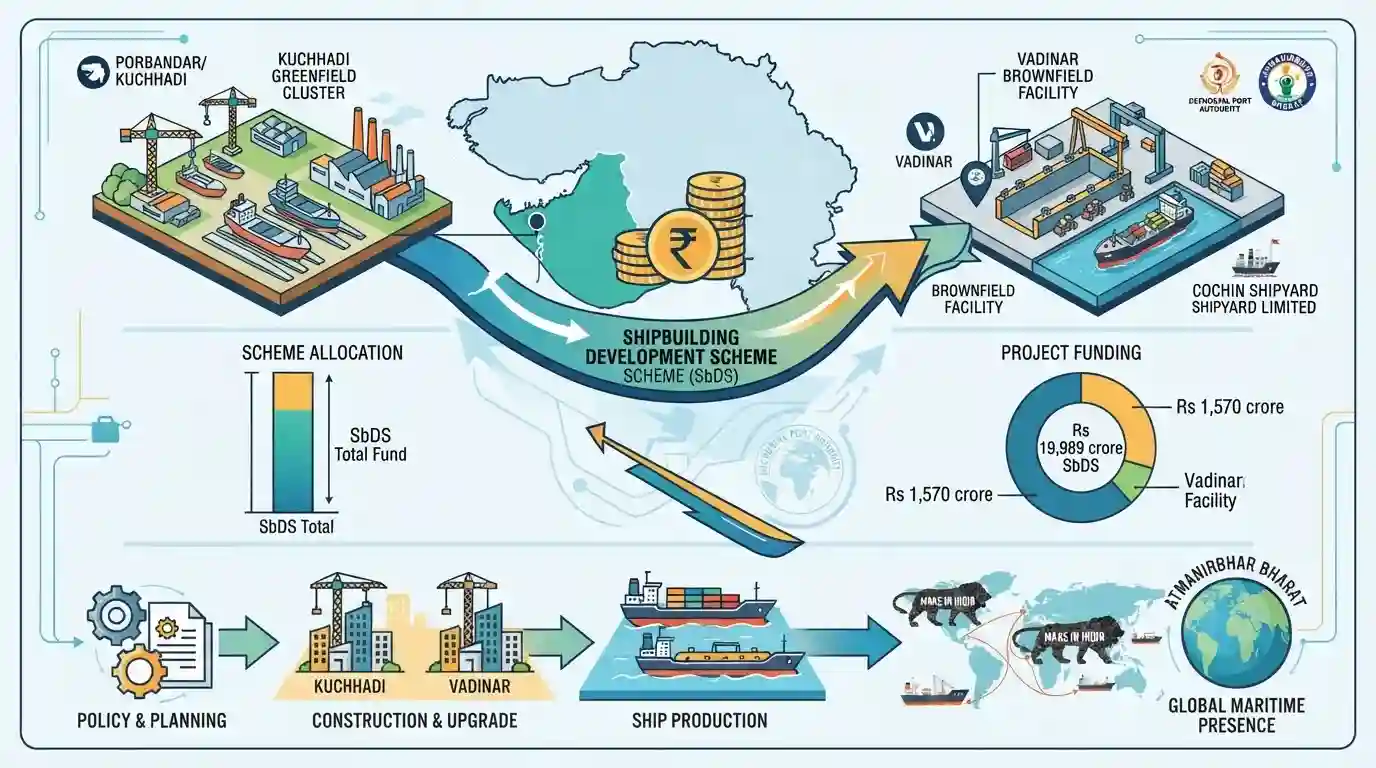
The Ministry of Ports, Shipping and Waterways (MoPSW) has sanctioned two major maritime infrastructure projects in Gujarat under the Shipbuilding Development Scheme (SbDS). A greenfield shipbuilding cluster will be developed at Kuchhadi in Porbandar district, while a Rs 1,570 crore brownfield ship repair facility will be built at Vadinar by Cochin Shipyard Limited and Deendayal Port Authority. Backed by the Rs 19,989 crore SbDS, these initiatives aim to achieve self-reliance (Atmanirbhar Bharat) in commercial shipbuilding and bolster India's global maritime presence.
Key Points
- The Ministry of Ports, Shipping and Waterways (MoPSW) approved a greenfield shipbuilding cluster at Kuchhadi, Porbandar, to be developed by the SPV NSHIP-Gujarat.
- A brownfield ship repair facility at Vadinar will be established jointly by Cochin Shipyard Limited (CSL) and Deendayal Port Authority (DPA) with an investment of Rs 1,570 crore.
- These projects fall under the Shipbuilding Development Scheme (SbDS), which commands a total corpus of Rs 19,989 crore aimed at transforming India's maritime manufacturing base.
- The SbDS offers 100% capital support for greenfield clusters established via Centre-State SPVs and provides financial assistance for brownfield shipyard expansions.
Important Terms
Shipbuilding Development Scheme (SbDS)

A ₹19,989-crore scheme by the Ministry of Ports, Shipping and Waterways valid until 2036. It funds 100% of common infrastructure for greenfield shipbuilding clusters and provides 25% capital assistance for expanding existing brownfield shipyards.
UPSC context
GS-3 (Infrastructure). Tests knowledge of government financial interventions to transform India into a global commercial shipbuilding hub.
NSHIP-Gujarat
The National Shipbuilding and Heavy Industries Park-Gujarat is a Centre-State Special Purpose Vehicle. Promoted by MoPSW and Gujarat Maritime Board, it will develop a 2,000-acre commercial greenfield shipbuilding cluster at Kuchhadi, Porbandar.
UPSC context
GS-3 (Investment Models). Highlights cooperative federalism and SPV frameworks used to execute large-scale, port-led industrial manufacturing hubs.
Deendayal Port Authority (DPA)
Formerly Kandla Port, DPA is a major state-owned port in Gujarat's Gulf of Kutch. It is partnering with Cochin Shipyard Limited to develop a ₹1,570-crore brownfield ship repair facility at Vadinar.
UPSC context
GS-1/GS-3 (Geography/Infrastructure). Tests awareness of India's major western ports and their strategic diversification into specialized vessel repair services.
Cochin Shipyard Limited (CSL)
A major Central Public Sector Enterprise and India’s largest shipbuilding facility. CSL is expanding its footprint by jointly developing a massive Panamax-capable ship repair center at Vadinar in Gujarat to reduce overseas repair dependence.
UPSC context
GS-3 (Public Sector Enterprises). Demonstrates the strategic role of maritime PSUs in building domestic capacity for heavy commercial shipping infrastructure.
Atmanirbhar Bharat
The government's flagship vision for economic self-reliance. In the maritime context, it focuses on indigenizing commercial shipbuilding, curbing reliance on foreign shipyards, and promoting domestic manufacturing to secure global supply chains.
UPSC context
GS-3 (Indigenization of Technology). Essential framework for analyzing import substitution and capacity-building across India's heavy manufacturing industries.
Indian Maritime University
A Central University focused on maritime studies. Under the new SbDS framework, it will host the India Ship Technology Centre to drive research, design, innovation, and specialized skill development for the domestic shipbuilding industry.
UPSC context
GS-2/GS-3 (Education/Technology). Relevant for understanding institutional and academic backing required to achieve technological self-reliance in the maritime sector.
Prelims Trap
The Shipbuilding Development Scheme (SbDS) provides a direct per-vessel financial subsidy to shipbuilders based on the size of the ship.
SbDS is for capital infrastructure (clusters/shipyards). The allied SBFAS (Shipbuilding Financial Assistance Scheme) is what provides direct per-vessel financial subsidies based on tonnage.
Static Concepts Connected
How is jurisdiction divided between Major and Non-Major ports in India?
- Union List (Entry 27): Major ports fall strictly under the Central government (Ministry of Ports, Shipping and Waterways).
- Concurrent List (Entry 31): Non-major (minor) ports fall under the Concurrent List, administered mostly by State Maritime Boards like the Gujarat Maritime Board.
- Legislation: Governed by the Major Port Authorities Act, 2021, which replaced the 1963 Trust Act to grant decentralized autonomy in fixing tariffs.
What makes the Gulf of Kutch a strategic location for maritime infrastructure like Vadinar?
- Deep Draft: Naturally deep waters allow the handling of Very Large Crude Carriers (VLCCs) and Panamax-class commercial ships without excessive dredging.
- Sheltered Waters: Protection from open ocean swells provides a safer environment for complex ship repair and berthing operations.
- Proximity to Middle East: Strategic location on the western coast optimizes logistics for crude imports and integration with major refineries.
Cross-Topic Patterns
Circular economy in shipbuilding
Linking ship recycling to new construction (via 'Shipbreaking Credit Notes') connects maritime manufacturing with environmental compliance, the circular economy, and India's accession to the Hong Kong Convention.
Blue Economy & Atmanirbhar Bharat
Shifting from merely operating ports (Sagarmala) to building/repairing heavy-tonnage vessels addresses the heavy foreign exchange drain caused by relying on foreign dry docks.

Expect a comparative Prelims question distinguishing SbDS (infrastructure focus) from SBFAS (vessel subsidy), paired with port jurisdiction.
Linked PYQs · 1
Linked PYQs · 1
- 2026GPSC_PRELIMSGS1
Consider the following statements regarding India's inland water transport infrastructure: 1. National Waterway 1 (NW-1) is the longest navigable inland waterway in the country, extending from Prayagraj to Haldia along the Ganga-Bhagirathi-Hooghly river system. 2. The Jal Marg Vikas Project (JMVP), implemented with technical and financial assistance from the World Bank, is primarily focused on capacity augmentation of the Brahmaputra River (NW-2). 3. The West Coast Canal (NW-3) maintains a highly consistent navigable draft year-round, facilitated by the natural topography of estuarine backwaters (Koyals) in Kerala. Which of the above statement/s is/are correct?
