Banaskantha Wildlife Park Establishes Asias First Desert Night Safari
Source:gktoday ↗
Why It Matters
As a landmark eco-tourism and conservation project in Gujarat, it is highly relevant for GPSC Prelims. It highlights specific geographical locations (Banaskantha), targeted native wildlife (Indian Wild Ass, Chinkara), and the regulatory framework of the Central Zoo Authority under the Wildlife (Protection) Act, 1972.
Summary
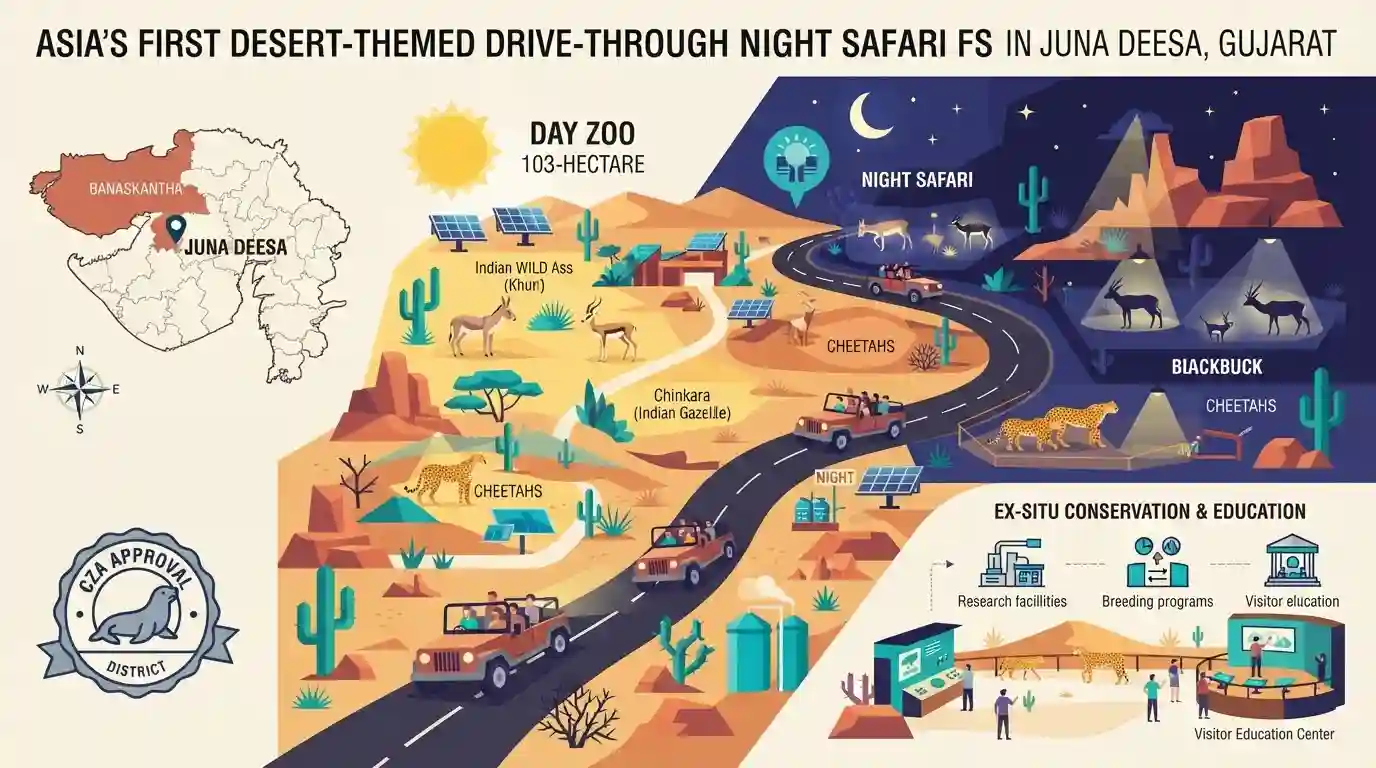
Gujarat is set to establish Asia’s first desert-themed drive-through night safari at Juna Deesa in the Banaskantha district, following approval from the Central Zoo Authority (CZA). The 103-hectare facility, built with a ₹542.14 crore budget, will host a day zoo and distinct night enclosures containing over 2,700 animals across 83 species. Prominent wildlife will include native arid-region animals such as the Indian Wild Ass, Chinkara, and Blackbuck, as well as exotics like cheetahs. The project emphasizes ex-situ conservation, environmental education, and sustainable operations through solar power and rainwater harvesting.
Key Points
- The Central Zoo Authority (CZA) has formally approved the establishment of Asia’s first desert-themed drive-through night safari park in Juna Deesa, Banaskantha district, Gujarat.
- The facility will cover an area of 103 hectares and has an estimated budget of ₹542.14 crore.
- The park will feature a day zoo, a safari, and five dedicated night enclosures, expected to house around 2,700 animals from 83 species.
- Key native species designated for the park include the Chinkara, Blackbuck, and Indian Wild Ass, alongside exotic animals like cheetahs, giraffes, and zebras.
- The safari will integrate sustainable infrastructure, including rainwater harvesting, solar energy utilization, sewage treatment, and solid waste management systems.
- The Central Zoo Authority is a statutory body constituted under the Wildlife (Protection) Act, 1972, tasked with regulating and overseeing the functioning of zoos in India.
Important Terms
Central Zoo Authority (CZA)

A statutory body under the Ministry of Environment, Forest and Climate Change, established in 1992 under the Wildlife (Protection) Act, 1972, to oversee and regulate the functioning of zoos in India.
UPSC context
GS-3 Environment. Highly tested regarding its statutory basis, parent act, and role in ex-situ conservation.
Ex-situ Conservation
The preservation of biological diversity outside natural habitats. Examples include zoological parks, botanical gardens, and seed banks. It serves as a crucial backup for species facing extinction.
UPSC context
GS-3 Environment. Frequently tested in Prelims, particularly asking candidates to distinguish it from in-situ conservation methods.
Indian Wild Ass
A Near Threatened subspecies of the Asian wild ass, uniquely adapted to desert ecosystems. Its only remaining wild population is restricted to the Little Rann of Kutch in Gujarat.
UPSC context
GS-3 Environment. A common Prelims species question focusing on its specific endemic habitat and conservation status.
Wildlife (Protection) Act, 1972
India's primary umbrella legislation safeguarding plant and animal species. It establishes protection schedules, authorizes protected areas, and mandates the creation of statutory bodies like the Central Zoo Authority.
UPSC context
GS-3 Environment. Core legal framework; heavily tested on its schedules, penalties, protected areas, and derivative statutory bodies.
Prelims Trap
The Juna Deesa desert night safari park is a major in-situ conservation initiative by Gujarat.
Safaris and zoos are classified as ex-situ (off-site) conservation, not in-situ. In-situ involves protecting species within their natural habitats (e.g., National Parks).
Static Concepts Connected
What is the statutory backing and role of the Central Zoo Authority (CZA)?
- Statutory Status: Established as a statutory body under the Wildlife (Protection) Act, 1972.
- Core Mandate: Regulates the functioning of zoos and safaris in India, enforcing minimum standards for animal housing, upkeep, and veterinary care.
- Breeding & Exchange: Coordinates captive breeding programs and approves the acquisition, exchange, or transfer of captive animals between Indian and foreign zoos.
What is the habitat and protection status of the Indian Wild Ass?
- Habitat: Endemic to the arid desert and grassland ecosystems of the Little Rann of Kutch in Gujarat.
- WPA Status: Listed under Schedule I of the Wildlife Protection Act, 1972, granting it the highest level of legal protection in India.
- IUCN Status: Categorized as Near Threatened (NT) on the IUCN Red List due to restricted range and habitat threats.
Cross-Topic Patterns
Ex-situ conservation + Exotic Species
The inclusion of African cheetahs in Gujarat's safari ties into the larger post-Kuno trend of importing exotics for captive management, tourism, and ecosystem awareness in GS-3 Environment.
Arid landscape ecology + Sustainable Ecotourism
Combining desert-adapted species (Chinkara, Wild Ass) with green infrastructure (solar, rainwater harvesting) sets a GS-3 model for sustainable ecotourism in water-scarce, arid regions.

CZA's statutory powers, mixed with ex-situ vs in-situ classifications, are prime targets for a GS-1 Prelims conceptual question in 2026.
Linked PYQs · 3
Linked PYQs · 3
- 2025GPSC_PRELIMSGS1
The Aravali Safari Park project proposed to be the world's largest safari park, will be developed in _________________.
- 2024GPSC_PRELIMSGS1
Which of the following are legal provisions for the implementation of the Fundamental Duties? 1. The Protection of Civil Rights Act. 2. The Unlawful Activities (Prevention) Act. 3. The Representation of Peoples Act. 4. The Wildlife (Protection) Act Select the correct answer code:
- 2026GPSC_PRELIMSGS1
The 'Great Indian Bustard (GIB)' (Ghorad) is frequently seen in the news in the context of wildlife conservation efforts in western India. Consider the following statements regarding this species: 1. Currently, the highest surviving wild population of the Great Indian Bustard in India is located in the semi-arid grasslands of Gujarat. 2. It is a long-distance migratory bird that travels from Central Asia to the Indian subcontinent to escape harsh winters. Which of the above statement(s) is/are correct?
