Gujarat forest department plans special enclosure at Ambardi park
Source:ians ↗
આ શા માટે મહત્વનું છે
The management of human-wildlife conflict is a critical challenge in Indian environmental policy. Understanding specific conservation strategies like 'problem' animal relocation, along with the geography of protected areas (e.g., Ambardi Safari Park and the Gir Protected Area), is essential for tackling questions related to biodiversity conservation and Indian geography in the GPSC Prelims.
સારાંશ
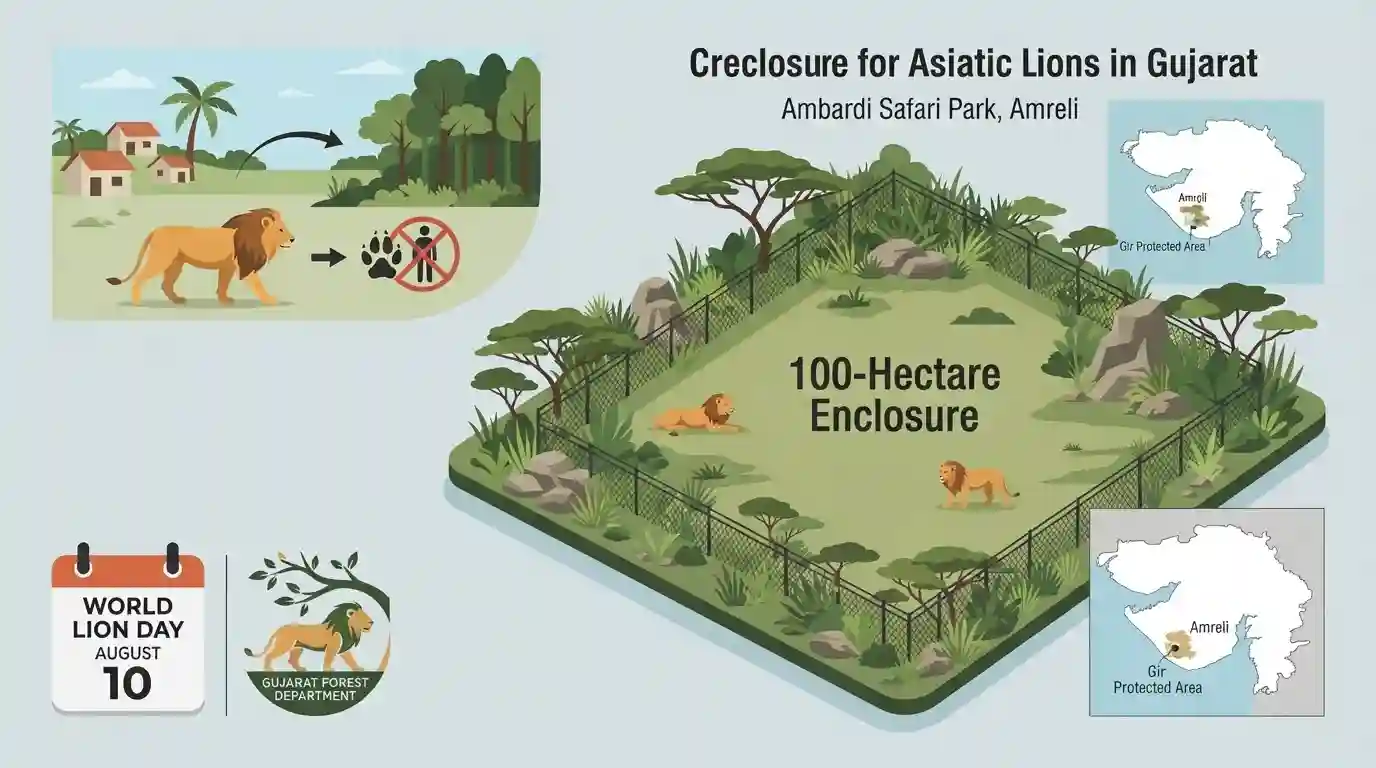
The Gujarat Forest Department is developing a 100-hectare enclosure within the Ambardi Safari Park in Amreli district specifically for Asiatic lions that have been involved in human attacks. This initiative aims to address human-wildlife conflict by providing a safe, natural habitat for these lions after they are relocated from populated areas, reducing risks to humans while supporting long-term conservation. Established in 2017 as part of the Gir Protected Area, the 365-hectare safari park is a key eco-tourism destination. The announcement coincides with World Lion Day (August 10), reflecting the state's ongoing commitment to the scientific relocation and protection of local wildlife.
મુખ્ય મુદ્દા
- The Gujarat Forest Department is setting up a 100-hectare special enclosure at Ambardi Safari Park to house Asiatic lions involved in human attacks.
- This strategy aims to manage human-wildlife conflict by relocating 'problem' lions into a designated natural forest environment rather than keeping them in conventional captivity.
- Ambardi Safari Park, established in 2017 in the Amreli district near Dhari, is part of the Gir Protected Area and serves as a major wildlife tourism and eco-conservation site.
- The initiative aligns with 'World Lion Day' (August 10) and broader conservation policies focusing on scientific relocation and habitat management to protect local communities and endangered wildlife.
મહત્વપૂર્ણ શબ્દો
Gujarat Forest Department

The state government body responsible for managing Gujarat's forests and wildlife, notably overseeing the conservation, scientific relocation, and habitat management of Asiatic lions.
UPSC context
Relevant for GS-3 (Environment) regarding the administrative role in mitigating human-wildlife conflict and executing wildlife conservation policies.
Ambardi Safari Park
A 365-hectare reserved forest and eco-tourism destination in Gujarat's Amreli district. Established in 2017, it now features a specialized enclosure for lions involved in human conflict.
UPSC context
Important for GS-1 (Geography) and GS-3 (Environment) for mapping protected areas and studying state-level ex-situ conservation models.
Asiatic Lion
A big cat subspecies whose only surviving wild population is restricted to Gujarat's Gir landscape. It requires intensive conservation due to threats like genetic bottlenecking and localized diseases.
UPSC context
Highly relevant for Prelims and GS-3 (Biodiversity) regarding its habitat range, conservation status, and scientific relocation debates.
Human-Wildlife Conflict
Negative interactions between humans and wild animals. In Gujarat, it often involves lions straying into populated areas, necessitating their safe relocation to naturalized enclosures.
UPSC context
Core GS-3 (Environment) topic. Tests knowledge on underlying causes, mitigation strategies, and balancing ecological security with human safety.
World Lion Day
An annual global event observed on August 10 to raise awareness about the declining populations of lions and to promote international efforts for their protection.
UPSC context
Relevant for Prelims and GS-3 (Environment) regarding environmental observance days and international wildlife conservation initiatives.
પ્રિલિમ્સ ટ્રેપ
Asiatic lions are critically endangered and their natural habitat is restricted exclusively to the Gir National Park boundaries.
Lions are 'Endangered' (not Critically Endangered). Also, their habitat is no longer restricted to Gir NP; they range across the 'Greater Gir Landscape' covering multiple districts.
સંલગ્ન સ્થિર ખ્યાલો
What is the legal and conservation status of the Asiatic Lion?
- IUCN Red List: Classified as 'Endangered', having improved from its previous 'Critically Endangered' status due to sustained local conservation efforts.
- WPA 1972: Listed in Schedule I, offering the absolute highest level of legal protection against hunting and exploitation in India.
- CITES: Included in Appendix I, strictly prohibiting international commercial trade of the species or its body parts.
What are the core objectives of 'Project Lion' (launched 2020)?
- Habitat Expansion: Securing and restoring new habitats beyond Gir, such as Barda Wildlife Sanctuary, to accommodate the growing population and prevent epidemic wipeouts.
- Disease Management: Establishing specialized veterinary care and surveillance against fatal outbreaks like Canine Distemper Virus (CDV) and Babesiosis.
- Conflict Mitigation: Creating community engagement models, safe enclosures, and infrastructure to address the rising human-lion encounters in Saurashtra.
આંતર-વિષય પેટર્ન
WPA Section 11 vs. Relocation enclosures
Managing 'problem' animals usually invokes Section 11 of the Wildlife Protection Act (allowing culling). Gujarat's specialized enclosure approach highlights non-lethal conflict mitigation and lifetime care.
Kuno SC mandate vs. internal dispersal
While the Supreme Court ordered interstate translocation to Kuno (MP) to prevent epidemic wipeouts, Gujarat actively focuses on internal dispersal sites like Ambardi and Barda.

Expect a multi-statement question on Asiatic lion conservation, testing Greater Gir geography, WPA conflict provisions, and IUCN status.
સંલગ્ન PYQ · 3
સંલગ્ન PYQ · 3
- 2026GPSC_PRELIMSGS1
The 'Great Indian Bustard (GIB)' (Ghorad) is frequently seen in the news in the context of wildlife conservation efforts in western India. Consider the following statements regarding this species: 1. Currently, the highest surviving wild population of the Great Indian Bustard in India is located in the semi-arid grasslands of Gujarat. 2. It is a long-distance migratory bird that travels from Central Asia to the Indian subcontinent to escape harsh winters. Which of the above statement(s) is/are correct?
- 2025GPSC_PRELIMSGS1
The Aravali Safari Park project proposed to be the world's largest safari park, will be developed in _________________.
- 2022GPSC_PRELIMSGS1
Which garden of Gujarat has the trees and plants of rare species?
