Gujarat Mandates Cement Concrete Roads To Prevent Monsoon Damage
Source:aninews ↗
આ શા માટે મહત્વનું છે
This policy highlights a critical shift in state-level infrastructure planning, emphasizing lifecycle cost-benefit analysis (higher initial capital expenditure for lower maintenance) and the need to build climate-resilient urban infrastructure to withstand extreme monsoon conditions.
સારાંશ
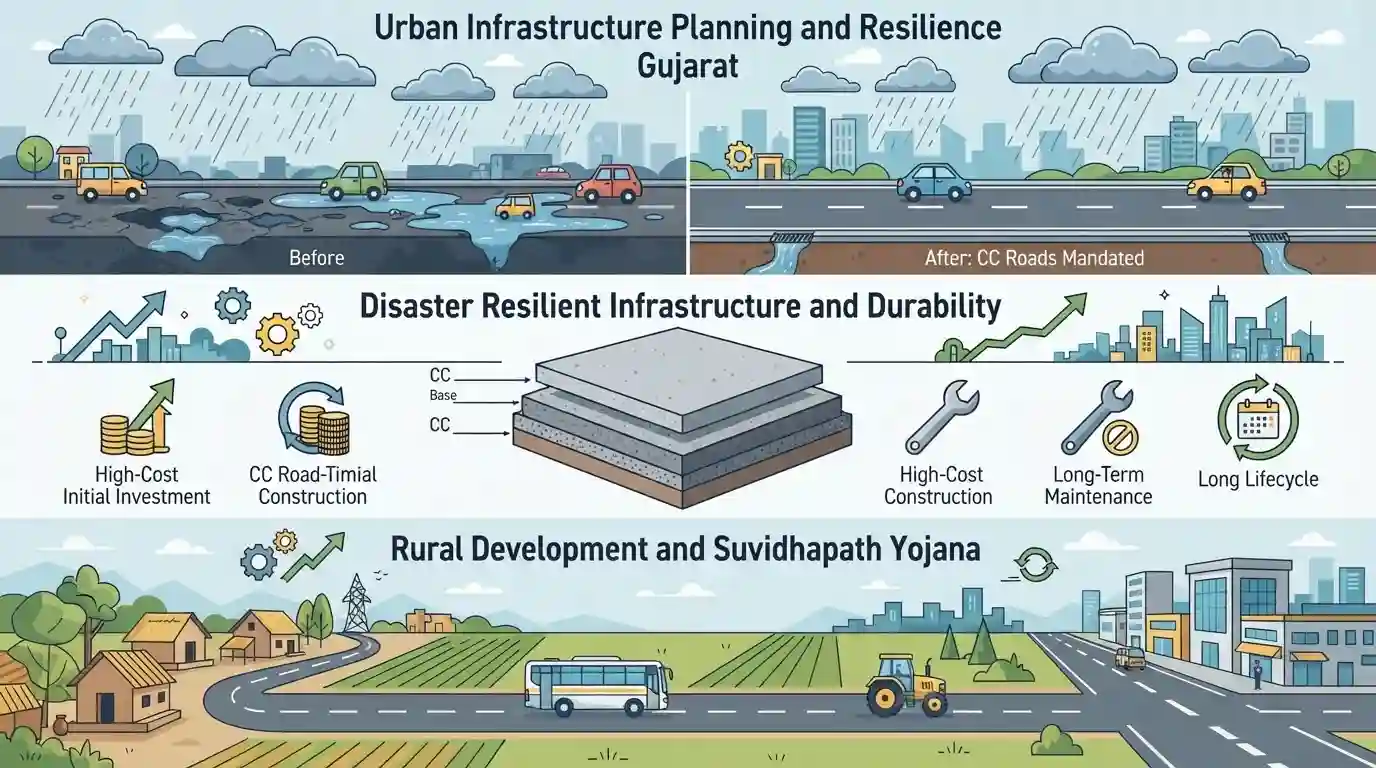
The Gujarat government, led by Chief Minister Bhupendra Patel, has mandated the construction of Cement Concrete (CC) roads in place of asphalt across municipal corporations, municipalities, and industrial zones. This strategic shift in urban infrastructure planning aims to eliminate the recurring problem of road damage, waterlogging, and pothole formation during the monsoon season. Although CC roads cost 30-40% more to construct initially, they are highly durable, require negligible maintenance, and have a longer lifecycle, thereby ensuring better long-term cost-effectiveness. Additionally, similar rural road upgrades are already being carried out under the Suvidhapath Yojana.
મુખ્ય મુદ્દા
- The Gujarat government has decided to replace asphalt with Cement Concrete (CC) for internal roads in Municipal Corporations and Municipalities.
- The shift aims to provide a permanent solution to recurring monsoon-induced road damage, such as waterlogging and pothole formation.
- While CC roads incur a 30-40% higher initial construction cost, they offer a longer service life, greater durability against heavy multi-axle traffic, and significantly lower maintenance needs.
- Industrial areas with heavy traffic will also transition to CC roads.
- In rural areas, the construction of CC roads in waterlogging-prone villages is already being executed under the 'Suvidhapath Yojana'.
મહત્વપૂર્ણ શબ્દો
Suvidhapath Yojana

A rural infrastructure scheme by the Government of Gujarat focused on upgrading asphalt roads to durable Cement Concrete (CC) roads in village settlements prone to waterlogging and monsoon damage.
UPSC context
Relevant for GS Paper 3 (Infrastructure) and GS Paper 2 (Government Policies); highlights rural development and climate-resilient planning.
Government of Gujarat
The state-level executive authority of Gujarat, currently prioritizing long-term public benefit over immediate costs by mandating disaster-resilient road construction across urban and rural zones.
UPSC context
Relevant for GS Paper 2 (State Executive). Illustrates sub-national governance, policy formulation, and strategic infrastructure investments.
Gujarat Cabinet
The supreme executive decision-making body in Gujarat, chaired by the Chief Minister, responsible for approving the state-wide mandate to shift from asphalt to Cement Concrete (CC) roads.
UPSC context
Fits GS Paper 2 (State Legislature & Executive). Tests understanding of the Council of Ministers' role in shaping public infrastructure policy.
પ્રિલિમ્સ ટ્રેપ
"Cement concrete roads are 'flexible pavements' because they can better withstand heavy monsoon rainfall."
Cement concrete roads are 'rigid pavements' that distribute loads via flexural strength. Asphalt/bitumen roads are 'flexible pavements' and are highly vulnerable to waterlogging.
સંલગ્ન સ્થિર ખ્યાલો
What is the fundamental difference between Rigid and Flexible road pavements?
- Rigid Pavements: Typically made of cement concrete. They distribute heavy loads over a wider area through the slab's flexural strength. Have high initial costs but low maintenance.
- Flexible Pavements: Typically made of asphalt/bitumen. They distribute loads layer by layer to the subgrade. Have lower initial costs but are highly prone to water damage and require frequent maintenance.
How does road material choice impact urban disaster resilience during monsoons?
- Asphalt Degradation: Bitumen acts as a binder in flexible roads but strips away when exposed to stagnant water, rapidly causing potholes and structural failure.
- Concrete Resilience: Rigid concrete is largely impervious to waterlogging, preventing road washouts during extreme monsoon events and ensuring post-disaster connectivity.
આંતર-વિષય પેટર્ન
Urban Flooding & Lifecycle Costing
Moving from the L1 (lowest initial bidder) model to lifecycle cost analysis is becoming a critical governance reform for climate-proofing urban infrastructure, heavily stressed by recent Finance Commissions.
CDRI goals at the State Level
State-level initiatives like Gujarat's Suvidhapath Yojana reflect the localized adoption of Coalition for Disaster Resilient Infrastructure (CDRI) principles to climate-proof last-mile assets.

Expect a GS-III Mains question on climate-proofing urban networks, emphasizing lifecycle cost analysis over initial capital expenditure.
સંલગ્ન PYQ · 2
સંલગ્ન PYQ · 2
- 2025GPSC_PRELIMSGS1
According to the Socio-Economic Review, 2024-2025 of Gujarat, Gujarat comes in ______ category in Logistic Ease Across Different States (LEADS), 2024.
- 2025GPSC_PRELIMSGS1
______ is one of the cities chosen by the NITI Aayog for its Growth Hub (G-HUB) programme to boost their economic growth.
