Gujarat Health Department Steps Up Monsoon Disease Prevention
Source:punjabkesari ↗
આ શા માટે મહત્વનું છે
Provides a practical example of state administrative machinery responding to seasonal public health risks, focusing on preventive measures like water chlorination and vector control. Useful for understanding governance in action for GS2.
સારાંશ
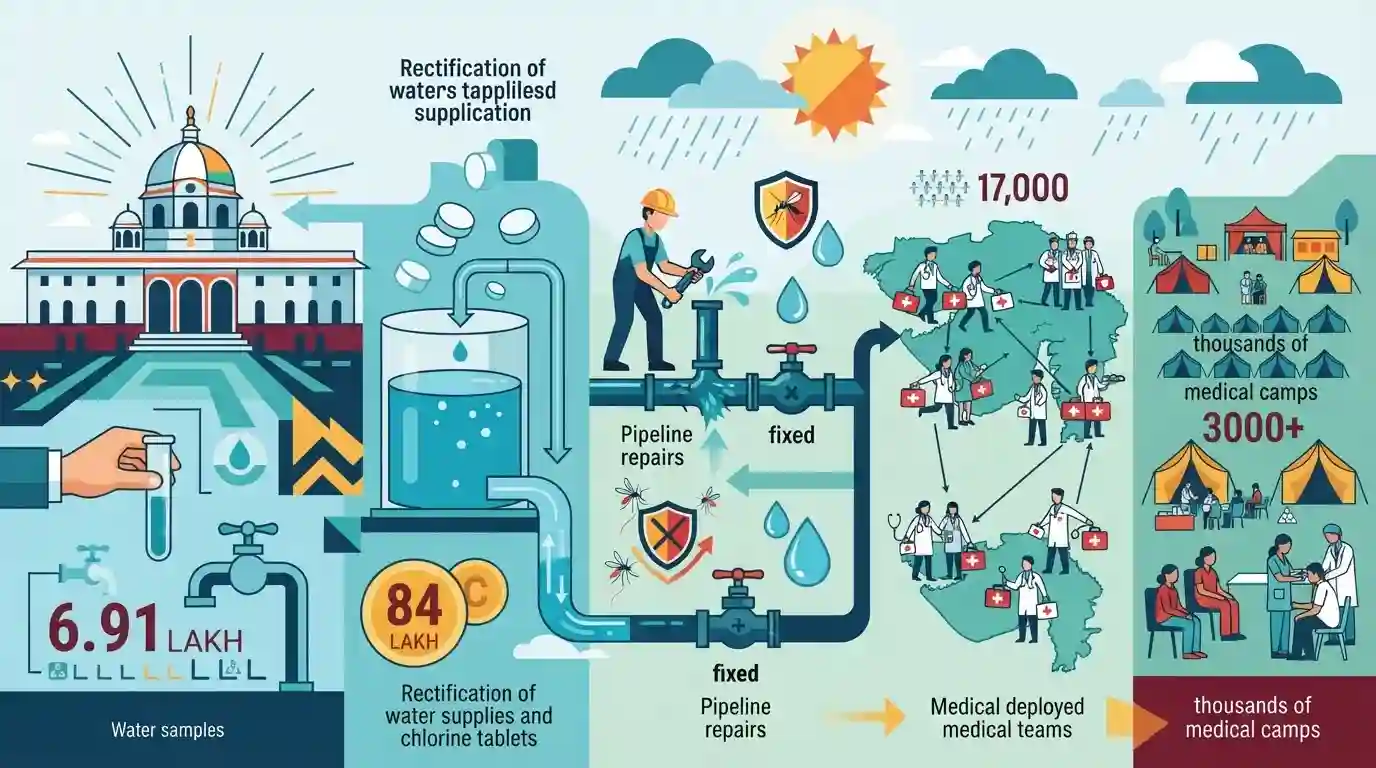
In a bid to prevent water-borne and vector-borne diseases during the monsoon, the Gujarat government has intensified its public health measures. The state health department tested over 6.91 lakh drinking water samples, rectified unchlorinated water supplies, and distributed more than 84 lakh chlorine tablets. Additionally, extensive repairs were carried out on thousands of leaking water pipelines. To provide immediate healthcare access, 17,000 medical teams have been deployed and thousands of medical camps organized across various districts, ensuring widespread monitoring and control of monsoon illnesses.
મુખ્ય મુદ્દા
- The Gujarat Health Department tested over 6.91 lakh drinking water samples and distributed 84.38 lakh chlorine tablets to prevent monsoon-related diseases.
- Over 6,700 samples were identified as unchlorinated, prompting immediate remedial measures to ensure safe drinking water.
- The state repaired more than 2,500 pipeline leakages that posed risks of water contamination.
- For disease surveillance and treatment, 17,000 medical and para-medical teams were deployed alongside 4,655 medical camps organized statewide.
મહત્વપૂર્ણ શબ્દો
Gujarat Health Department

The state-level department responsible for implementing public health initiatives, medical services, and disease control measures across Gujarat, such as the statewide testing of drinking water samples and deployment of medical teams to prevent monsoon-related diseases.
UPSC context
Relevant for GS Paper 2 (Governance, Health) and GS Paper 3 (Disaster Management). Demonstrates state-level epidemic preparedness and water quality management.
Ahmedabad Municipal Corporation
The civic body governing Ahmedabad, responsible for local public health, sanitation, and infrastructure, currently tasked with preventing monsoon illnesses through water sample testing, distribution of chlorine tablets, and deploying medical teams.
UPSC context
Relevant for GS Paper 2 (Local Self-Government) and GS Paper 3 (Disaster Management). Highlights the role of urban local bodies in crisis mitigation.
Surat Municipal Corporation
The local government body for Surat, responsible for urban governance and public services, which distributed over 12.85 lakh chlorine tablets and ORS packets to manage water-borne and vector-borne diseases during the monsoon.
UPSC context
Relevant for GS Paper 2 (Urban Local Bodies) and GS Paper 3 (Disaster Management). Illustrates civic responsiveness in public health emergencies and flood management.
પ્રિલિમ્સ ટ્રેપ
Public health and drinking water quality regulation fall under the Concurrent List of the Seventh Schedule.
Public health and sanitation fall strictly under the State List (Entry 6), not the Concurrent List. The Union guides and funds, but states execute.
સંલગ્ન સ્થિર ખ્યાલો
What is the BIS IS 10500:2012 framework for drinking water in India?
- Dual Limits: It specifies both 'acceptable limits' (ideal) and 'permissible limits in the absence of an alternate source' for physical, chemical, and biological parameters.
- Biological Parameters: Mandates zero presence of E. coli or thermotolerant coliform bacteria in any 100 ml sample of drinking water.
- Chlorine Residual: Requires residual free chlorine to be maintained at least at 0.2 mg/l to ensure protection against microbial contamination in pipelines.
How is drinking water management constitutionally distributed in India?
- State List: 'Water' (Entry 17) and 'Public health and sanitation' (Entry 6) are explicitly mandated under the State List.
- Local Governance: Under Articles 243G and 243W, PRIs and Urban Local Bodies are tasked with the local provision and management of safe drinking water.
- Community Role: Paani Samitis (village committees) are statutorily empowered to monitor local water quality using Field Test Kits (FTKs).
આંતર-વિષય પેટર્ન
Climate anomalies and vector-borne surges
Erratic monsoons and urban flooding increase breeding grounds for mosquitoes, linking climate change directly to state-level disease burdens and disaster management preparedness.
Decentralized monitoring via Jal Jeevan
The shift towards community-led water testing using Field Test Kits (FTKs) merges local 73rd Amendment decentralization (Paani Samitis) with mass public health surveillance.

Expect a multi-statement question on BIS drinking water standards linked with Jal Jeevan Mission's decentralized community testing mechanisms.
સંલગ્ન PYQ · 1
સંલગ્ન PYQ · 1
- 2021GPSC_PRELIMSGS1
Statement: A large number of people in the city die every year due to polluted drinking water. Courses of action: 1. The government should make necessary arrangements to provide safe drinking water to the people of the city. 2. The government should educate people about the dangers of drinking contaminated water.
