Panchayat Advancement Index and Grassroots Local Governance
Source:Indian Express ↗
Why It Matters
The Panchayat Advancement Index is a crucial development for GS Paper 2, directly addressing the evolution and effectiveness of local self-government in India. It highlights the transition from focusing on 'Funds, Functions, and Functionaries' to tracking measurable 'Functionality' and grassroots outcomes—a direct theme of past UPSC questions. Additionally, it illustrates how global SDG commitments are being operationalized at the village level.
Summary
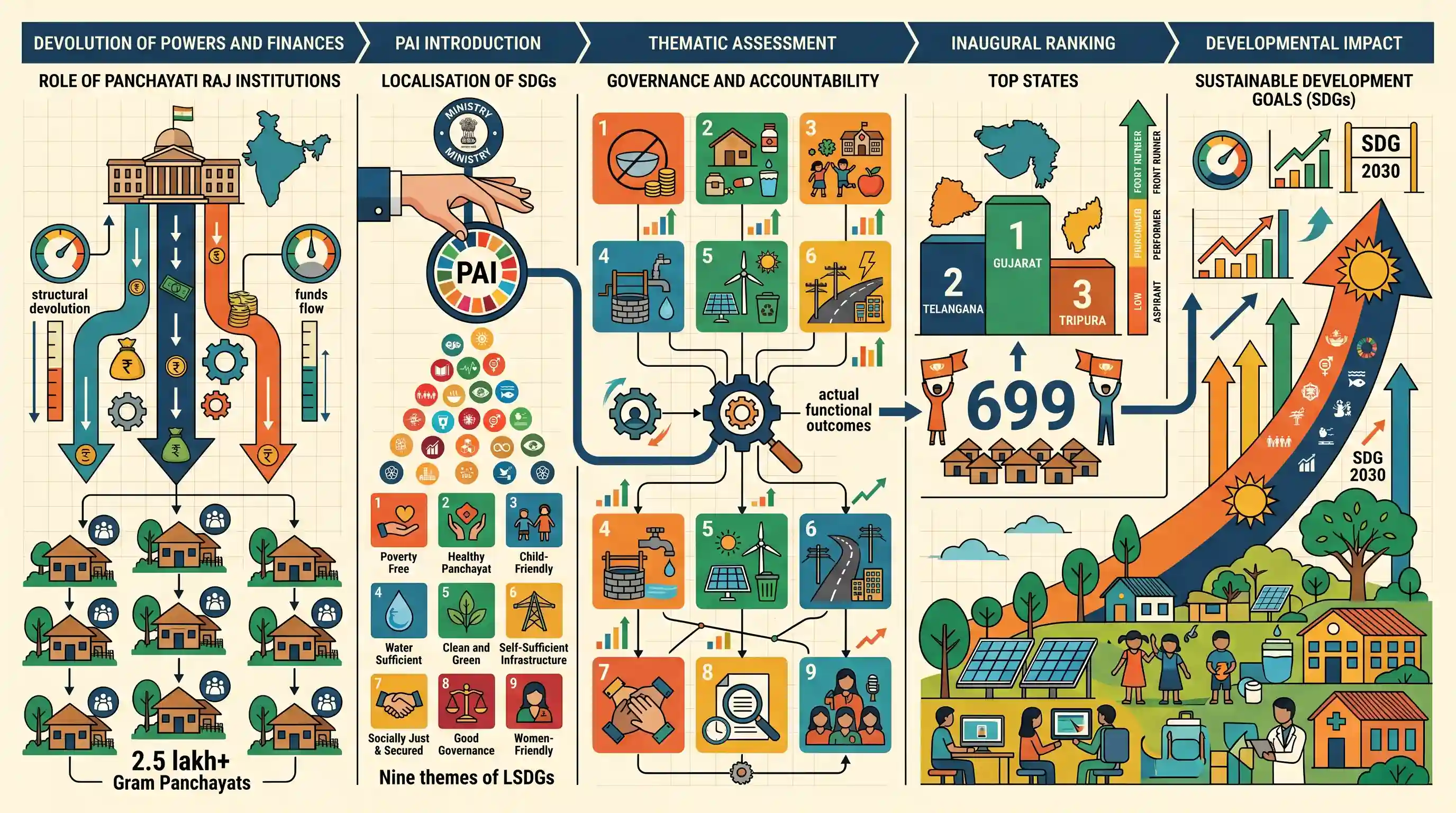
The Ministry of Panchayati Raj has introduced the maiden Panchayat Advancement Index (PAI) to assess the performance of Panchayati Raj Institutions (PRIs) in implementing the Localisation of Sustainable Development Goals (LSDGs). Gujarat, Telangana, and Tripura have topped the inaugural rankings, which recognized 699 local bodies for their leadership in grassroots development. The PAI marks a significant step towards data-driven governance at the village level, tracking progress across thematic areas such as rural health, poverty reduction, and infrastructure. This framework shifts the evaluation of local self-governments from structural devolution to actual functional outcomes and developmental impact.
Key Points
- The Ministry of Panchayati Raj has released the maiden Panchayat Advancement Index (PAI) to evaluate and rank the performance of PRIs.
- Gujarat, Telangana, and Tripura emerged as the top-performing states in the inaugural rankings, with 699 local bodies recognized as leaders.
- The index is centered around the Localisation of Sustainable Development Goals (LSDGs), measuring progress across thematic areas like poverty alleviation, health, and water sufficiency.
- PAI promotes evidence-based governance and fosters competitive federalism at the grassroots level.
- The index signifies a shift in evaluating local bodies from their administrative capacity (funds and functions) to actual developmental outcomes and functionality.
Important Terms
Panchayat Advancement Index (PAI)

A data-driven framework introduced by the Ministry of Panchayati Raj to assess, rank, and incentivize the performance of rural local bodies based on objective indicators and functional outcomes.
UPSC context
GS Paper II: Governance. Tests knowledge of performance-based assessment tools for local self-government and data-driven administrative reforms.
Localisation of Sustainable Development Goals (LSDGs)
The process of adapting the 17 global Sustainable Development Goals into 9 thematic areas specifically tailored for rural India’s socio-economic and environmental needs at the village level.
UPSC context
GS Paper II & III: Development and SDGs. Relevant for explaining how global targets are translated into grassroots action.
73rd Constitutional Amendment Act
The 1992 legislation that granted constitutional status to rural local bodies, introducing Part IX, the 11th Schedule, and a mandatory three-tier structure of local self-governance.
UPSC context
GS Paper II: Indian Polity. A fundamental topic for understanding the constitutional basis of democratic decentralization in India.
Panchayati Raj Institutions (PRIs)
The three-tier system of local self-government—Gram Panchayat, Panchayat Samiti, and Zila Parishad—mandated to ensure grassroots democracy, social justice, and economic development in rural India.
UPSC context
GS Paper II: Local Self-Government. Vital for questions on devolution of power and grassroots development challenges.
Ministry of Panchayati Raj
The nodal central agency responsible for strengthening Panchayati Raj Institutions through policy support, financial devolution, and monitoring the implementation of rural governance reforms.
UPSC context
GS Paper II: Government Policies. Tests understanding of executive bodies overseeing local governance and rural empowerment.
Prelims Trap
"The Panchayat Advancement Index is released by NITI Aayog to evaluate local SDGs."
Aspirants reflexively associate any SDG-tracking index with NITI Aayog. However, the PAI is specifically developed and released by the Ministry of Panchayati Raj.
Static Concepts Connected
What are the "3Fs" essential for genuine decentralization under the 73rd Amendment?
- Funds: Independent power of taxation and guaranteed grants (via State Finance Commissions) to ensure financial autonomy.
- Functions: Meaningful devolution of the 29 subjects listed in the 11th Schedule for local planning and execution.
- Functionaries: Adequate administrative and technical staff who are accountable directly to PRIs, rather than the state government.
How are global SDGs localized for Panchayats in India?
- Thematic approach: The Ministry of Panchayati Raj (MoPR) mapped the 17 global SDGs into 9 broad themes (e.g., Poverty-free, Water-sufficient villages).
- GPDP Integration: Panchayats integrate these 9 themes directly into their mandatory annual Gram Panchayat Development Plans (GPDPs) for localized, targeted action.
Cross-Topic Patterns
Competitive Sub-Federalism
The evolution from state-level indices (NITI Aayog's SDG India Index) to panchayat-level metrics (PAI) deepens competitive federalism straight to the third tier of government.
Structural inputs vs Functional outcomes
Evaluation frameworks are shifting from tracking structural inputs (state budget allocations) to actual functional outcomes, aligning closely with the broader push toward Outcome Budgeting.

Expect a paired Prelims question confusing NITI Aayog's SDG India Index with MoPR's Panchayat Advancement Index (PAI).
Linked PYQs · 3
Linked PYQs · 3
- 2020MainsGS2
The strength and sustenance of local institutions in India has shifted from their formative phase of 'Functions, Functionaries and Funds' to the contemporary stage of 'Functionality'. Highlight the critical challenges faced by local institutions in terms of their functionality in recent times.
- 2017MainsGS2
The local self-government system in India has not proved to be effective instrument of governance." Critically examine the statement and give your views to improve the situation.
- 2011PrelimsGS1
The Constitution (Seventy-Third Amendment) Act, 1992, which aims at promoting the Panchayati Raj Institutions in the country, provides for which of the following? 1. Constitution of District Planning Committees. 2. State Election Commissions to conduct all panchayat elections. 3. Establishment of State Finance Commissions. Select the correct answer using the codes given below:
