Gujarat skill mission targets training for one lakh youth
Source:indian-masterminds ↗
Why It Matters
State-level skill and employment missions reflect decentralized efforts toward human capital formation and demographic dividend utilization. The integration of emerging technologies (AI, Blockchain, Semiconductors) aligns with modern industrial policy, and understanding such frameworks is vital for GPSC economy and governance sections.
Summary
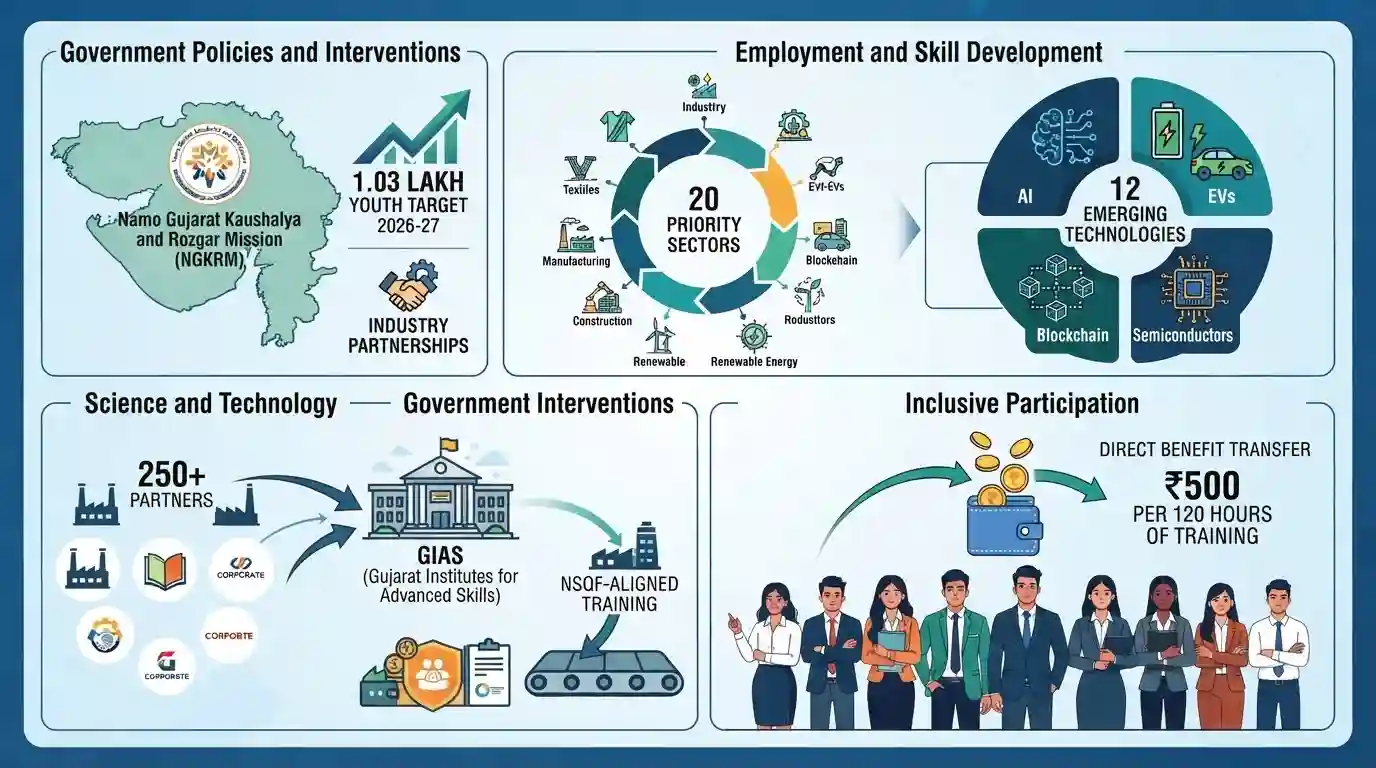
Gujarat's Namo Gujarat Kaushalya and Rozgar Mission (NGKRM) has set a target to train 1.03 lakh youth during 2026-27, focusing heavily on modern industry requirements. The initiative spans 20 priority sectors and 12 emerging technological domains such as Artificial Intelligence, EVs, Blockchain, and Semiconductors. Through Gujarat Institutes for Advanced Skills (GIAS), the state has onboarded over 250 industry and academic partners, including L&T, Tata Indian Institute of Skills, and iACE, to deliver NSQF-aligned training. Additionally, to ensure inclusive participation, the government provides a financial incentive of ₹500 per 120 hours of training via Direct Benefit Transfer (DBT).
Key Points
- Gujarat launched the Namo Gujarat Kaushalya and Rozgar Mission (NGKRM) to train over 1.03 lakh youth in 2026-27.
- The training spans 20 priority sectors and 12 emerging technologies, including Artificial Intelligence, Blockchain, Electric Vehicles, and Semiconductors.
- Executed via Gujarat Institutes for Advanced Skills (GIAS) and aligned with the National Skills Qualification Framework (NSQF).
- Over 250 industry and academic partners, including L&T, Tata IIS, and iACE, are collaborating for curriculum design and implementation.
- Financial incentive of ₹500 for every 120 hours of training will be provided to participants through Direct Benefit Transfer (DBT) to encourage inclusive skilling.
Important Terms
Namo Gujarat Kaushalya and Rozgar Mission (NGKRM)

A Gujarat government initiative targeting the skilling of youth, women, and disadvantaged groups. It focuses on 20 priority sectors and 12 emerging domains like AI and EVs to build an industry-aligned workforce.
UPSC context
GS-2 & GS-3. Important as a state-level model for skill development, employment generation, and demographic dividend utilization.
National Skills Qualifications Framework (NSQF)
A nationally integrated, competency-based framework that organizes educational and vocational qualifications into levels based on learning outcomes, facilitating mobility between education, training, and the job market.
UPSC context
GS-2 (Education) & GS-3 (Employment). Tests knowledge of skill standardization, lifelong learning, and bridging the academia-industry gap.
Direct Benefit Transfer (DBT)
A governance reform that directly transfers subsidies and welfare payments into beneficiaries' Aadhaar-linked bank accounts. It utilizes the JAM trinity to eliminate intermediaries, plug leakages, and ensure transparent delivery.
UPSC context
GS-2 (Governance). Essential for evaluating welfare delivery efficiency, e-governance applications, and anti-corruption measures.
Gujarat Institutes for Advanced Skills (GIAS)
The primary training delivery framework under Gujarat's NGKRM. It partners with industries and academia to offer short-term, NSQF-aligned vocational courses, directly linking advanced skill training with modern employment needs.
UPSC context
GS-2 (Skill Development). Serves as a specific institutional case study for demand-driven, industry-led skilling ecosystems.
International Automobile Centre of Excellence (iACE)
A premier skill development institute formed as a joint venture between the Gujarat Government and Maruti Suzuki. It focuses on creating a specialized workforce for the modern automotive sector.
UPSC context
GS-3 (Industrial Growth & Skill Development). Exemplifies successful public-private partnerships (PPP) in building industry-specific vocational infrastructure.
Prelims Trap
Certifications granted under state-specific skilling missions are only valid within that particular state's jurisdiction.
State missions like NGKRM align with the National Skills Qualification Framework (NSQF), which organizes competencies into national levels, ensuring certifications have nationwide mobility and recognition.
Static Concepts Connected
What is the National Skills Qualification Framework (NSQF)?
- Competency-based framework: Organizes qualifications according to a series of levels of knowledge, skills, and aptitude, ranging from Level 1 to 10.
- Mobility and Integration: Enables seamless mobility between vocational training, vocational education, and general academic education tracks.
- National Recognition: Maintained under the National Qualifications Register (NQR), ensuring that certified skills are standardized and recognized nationwide.
How do Sector Skill Councils (SSCs) support India's skilling ecosystem?
- Industry Connect: They are autonomous, industry-led bodies set up by the National Skill Development Corporation (NSDC) to bridge the industry-academia gap.
- Standards Creation: They develop National Occupational Standards (NOS) and Qualification Packs (QPs) to ensure training matches exact market requirements.
Cross-Topic Patterns
Semiconductor PLI + Targeted Skilling
State initiatives like Gujarat's GIAS complement national PLI schemes (like the India Semiconductor Mission) by directly addressing the critical shortage of fabrication and VLSI design engineers.
Demographic Dividend + PPP Models
The onboarding of 250+ corporate partners addresses the systemic 'employability gap' highlighted in the India Skills Report, serving as a prime GS3 case study for resolving industry-academia friction.

Expect a GS3 Mains question in 2026 linking state-level PPP skilling models to the success of high-tech manufacturing PLIs like ISM.
Linked PYQs · 2
Linked PYQs · 2
- 2022GPSC_PRELIMSGS1
Which one of the following schemes is aimed at increasing the confidence of young, educated or skilled workers who would now be able to aspire to become first generation entrepreneurs?
- 2018GPSC_PRELIMSGS1
Recently constituted National SC/ST Hub (NSSH) is functioning under the _________________.
