Gujarat And Sikkim Join All India Tiger Census For First Time
Source:the-tribune ↗
Why It Matters
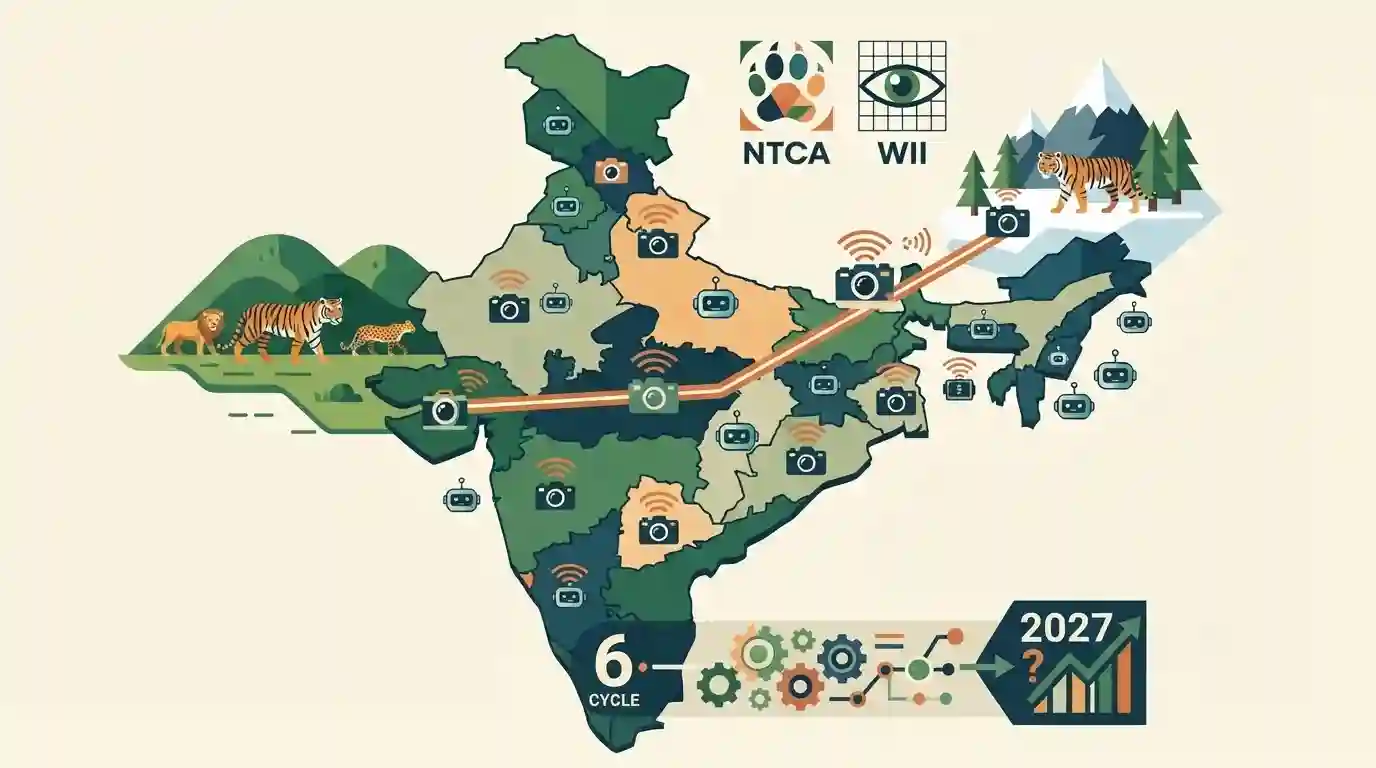
The expansion of the All India Tiger Census to include states like Gujarat and Sikkim emphasizes shifting tiger habitats and the importance of ecological corridors connecting states like Madhya Pradesh and Gujarat. It bears relevance for environmental conservation, habitat repopulation success (Project Tiger), and high-altitude biodiversity monitoring.
Summary
For the first time, Gujarat and Sikkim have been included in the sixth cycle of the All India Tiger Estimation (Census). Conducted by the National Tiger Conservation Authority (NTCA) and the Wildlife Institute of India (WII), the census involves extensive camera trapping and AI technology across 21 states, with final results expected in 2027. Gujarat, already home to Asiatic lions and leopards, anticipates the return of tigers after a young male recently migrated from Madhya Pradesh to the Ratanmahal sanctuary landscape. Meanwhile, Sikkim's inclusion reflects documented sightings of high-altitude tigers in the state.
Key Points
- Gujarat and Sikkim are participating in the sixth All India Tiger Estimation for the first time.
- The census is organized by the National Tiger Conservation Authority (NTCA) and the Wildlife Institute of India (WII), with the final report expected in 2027.
- A tiger migrating from Madhya Pradesh was recorded in the Ratanmahal sanctuary landscape, bringing hope for a tiger population in Gujarat, which last recorded tigers in 1989.
- Gujarat currently hosts lions and leopards; the establishment of a tiger population would make it uniquely home to all three prominent big cats.
- Sikkim's inclusion comes after confirmed tiger sightings at high altitudes, underscoring the expansion of high-altitude tiger habitats.
- The 2022 census indicated India's tiger population stands at 3,682, constituting 75 percent of the global wild tiger population.
Important Terms
All India Tiger Estimation (Census)

A quadrennial nationwide wildlife survey conducted by the NTCA and WII to monitor tiger populations, prey abundance, and habitat connectivity across India.
UPSC context
GS Paper III (Environment & Ecology); tests knowledge of wildlife monitoring methodologies, population trends, and conservation outcomes.
National Tiger Conservation Authority (NTCA)
A statutory body under the Ministry of Environment, Forest and Climate Change, constituted under the Wildlife (Protection) Act, 1972, to oversee and strengthen tiger reserve management in India.
UPSC context
GS Paper III (Environment/Institutions); tests understanding of statutory environmental bodies, their legal mandates, and wildlife governance frameworks.
Wildlife Institute of India (WII)
An autonomous institution under the Ministry of Environment, Forest and Climate Change, founded in 1982 in Dehradun, specializing in wildlife research, training, and conservation advisory services.
UPSC context
GS Paper III (Biodiversity Conservation); tests knowledge of premier scientific institutions guiding ecological research and conservation policy in India.
Project Tiger
A flagship centrally sponsored conservation scheme launched in 1973 to protect Bengal tigers and conserve their critical habitats across designated tiger reserves.
UPSC context
GS Paper III (Ecology & Conservation); tests historical frameworks of flagship species preservation and landscape-level environmental governance.
Prelims Trap
Gujarat is currently the only Indian state with established, breeding wild populations of Asiatic Lions, Leopards, and Bengal Tigers.
While Gujarat hosts wild lions and leopards, and has recorded a migrating tiger, it does not yet support an established, breeding resident population of wild tigers.
Static Concepts Connected
What is the statutory framework and role of the National Tiger Conservation Authority (NTCA)?
- Statutory Basis: Established under the Wildlife (Protection) Act, 1972, following the 2006 amendment to provide statutory backing to Project Tiger.
- Composition: Functions under the Ministry of Environment, Forest and Climate Change, and is chaired by the Minister.
- Core Mandate: Approves Tiger Conservation Plans, coordinates the quadrennial tiger estimation, and establishes standards for tiger reserve management.
How do high-altitude tiger habitats alter conventional ecological understanding in India?
- Geographical Shift: Tigers are increasingly recorded in high-altitude regions of Sikkim, Uttarakhand, and Arunachal Pradesh, challenging the low-land tropical forest paradigm.
- Climate Adaptation: These habitats serve as critical climate refugia as global warming shifts prey species and vegetation zones upward.
Cross-Topic Patterns
Interstate wildlife corridors and federalism
A tiger migrating from MP to Gujarat highlights that wildlife corridors transcend political boundaries, demanding cooperative federalism and joint state forest management frameworks.
AI and digital tools in conservation
Integrating AI and M-STrIPES in the 2026 census reflects a broader shift from traditional pugmark methods to tech-driven, objective ecological monitoring.

Expect a 2026 Prelims question mapping high-altitude tiger habitats (Sikkim) and the statutory powers of the NTCA.
Linked PYQs · 2
Linked PYQs · 2
- 2024GPSC_PRELIMSGS1
Which of the following are legal provisions for the implementation of the Fundamental Duties? 1. The Protection of Civil Rights Act. 2. The Unlawful Activities (Prevention) Act. 3. The Representation of Peoples Act. 4. The Wildlife (Protection) Act Select the correct answer code:
- 2026GPSC_PRELIMSGS1
The 'Great Indian Bustard (GIB)' (Ghorad) is frequently seen in the news in the context of wildlife conservation efforts in western India. Consider the following statements regarding this species: 1. Currently, the highest surviving wild population of the Great Indian Bustard in India is located in the semi-arid grasslands of Gujarat. 2. It is a long-distance migratory bird that travels from Central Asia to the Indian subcontinent to escape harsh winters. Which of the above statement(s) is/are correct?
