Gujarat signs MoU with Meta to offer government services via WhatsApp
Source:The Hindu ↗
Why It Matters
It highlights state-level innovations in leveraging social media and messaging applications for citizen-centric e-governance, a key theme in public administration and governance questions.
Summary
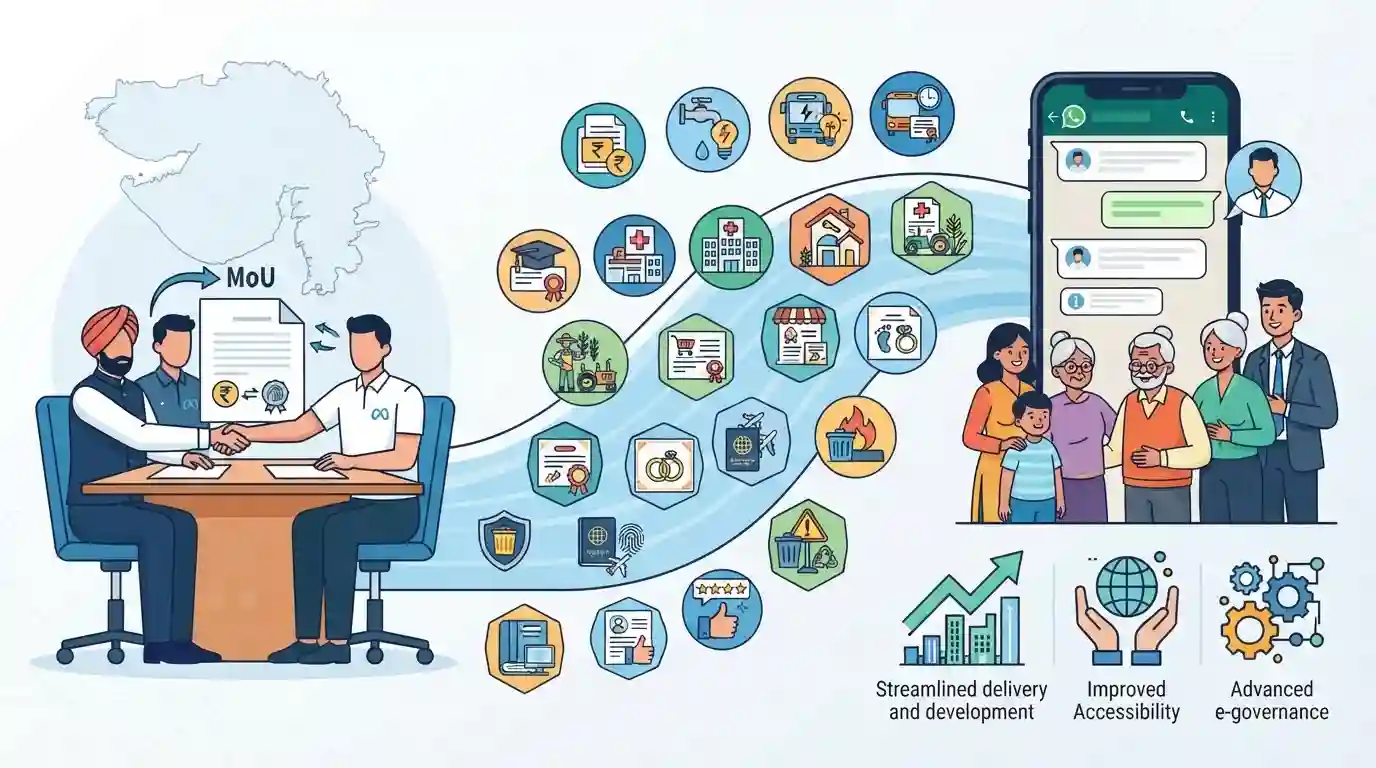
The Gujarat government signed an MoU with Meta to launch 20 government services on WhatsApp, aiming to streamline public service delivery, improve administrative accessibility, and advance e-governance initiatives across the state.
Key Points
- The Government of Gujarat has signed a Memorandum of Understanding (MoU) with Meta to integrate and deliver 20 essential government services directly via WhatsApp.
- The initiative aims to enhance citizen convenience, leverage conversational platforms for e-governance, and make public service delivery more accessible and transparent.
- Utilizes widely adopted consumer platforms to bridge the digital divide and reduce bureaucratic friction in accessing state welfare and utility services.
Important Terms
Meta

A multinational technology conglomerate that owns major social media and messaging platforms like Facebook, Instagram, and WhatsApp, partnering with governments to drive digital public infrastructure and citizen service delivery.
UPSC context
Relevant for GS Paper III (Technology / Digital Initiatives) and Governance (Public-Private Partnerships in e-governance).
A popular end-to-end encrypted messaging application owned by Meta, utilized by governments to deploy chatbots for delivering citizen-centric services directly on mobile devices.
UPSC context
Relevant for GS Paper II (Governance / E-governance applications) and mobile governance initiatives.
Government of Gujarat
The state executive body of Gujarat that leverages public-private partnerships and digital technologies to enhance transparency, streamline public service delivery, and advance e-governance initiatives.
UPSC context
Core to GPSC Mains (Administration, Governance, and State-specific digital transformation schemes).
Prelims Trap
MoUs with tech giants like Meta transfer total ownership and sovereignty of citizen state records to private corporate entities.
Aspirants often assume that integrating private platforms like WhatsApp for public services means the state government has transferred its statutory data sovereignty or ownership of citizen records to private entities. In reality, such MoUs involve API integrations under strict state data policies.
Static Concepts Connected
What are the key pillars and objectives of the National e-Governance Plan (NeGP) in India?
- Core Objective: NeGP aims to make all government services accessible to the common man in his locality, ensure efficiency, transparency, and reliability of services.
- Pillars & Infrastructure: Includes foundational infrastructure elements like State Data Centres (SDCs), State Wide Area Networks (SWANs), and Common Services Centres (CSCs).
Cross-Topic Patterns
E-Governance vs. Data Privacy & Vendor Lock-in
Deploying conversational AI and messaging apps for grievance redressal and welfare distribution bridges the rural digital divide while raising critical questions on data localization, vendor lock-in, and citizen privacy under upcoming data protection frameworks.

Expect a multi-statement question on public-private tech partnerships in e-governance, balancing administrative ease with data privacy risks.
Linked PYQs · 3
Linked PYQs · 3
- 2026GPSC_PRELIMSGS1
Which of the following initiatives are primarily aimed at strengthening digital governance and digital public infrastructure in India? 1. Digital India 2. Aadhaar 3. Unified Payments Interface (UPI) Choose the correct option from the following.
- 2022GPSC_PRELIMSGS1
One of the following is not a benefit of e-Governance to the citizens:
- 2018GPSC_PRELIMSGS1
Which of the following statement(s) is(are) correct? 1. Digital governance has been legalized by the Information Technology Act (2000) in India. 2. Information Technology Act is a watershed in conceptualizing administrative reforms in India. 3. Digital Governance is an attack on bureaucratic red-tapism.
