Gujarat MSME Incentive Scheme: Five Year Industrial Support
Source:timesofindia-indiatimes ↗
Why It Matters
Important for understanding Gujarat's industrial growth model, state-level economic policies, and support mechanisms for the MSME sector, which forms the backbone of the state's economy.
Summary
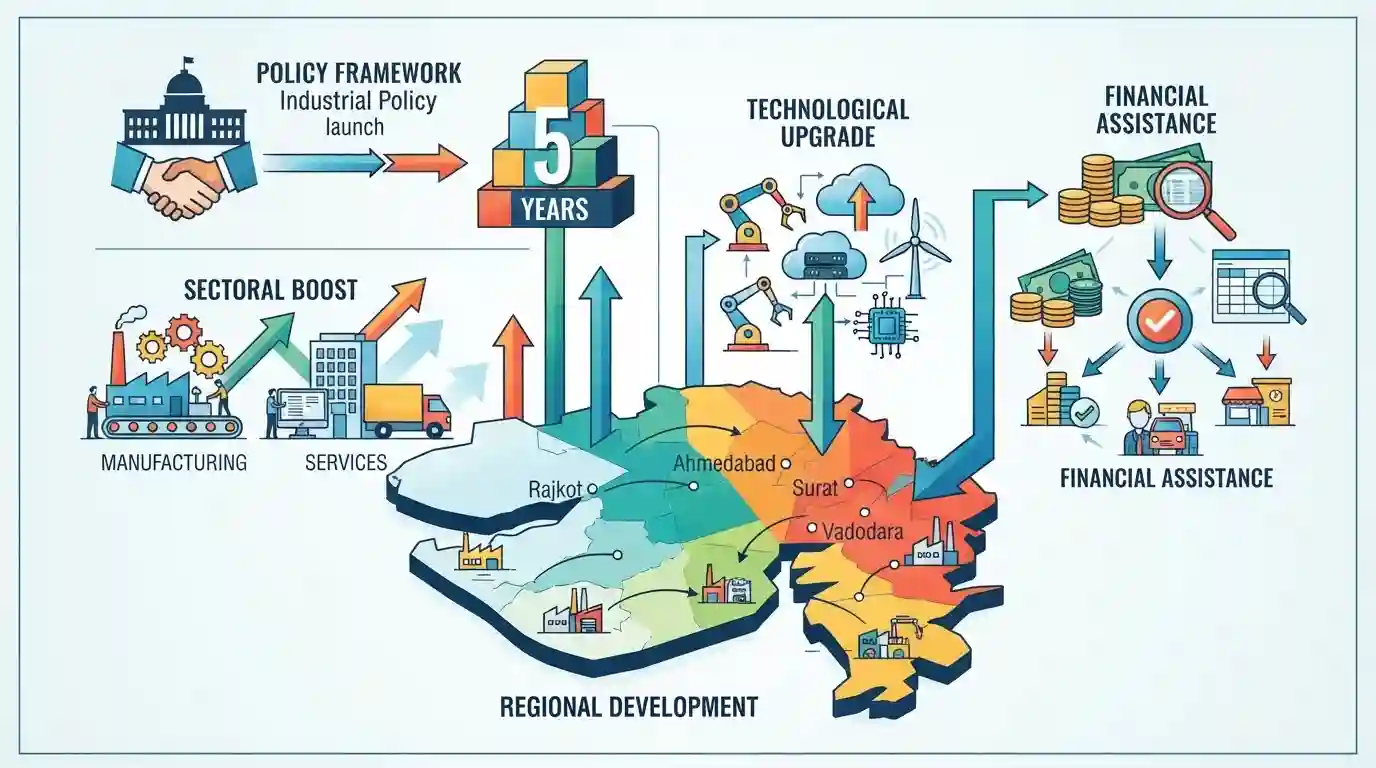
Gujarat has rolled out a comprehensive 5-year MSME incentive scheme under its Industrial Policy, aimed at boosting the manufacturing and service sectors, encouraging technological upgrade, and ensuring balanced regional development across the state through targeted financial assistance and subsidies.
Key Points
- Gujarat government has rolled out a new 5-year MSME incentive scheme under its Industrial Policy to boost manufacturing and service sector enterprises.
- The scheme aims to enhance competitiveness, encourage technology adoption, and provide financial assistance, capital subsidies, and interest subsidies to micro, small, and medium enterprises.
- It focuses on regional balanced development by categorizing talukas to offer differential financial incentives.
Important Terms
5-year MSME incentive scheme

A strategic framework introduced by the Gujarat government to provide capital subsidies, interest subvention, and power tariff reliefs to boost the manufacturing and service sectors.
UPSC context
GPSC Paper-2/3 (Economy & Policy): Evaluates state-level initiatives promoting MSMEs, employment generation, and balanced regional development.
Industrial Policy
A state-level framework formulated to guide industrial growth, attract domestic and foreign investment, and foster balanced economic development across different regions.
UPSC context
GPSC Paper-3 (Indian Economy and Planning): Tests knowledge of industrial reforms, manufacturing growth strategies, and state-level business ecosystems.
MSME
Micro, Small, and Medium Enterprises defined under the MSMED Act, serving as the backbone of employment generation, exports, and manufacturing in the economy.
UPSC context
GPSC Paper-3 (Economic Development): Assesses the role of small businesses, financial inclusion, and government credit support schemes.
Prelims Trap
Category A talukas offer lower financial incentives due to higher industrial readiness compared to Category B talukas.
Aspirants often confuse Category A and Category B talukas; Category A refers to less-developed talukas offering higher investment subsidy ceilings (up to 45-50%), not developed ones.
Static Concepts Connected
What are the classification criteria for Micro, Small, and Medium Enterprises (MSMEs) in India?
- Micro Enterprise: Investment up to Rs. 1 crore and turnover up to Rs. 5 crore.
- Small Enterprise: Investment up to Rs. 10 crore and turnover up to Rs. 50 crore.
- Medium Enterprise: Investment up to Rs. 50 crore and turnover up to Rs. 250 crore.
Cross-Topic Patterns
Industrial Policy & Balanced Regional Growth
Gujarat's taluka-wise categorization model mirrors central schemes like backward district development, testing decentralized fiscal federalism in competitive federal state economies.
MSME Subsidies and Credit Linkages
MSME incentive schemes intersect with priority sector lending norms and SIDBI credit lines, linking state industrial subsidies directly to national banking frameworks.

State industrial policies with differential taluka incentives (Cat A/B) are high-yield for matching lists and analytical statements.
Linked PYQs · 2
Linked PYQs · 2
- 2025GPSC_PRELIMSGS1
______ is one of the cities chosen by the NITI Aayog for its Growth Hub (G-HUB) programme to boost their economic growth.
- 2025GPSC_PRELIMSGS1
According to the Socio-Economic Review, 2024-2025 of Gujarat, Gujarat comes in ______ category in Logistic Ease Across Different States (LEADS), 2024.
