IMD Issues Red Alert for Extreme Monsoon Rains and Flash Floods
Source:indiatoday ↗
Why It Matters
The event serves as a practical case study for understanding how monsoon depressions and low-pressure systems trigger extreme precipitation in India. It is highly relevant for the GS1 Geography syllabus (Indian climate) and the GS3 Disaster Management syllabus concerning urban flooding and early warning systems like IMD alerts.
Summary
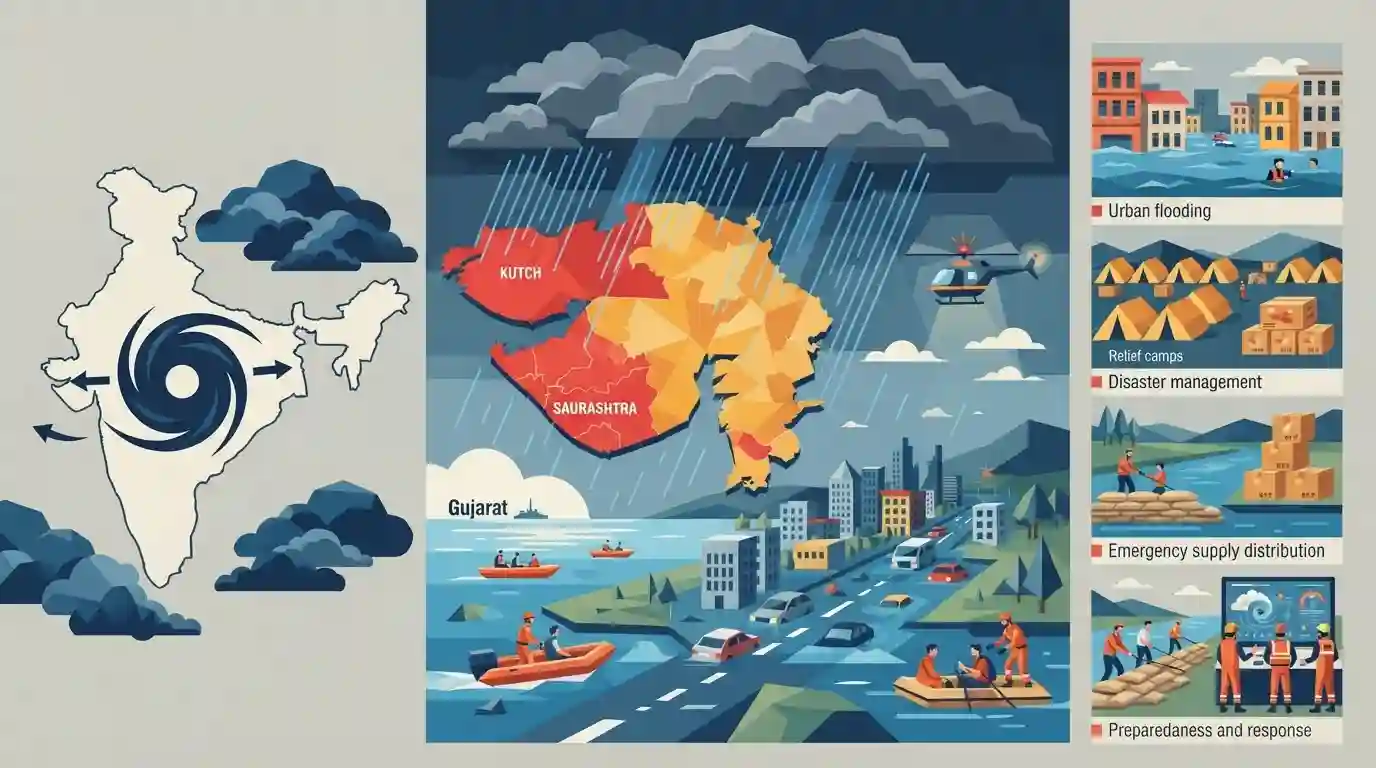
The India Meteorological Department (IMD) has issued a red alert for Gujarat due to the imminent threat of extreme monsoon rainfall and flash floods. The severe weather conditions are the result of a deep depression originating over central India that has developed into a well-marked low-pressure system moving toward Gujarat. The alert highlights the risk of localized urban flooding, severe waterlogging, and broader disaster management challenges, particularly across the Saurashtra and Kutch regions.
Key Points
- The India Meteorological Department (IMD) has issued a red alert for Gujarat, warning of extreme monsoon downpours and severe flood risks.
- The torrential rainfall is driven by a deep depression over central India that has intensified into a well-marked low-pressure area moving west-northwestwards toward the state.
- The IMD has specifically warned of flash floods, massive waterlogging, and localized urban flooding, particularly in low-lying areas of the Saurashtra and Kutch regions.
- The extreme weather threatens to cause significant infrastructural damage, severe traffic disruptions, and poses a general challenge to state disaster management operations.
Important Terms
India Meteorological Department (IMD)

Established in 1875, it is India's principal agency under the Ministry of Earth Sciences responsible for meteorological observations, weather forecasting, and seismology.
UPSC context
GS Paper 1 (Climatology) & GS Paper 3 (Disaster Management); tests state institutional structures for climate resilience.
Deep Depression
A low-pressure meteorological system classified by the IMD where maximum sustained surface wind speeds range between 28 and 33 knots (50 to 61 km/h).
UPSC context
GS Paper 1 (Climatology); tests knowledge of tropical atmospheric disturbances, monsoon systems, and physical geography.
Urban Flooding
The inundation of built-up areas caused by intense rainfall overwhelming drainage systems, drastically worsened by concretization, encroachment of natural wetlands, and inadequate urban infrastructure.
UPSC context
GS Paper 3 (Disaster Management); tests mitigation strategies, NDMA guidelines, and climate-induced urban vulnerabilities.
Red Alert (IMD)
The highest level of IMD's color-coded weather warning, indicating imminent or ongoing extremely severe weather with high risk to life and property, requiring immediate action.
UPSC context
GS Paper 3 (Disaster Management); tests disaster communication frameworks, early warning systems, and administrative mitigation.
Prelims Trap
Monsoon depressions rapidly dissipate upon landfall due to the immediate loss of moisture and latent heat supply from the ocean.
Wet soil conditions (the 'brown ocean effect') can sustain or even intensify depressions as they move across central India toward Gujarat.
Static Concepts Connected
What are monsoon depressions and how do they behave over India?
- Origin and core: These are low-pressure systems (winds 17–33 knots) forming mostly over the head Bay of Bengal during the summer monsoon.
- Steering mechanism: They travel west-northwest along the monsoon trough, acting as the primary source of rainfall for central and western India.
- Vertical structure: Unlike classic tropical cyclones, they have a cold core in the upper troposphere and lack a distinct cloud-free eye.
What is the 'Brown Ocean Effect' in meteorology?
- Core definition: A phenomenon where tropical systems or depressions maintain or intensify strength over land instead of decaying.
- Key driver: Abundant soil moisture and latent heat release from saturated tropical soils act as a pseudo-oceanic heat source.
- Indian significance: It explains why some monsoon depressions travel deep into central and western India without dissipating.
Cross-Topic Patterns
Urbanization vs Hydrological Cycle
Unplanned concrete expansion blocks natural drainage channels, turning standard monsoon depressions into high-impact urban flood disasters in western states.
Sponge Cities + Disaster Resilience
Integrating 'Sponge Cities' principles into urban redevelopment schemes (like AMRUT) provides a nature-based buffer to mitigate rapid-onset flash floods.

UPSC may couple the thermodynamic 'brown ocean effect' of land depressions with urban planning solutions like Sponge Cities in 2026.
Linked PYQs · 2
Linked PYQs · 2
- 2026GPSC_PRELIMSGS1
Consider the following statements regarding climate change: 1. Floods and droughts are increasing in India. 2. There has been a sharp increase in the number of tropical cyclones in India. 3. Humidity levels are gradually increasing in the regions of central India. Which of the above statement/s is/are correct?
- 2021GPSC_PRELIMSGS1
The 15ᵗʰ Finance Commission recommended Grants-in-Aid falls into five broad categories. Which of the following is NOT in the said categories?
