Gujarat raises income limit for unreserved students study abroad loans
Source:thehansindia ↗
Why It Matters
Questions on state-specific welfare initiatives, particularly targeting educational loans and specific demographic categories (like unreserved economic development corporations), frequently feature in the GPSC Prelims under polity and governance sections.
Summary
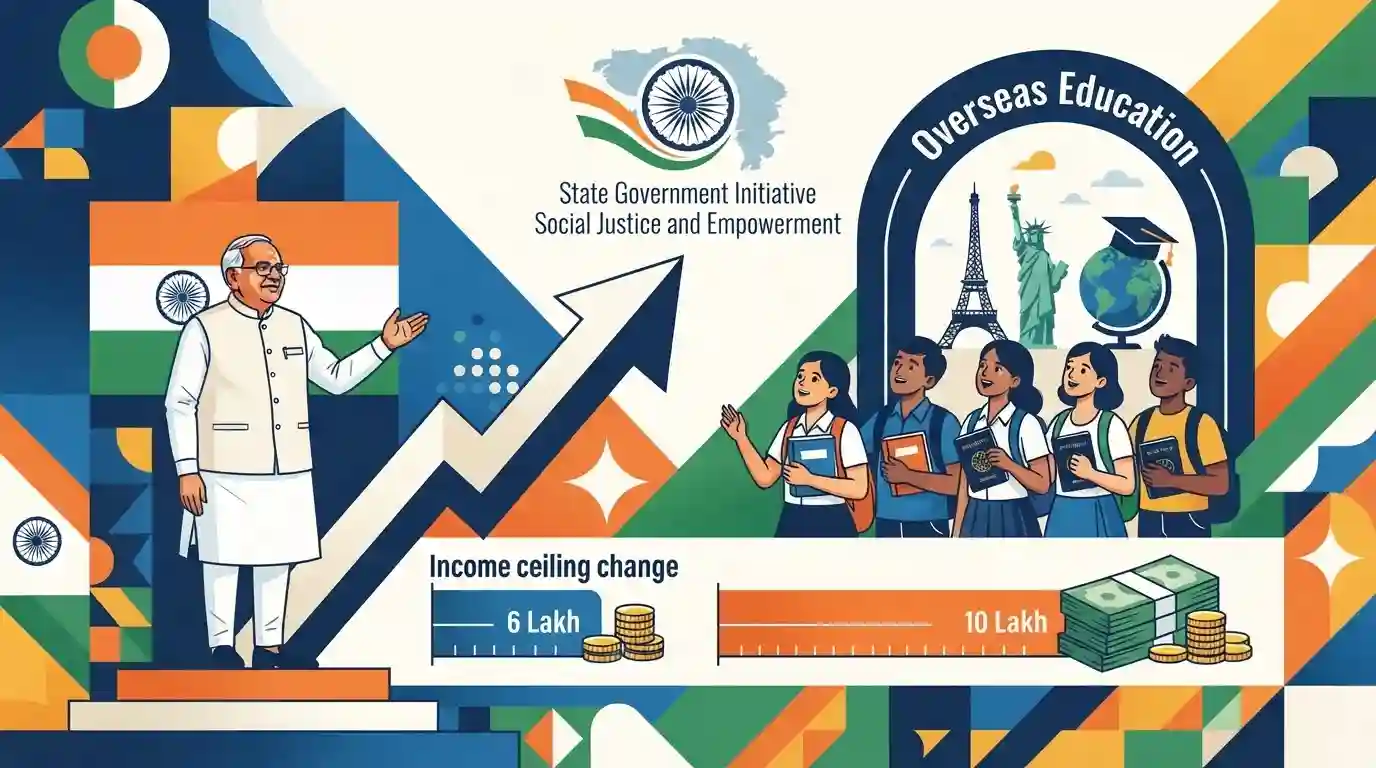
The Gujarat government has expanded the eligibility for its overseas higher education loan scheme targeting unreserved category students by raising the annual family income ceiling from Rs 6 lakh to Rs 10 lakh. Administered by the Gujarat Unreserved Educational and Economic Development Corporation (GUEEDC) under the Department of Social Justice and Empowerment, this scheme provides vital financial assistance for higher studies abroad. Chief Minister Bhupendra Patel formally announced the increased income cap during the 80th Independence Day celebrations held in Amreli, marking a significant step to broaden educational opportunities for the state's unreserved youth.
Key Points
- The Gujarat government increased the annual family income limit from Rs 6 lakh to Rs 10 lakh for unreserved category students seeking loans for studying abroad.
- The financial assistance scheme is managed by the Gujarat Unreserved Educational and Economic Development Corporation (GUEEDC).
- Chief Minister Bhupendra Patel announced this policy update during the 80th Independence Day celebrations in Amreli.
- The move, spearheaded by the Department of Social Justice and Empowerment, aims to provide greater access to global higher education for unreserved youths facing economic constraints.
Important Terms
Overseas Higher Education Loan Scheme

A Gujarat government financial assistance scheme offering low-interest educational loans (up to ₹15 lakh at 4%) to unreserved category students for foreign higher education. The family income eligibility ceiling was recently raised to ₹10 lakh.
UPSC context
Tests knowledge of Gujarat-specific welfare and education policies in GPSC General Studies Paper on State Economy.
Gujarat Unreserved Educational and Economic Development Corporation (GUEEDC)
A state agency under the Gujarat government that implements educational and economic development schemes, including foreign study loans, specifically targeting citizens from the unreserved category (EWS).
UPSC context
Highly relevant for GPSC governance topics covering state statutory boards and social empowerment mechanisms.
Department of Social Justice and Empowerment
The nodal department of the Gujarat government responsible for formulating and executing welfare schemes for marginalized and unreserved sections, ensuring social parity and administering bodies like GUEEDC.
UPSC context
Important for GPSC Public Administration and Social Justice syllabus regarding state government departments and welfare administration.
Prelims Trap
"The Foreign Study Loan Scheme is administered by the State Education Department."
Aspirants logically link study loans to the Education Department, but the GUEEDC and its schemes strictly fall under the Department of Social Justice and Empowerment.
Static Concepts Connected
What is the mandate of the Gujarat Unreserved Educational and Economic Development Corporation (GUEEDC)?
- Core Objective: Established in 2017 to support the educational and economic development of unreserved classes (those not covered under SC/ST/SEBC).
- Key Schemes: Provides foreign study loans, self-employment assistance, and coaching fees for competitive exams like GPSC and UPSC.
- Nodal Department: It functions under the aegis of the Department of Social Justice and Empowerment, Government of Gujarat.
How do income criteria differ between constitutional EWS reservations and state welfare schemes?
- Constitutional EWS Limit: Under the 103rd Constitutional Amendment, the central threshold for EWS reservation is generally an annual family income of ₹8 lakh.
- State Scheme Autonomy: States retain autonomy to define distinct income ceilings for specific financial assistance or loan schemes based on regional economic indicators.
Cross-Topic Patterns
Central EWS vs State Welfare Ceilings
While the central EWS reservation caps annual family income at ₹8 lakh, Gujarat's loan scheme sets a higher ₹10 lakh ceiling, demonstrating state flexibility in unreserved economic welfare.
Demographic Dividend & Diaspora Strategy
State-funded overseas education loans highlight the intersection of youth welfare, global skill acquisition, and Gujarat's strategic focus on nurturing its international diaspora.

Expect a matching question pairing state welfare schemes with their nodal departments (e.g., GUEEDC maps to SJ&E, not Education).
Linked PYQs · 1
Linked PYQs · 1
- 2025GPSC_PRELIMSGS1
Which of the following statements is/are correct regarding the G-SAFAL scheme?
