Gujarat Flood Evacuation and Multi Agency Rescue Operations
Source:The Hindu ↗
Why It Matters
The floods in Gujarat demonstrate the practical challenges of disaster management in India, emphasizing the roles of the NDRF and SDRF. It also brings attention to the geography of South Gujarat's river systems and the broader impact of changing monsoon patterns and extreme precipitation events driven by climate change.
Summary
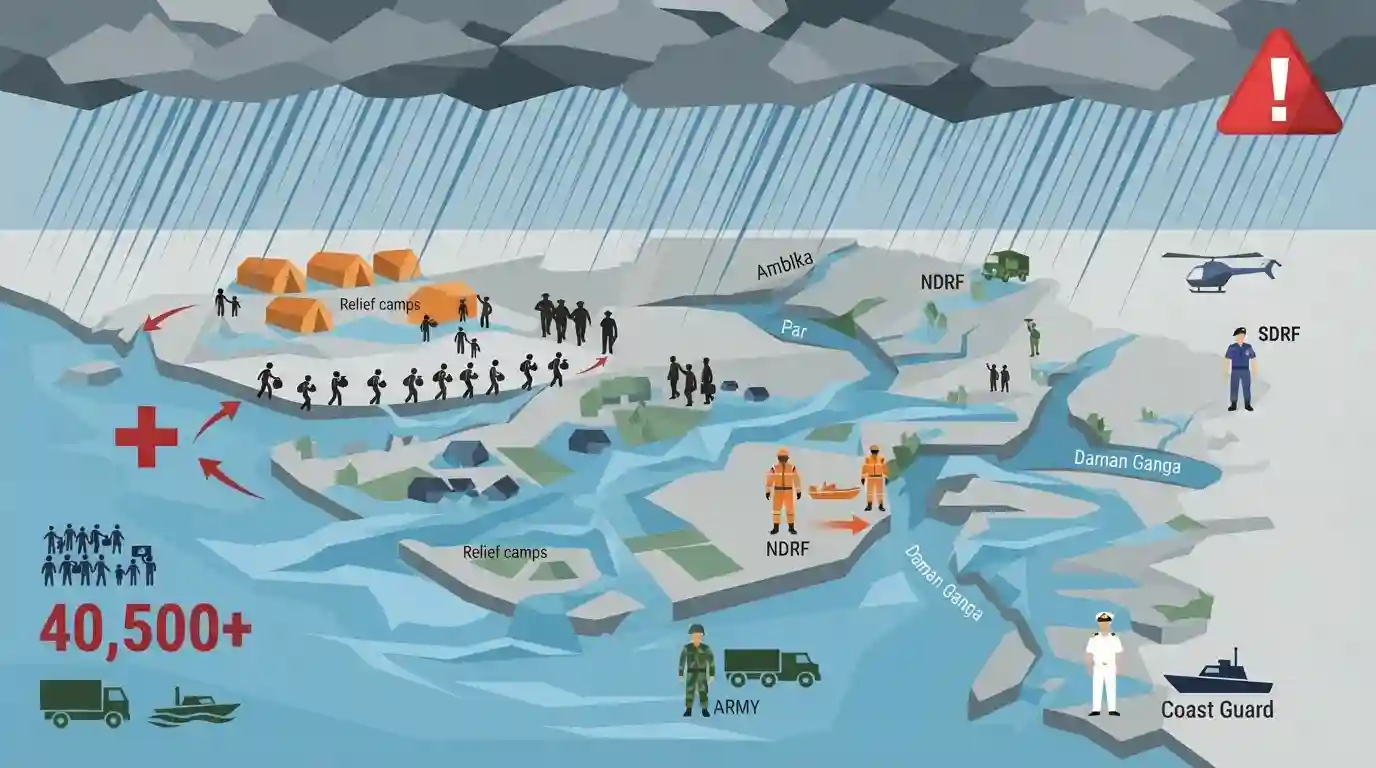
Torrential monsoon rains in Gujarat have caused widespread flooding, resulting in the evacuation of over 40,500 people. With several major rivers such as the Ambika, Par, and Daman Ganga breaching their danger levels, the state has stepped up relief efforts by deploying the Army, NDRF, SDRF, and Coast Guard. The India Meteorological Department (IMD) has issued red alerts for continued heavy rainfall, underscoring the region's vulnerability to extreme weather events and the critical need for robust disaster management.
Key Points
- Over 40,500 people were evacuated to safety following severe flooding across Gujarat triggered by torrential monsoon rainfall.
- Coordinated rescue operations were launched involving the Army, National Disaster Response Force (NDRF), State Disaster Response Force (SDRF), and the Coast Guard.
- Major rivers in South Gujarat, including the Ambika, Par, Auranga, Daman Ganga, and Poorna, breached their respective danger marks, causing extensive waterlogging.
- The India Meteorological Department (IMD) issued red alerts for multiple districts, forecasting continued extremely heavy rainfall and advising extreme caution.
- The situation highlights the growing challenge of extreme weather events and tests the state's disaster resilience and response infrastructure.
Important Terms
National Disaster Response Force (NDRF)

A specialized, multi-disciplinary force constituted in 2006 under the Ministry of Home Affairs to deliver a dedicated, rapid response during natural and man-made disasters.
UPSC context
GS Paper III (Disaster Management). Tests understanding of India's institutional response architecture, specialized rescue capabilities, and inter-agency coordination.
Disaster Management Act, 2005
A landmark central law establishing India's legal-institutional framework for managing disasters, mandating the creation of NDMA, SDMAs, and the NDRF, while shifting focus from post-disaster relief to proactive mitigation.
UPSC context
GS Paper II (Governance) and GS III (Disaster Management). Tests knowledge of legal frameworks, federal crisis management, and response funding.
State Disaster Response Force (SDRF)
A state-level specialized response unit raised by individual Indian states—usually from police or home guards—to act as the primary local search, rescue, and relief responder during crises.
UPSC context
GS Paper III (Disaster Management). Tests knowledge of state-level capacity building, federal disaster response architecture, and local emergency coordination.
India Meteorological Department (IMD)
An agency under India's Ministry of Earth Sciences responsible for weather forecasting, climatology, and issuing early warnings for extreme weather events such as cyclones, heatwaves, and heavy monsoon rains.
UPSC context
GS Paper I (Geography) and GS III (Disaster Management). Tests concepts of climatology, monsoon tracking, early warning systems, and risk mitigation.
Indian Coast Guard (ICG)
An armed force and maritime law enforcement agency under the Ministry of Defence, mandated with marine environmental protection, search and rescue, and assisting civil authorities during coastal disasters.
UPSC context
GS Paper III (Internal Security/Disaster Management). Tests knowledge of maritime security architecture, coastal safety, and multi-agency response capabilities.
Indian Army
The land force of the Indian Armed Forces which plays a critical role in Humanitarian Assistance and Disaster Relief (HADR) under the statutory principle of "Aid to Civil Authorities."
UPSC context
GS Paper III (Disaster Management). Tests understanding of civil-military coordination, emergency logistics, and armed forces' role in domestic disaster response operations.
Prelims Trap
The Central Government bears the primary administrative and financial responsibility for disaster response in India.
The primary responsibility for disaster management lies with State Governments. The Centre only provides supplementary financial (NDRF) and logistical support (Army/NDRF deployment) upon request.
Static Concepts Connected
What are the key features of minor west-flowing rivers in Peninsular India?
- Short and swift: They typically originate in the Western Ghats (Sahyadris) and have short, swift, high-gradient courses.
- Estuary formation: Due to their steep gradients, rapid flow, and lower sediment loads, they form estuaries rather than deltas.
- Notable examples: Daman Ganga, Par, Auranga, Ambika, and Purna are prominent minor rivers draining into the Arabian Sea along the Gujarat coast.
How is the State Disaster Response Fund (SDRF) constituted and financed?
- Statutory backing: It is the primary fund available with State Governments, constituted under Section 48(1)(a) of the Disaster Management Act, 2005.
- Funding ratio: The Centre contributes 75% of the SDRF allocation for general category states and 90% for special category (hilly/NE) states.
- Restricted usage: SDRF funds can only be utilized for meeting the expenditure of providing immediate relief to victims of notified disasters.
Cross-Topic Patterns
Par-Tapi-Narmada River Link debate
Flooding in minor west-flowing rivers like the Par regularly revives the contentious Par-Tapi-Narmada interlinking project, which aims to divert 'surplus' water to arid Saurashtra and Kutch.
Arabian Sea warming and extreme rain
Escalating sea surface temperatures in the Arabian Sea are shifting monsoon dynamics, driving short, intense rainfall bursts and severe flash floods along India's western coast.

Expect a Prelims mapping question pairing minor west-flowing rivers (Ambika, Par, Auranga, Daman Ganga) with their respective coastal states.
Linked PYQs · 2
Linked PYQs · 2
- 2026GPSC_PRELIMSGS1
Consider the following statements regarding climate change: 1. Floods and droughts are increasing in India. 2. There has been a sharp increase in the number of tropical cyclones in India. 3. Humidity levels are gradually increasing in the regions of central India. Which of the above statement/s is/are correct?
- 2021GPSC_PRELIMSGS1
The 15ᵗʰ Finance Commission recommended Grants-in-Aid falls into five broad categories. Which of the following is NOT in the said categories?
