Gujarat Police Recovers Funds In International Cyber Fraud
Source:the-hans-india ↗
Why It Matters
Demonstrates the rising incidence of online financial fraud exploiting social media platforms, while highlighting the critical role of responsive cyber policing (e.g., rapid freezing of accounts) in protecting citizens and the diaspora. Reinforces the need for robust cybersecurity awareness and trust in digital financial ecosystems.
Summary
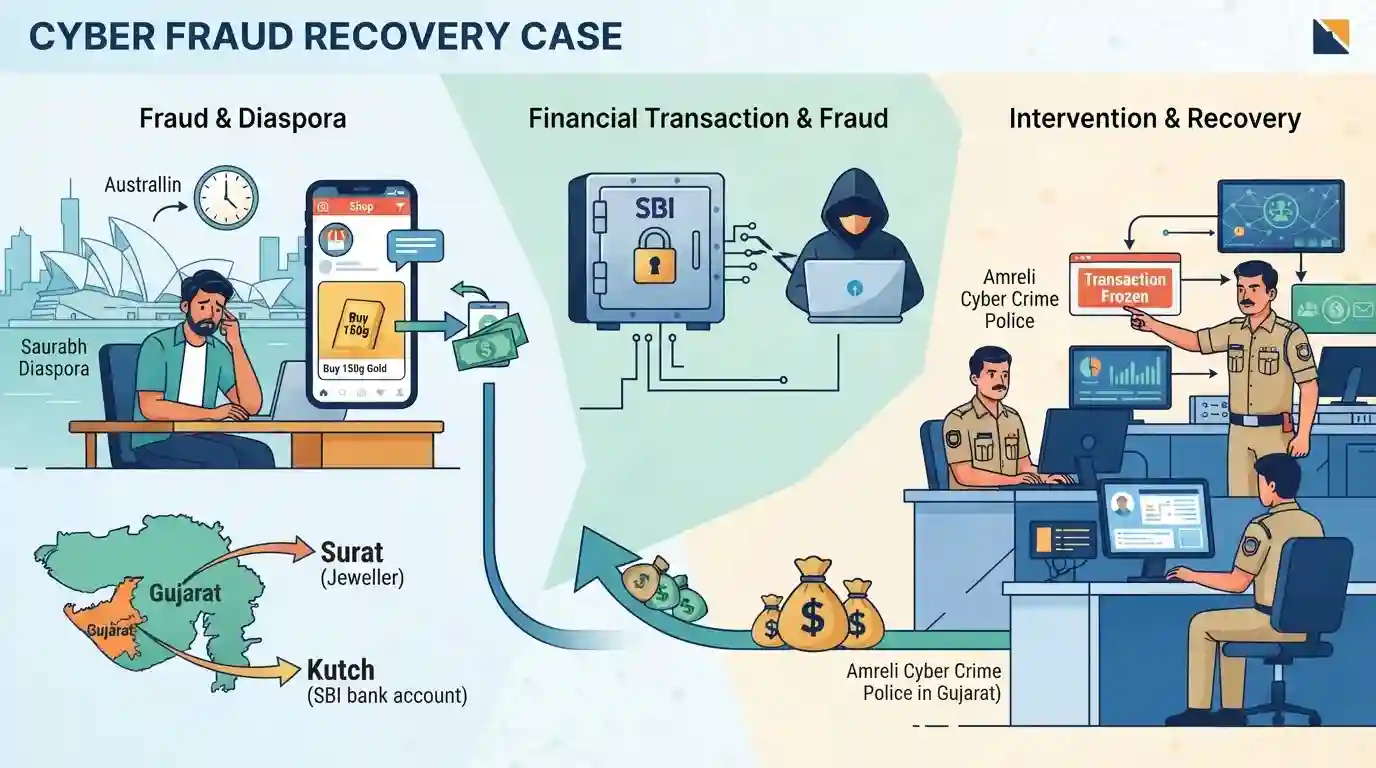
The Amreli Cyber Crime Police in Gujarat successfully recovered ₹11.23 lakh for Saurabh Jolly, an Indian national residing in Sydney, Australia. Jolly fell victim to a cyber fraud scheme after attempting to purchase 150 grams of gold from a Surat-based jeweller he found on social media. After transferring the funds to an SBI account in Kutch, the seller severed all communication. Prompt intervention by the Amreli police ensured the transaction was frozen in time, leading to the full recovery of the funds. This incident underscores the growing threat of social media-based financial scams and highlights the effectiveness of timely law enforcement action in the digital domain.
Key Points
- A Sydney-based NRI, Saurabh Jolly, was defrauded of ₹11.23 lakh in an online gold purchase scam.
- The victim transferred the money to an SBI account located in Kutch after connecting with a Surat-based jeweller on social media, who then became unresponsive.
- Following a complaint, the Amreli Cyber Crime Police acted swiftly to freeze the fraudulent transaction.
- The police successfully recovered the entire defrauded amount and returned it to the victim, demonstrating effective cybercrime response capabilities.
- The case highlights the risks of unregulated social media transactions and the importance of prompt reporting for recovering funds lost to cyber fraud.
Important Terms
State Bank of India (SBI)

India's largest multinational public sector bank and a statutory body. It serves as a Domestic Systemically Important Bank (D-SIB), playing a central role in India's economy and the secure management of digital banking frameworks.
UPSC context
Essential for GS-3 (Economy), focusing on banking sector regulation, D-SIBs, and the security of digital banking infrastructure.
Cybercrime
Illicit activities conducted via computer networks or digital devices, such as social media-based financial scams. It threatens data privacy, financial stability, and public trust in digital platforms.
UPSC context
A core GS-3 (Internal Security) topic evaluating knowledge of digital vulnerabilities, financial fraud mechanisms, and institutional cybersecurity frameworks.
Gujarat Police
The primary law enforcement agency of Gujarat, responsible for maintaining public order and deploying specialized units, such as cyber crime cells, to combat complex digital and cross-border financial offenses.
UPSC context
Relevant to GS-2 and GS-3 regarding state-level police reforms, modernization, and institutional capacity building against emerging technological threats.
Amreli Cyber Crime Police
A specialized district-level law enforcement unit in Gujarat dedicated to investigating digital fraud, tracing illicit financial transactions, and coordinating with banks to swiftly freeze and recover misappropriated funds.
UPSC context
Maps to GS-3 (Internal Security), illustrating the operational necessity of decentralized cybercrime units for effective tracking and swift intervention.
Prelims Trap
"Under RBI norms, customers bear zero liability for any unauthorized electronic banking transactions."
Zero liability is not absolute; it specifically requires the customer to report the unauthorized transaction within three working days of receiving an alert.
Static Concepts Connected
What are the key institutional mechanisms for addressing financial cybercrime in India?
- I4C: The nodal point under the Ministry of Home Affairs to coordinate law enforcement responses against digital crimes.
- NCRP: A centralized platform that addresses jurisdictional challenges by automatically routing citizen complaints to the respective State/UT police.
- CFCFRMS: The Citizen Financial Cyber Fraud Reporting System, integrated with helpline 1930, enabling real-time freezing of defrauded funds.
How does RBI protect retail customers in unauthorized electronic banking transactions?
- Zero Liability: The customer has zero liability if the fraud (third-party breach) is reported within three working days of the alert.
- Limited Liability: If reported between 4 to 7 working days, customer liability is capped at a specific maximum amount depending on the account type.
- Shadow Reversal: The bank must credit the amount involved in the unauthorized transaction to the customer's account within 10 working days of reporting.
Cross-Topic Patterns
Cyber Vulnerability of the Indian Diaspora
Cross-border financial transactions by the diaspora are increasingly targeted. This necessitates integrating consular grievance mechanisms (like the MADAD portal) with domestic cyber frameworks (NCRP) to protect NRI interests.
Unregulated E-commerce on Social Media
Social media platforms acting as informal storefronts bypass the Consumer Protection (E-Commerce) Rules, 2020. This regulatory gray area exposes buyers to unregulated transactions lacking escrow-based or institutional safeguards.

Expect a 2026 Prelims statement swapping the functions of I4C, CERT-In, and NCIIPC regarding citizen-facing vs critical infrastructure.
Linked PYQs · 3
Linked PYQs · 3
- 2025GPSC_PRELIMSGS1
Which of the following statements is/are true regarding Cyber Surakshit Bharat? (i) It is an initiative of the Ministry of Defence, Government of India. (ii) It was conceptualized with the mission to spread awareness about cybercrime and build the capacities of Chief Information Security Officers (CISOs) and frontline IT officials across all government departments, banks and PSU.
- 2018GPSC_PRELIMSGS1
Which of the following statement(s) is(are) correct? 1. Digital governance has been legalized by the Information Technology Act (2000) in India. 2. Information Technology Act is a watershed in conceptualizing administrative reforms in India. 3. Digital Governance is an attack on bureaucratic red-tapism.
- 2026GPSC_PRELIMSGS1
What does a "Firewall" do?
