Gujarat Police Eliminates Station Visits for Passport Verification
Source:indianmasterminds ↗
Why It Matters
Highlights the practical application of e-governance and digital record-keeping to streamline public service delivery, aligning with the broader administrative goals of transparency, accountability, and reducing red tape in governance.
Summary
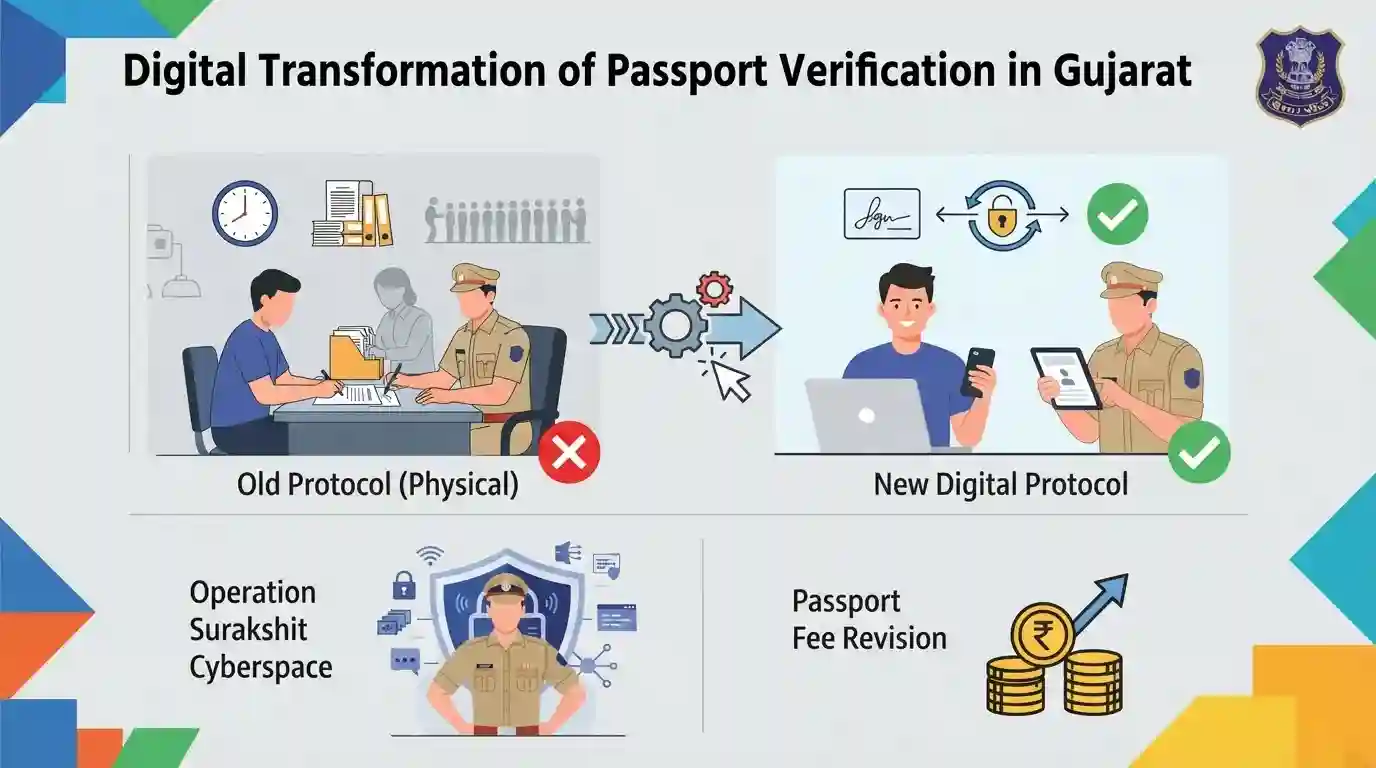
The Gujarat Police, under DGP Gyanendra Sinh Malik, has introduced new citizen-friendly guidelines that eliminate routine visits to police stations for passport verification. Under the new protocol, verification of citizenship and criminal antecedents will be conducted digitally, ending the requirement for applicants to provide physical signatures at the station. Field visits by police personnel will be restricted to suspicious cases. This reform represents a significant shift towards e-governance and citizen-centric administration by reducing bureaucratic friction, enhancing transparency, and minimizing opportunities for corruption. Additionally, the article highlights the recent nationwide hike in passport fees implemented by the Central Government on July 1, 2026, and mentions Gujarat Police's ongoing 'Operation Surakshit Cyberspace' initiative.
Key Points
- Gujarat Police has eliminated the mandatory requirement for applicants to physically visit police stations for passport verification.
- Police will now verify citizenship and criminal antecedents exclusively through digital records, dropping the need for applicant signatures.
- Physical field verifications will only be conducted in suspicious cases or where digital records are insufficient.
- The initiative aims to enhance transparency, curb corruption, and promote citizen-centric e-governance.
- The Central Government recently hiked passport issuance fees nationwide, effective July 1, 2026.
Important Terms
Passports Act, 1967

An Act of Parliament that governs the issuance, impounding, and revocation of Indian passports and travel documents, regulating citizens' departure from India.
UPSC context
Important for GS Paper 2 (Polity). Tests the statutory regulation of the fundamental right to travel abroad (Article 21).
Operation Surakshit Cyberspace
A 28-day campaign launched by the Gujarat Police to enhance online safety for women and children via digital awareness, victim outreach, and technology-driven policing.
UPSC context
Crucial for GS Paper 3 (Internal Security). Illustrates state-level administrative initiatives targeting modern cybercrimes and protecting vulnerable demographics.
E-governance
The use of Information and Communication Technology (ICT) by the government to streamline processes—such as digital passport verification—enhancing transparency and reducing bureaucratic friction.
UPSC context
Relevant for GS Paper 2 (Governance). Demonstrates how technology curbs corruption and promotes citizen-centric administration.
Police Reforms
Systemic administrative changes aimed at making law enforcement more efficient and citizen-friendly, exemplified by eliminating mandatory physical station visits for routine procedural verifications.
UPSC context
Vital for GS Paper 2 & 3 (Governance/Security). Highlights the transition toward accountable and modern law enforcement frameworks.
Prelims Trap
"The police verification protocol for passport issuance is formulated directly by the Ministry of External Affairs across all states."
While passports and visas are strictly Union subjects, 'Police' is a State subject. State governments retain the authority to formulate and reform their own police verification protocols.
Static Concepts Connected
What is the Constitutional division of power regarding Passports and Police Verification?
- Union Jurisdiction: Passports and visas fall under Entry 19 of the Union List, governed by the MEA under the Passports Act, 1967.
- State Jurisdiction: Police and Public Order (Entries 1 & 2 of the State List) empower states to independently design their background verification protocols.
- Cooperative Integration: The Central government relies on state-administered police machinery to conduct criminal antecedent checks prior to issuing a passport.
How does the CCTNS facilitate digital criminal verification in India?
- Mission Mode Project: It is a Mission Mode Project under the National e-Governance Plan (NeGP), implemented by the National Crime Records Bureau (NCRB).
- Nationwide Network: CCTNS digitally networks over 16,000 police stations nationwide, creating a centralized, searchable database of FIRs, crimes, and criminals.
- Digital Verification: It allows state police to digitally verify a citizen's criminal antecedents in real-time, eliminating the need for routine physical visits.
Cross-Topic Patterns
E-Governance bridging Federal silos
State-level digital databases like CCTNS are increasingly becoming the backbone for Union government services like passport issuance, highlighting tech-driven cooperative federalism.
Sub-national cybersecurity operations
Gujarat's 'Operation Surakshit Cyberspace' highlights an emerging trend of state-specific cyber drives complementing national agencies like I4C to tackle localized digital threats and deepfakes.

Expect a 2026 Prelims question testing the overlap of Union passport jurisdiction (List I) with State-level police verification (List II).
Linked PYQs · 2
Linked PYQs · 2
- 2022GPSC_PRELIMSGS1
One of the following is not a benefit of e-Governance to the citizens:
- 2024GPSC_PRELIMSGS1
Public Administration is the study of
