Gujarat Tourism Policy Targets Commonwealth Games and Orange Economy
Source:dailypioneer ↗
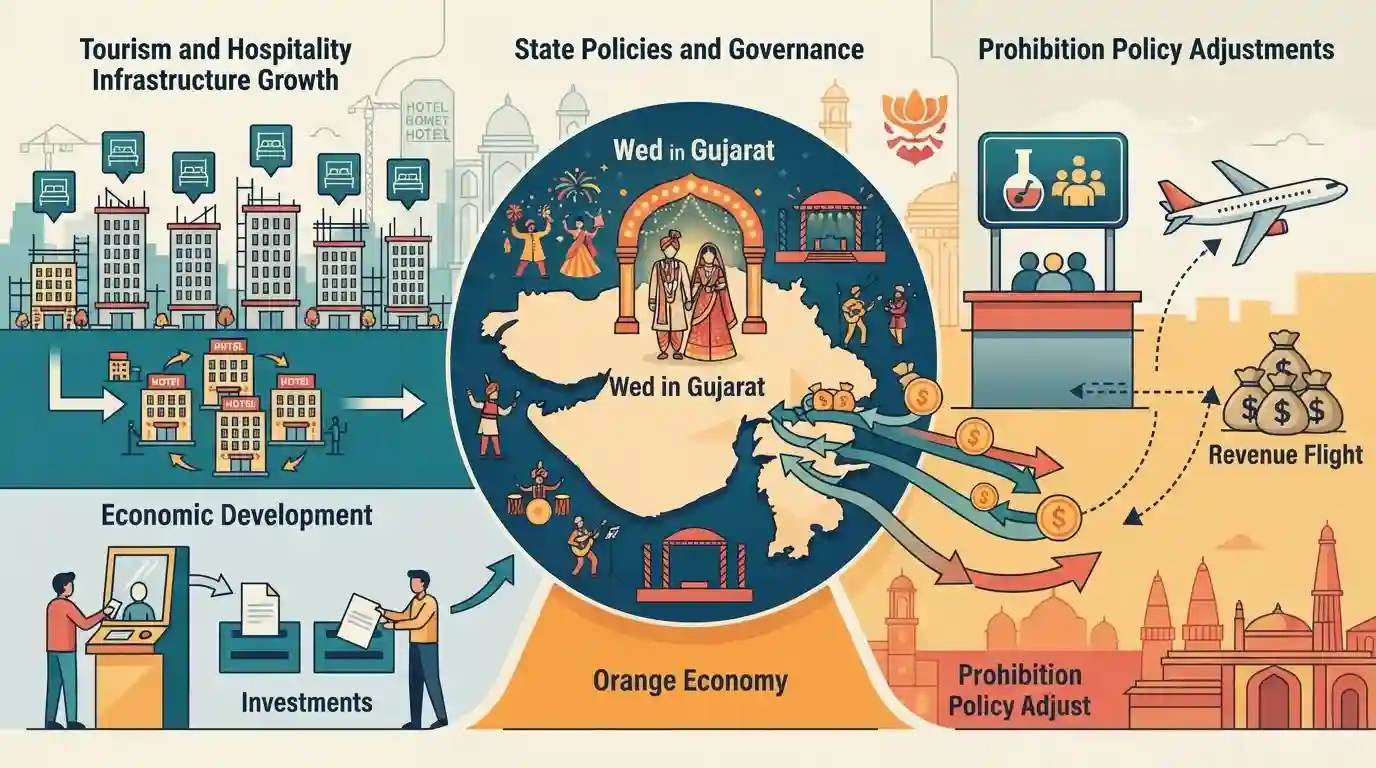
Why It Matters
Highlights the integration of the creative 'Orange Economy' into state policy and demonstrates how socio-legal frameworks (like prohibition) must be balanced with economic goals such as promoting destination weddings and tourism revenue.
Summary
The Gujarat government is formulating an ambitious new tourism and hospitality policy ahead of the 2030 Commonwealth Games to position the state as a premier global destination. The framework aims to drastically expand hospitality infrastructure by adding 60,000 hotel rooms and streamlining investments through single-window clearances. Notably, it emphasizes the 'Orange Economy' through large-scale entertainment events and launches the 'Wed in Gujarat' initiative. To make destination weddings competitive and curb a massive Rs 1,500 crore revenue flight to neighboring states, Gujarat is deliberating progressive relaxations in its prohibition laws via event-specific temporary group liquor permits.
Key Points
- Gujarat is drafting a comprehensive new tourism and hospitality policy in preparation for the 2030 Commonwealth Games, aiming to position the state as a global destination.
- The policy targets vast infrastructure expansion by adding 300 new hotels and 60,000 rooms, facilitated by a single-window clearance mechanism for investors.
- To curb an estimated Rs 1,500 crore annual revenue loss to states like Rajasthan, the 'Wed in Gujarat' initiative proposes event-specific group liquor permits to bypass strict prohibition hurdles for destination weddings.
- The policy strongly focuses on the 'Orange Economy' by promoting large-scale concerts, entertainment events, and specialized medical and wellness tourism centers.
Important Terms
Orange Economy

A knowledge-based economic model driven by creativity, culture, and intellectual property. It encompasses sectors like entertainment, arts, design, and cultural tourism that transform ideas into valuable goods and services, driving job creation.
UPSC context
GS Paper 3 (Indian Economy). Crucial for understanding alternative economic models, creative industries, and innovation-driven growth in India.
Wed in Gujarat
A state-backed tourism campaign to market Gujarat's coastal, desert, and heritage locations as premium destination wedding venues. It seeks to curb revenue flight to neighboring states and boost local hospitality infrastructure.
UPSC context
GS Paper 2 (Government Policies). Highlights state-level governance interventions to promote cultural tourism and capture domestic economic revenues.
New Tourism Policy (Gujarat)
An upcoming state framework to expand Gujarat's hospitality infrastructure ahead of the 2030 Commonwealth Games. It introduces single-window clearances, promotes the Orange Economy, and considers temporary liquor permits for large-scale events.
UPSC context
GS Paper 3 (Infrastructure). Demonstrates structural policy reforms, deregulation, and capacity-building strategies required to host major global sporting events.
Prelims Trap
"The 'Orange Economy' refers to state initiatives aimed at boosting horticulture and citrus fruit production."
Aspirants often confuse 'Orange Economy' with horticulture (citrus fruits). It actually refers to the creative and cultural economy (music, AVGC, fashion) driven by intellectual property.
Static Concepts Connected
What is the constitutional framework governing liquor prohibition in India?
- Article 47 (DPSP): Directs the State to endeavor to prohibit the consumption of intoxicating drinks and drugs that are injurious to health.
- State List (Entry 8): Entry 8 grants state legislatures exclusive authority to regulate or prohibit the production, transport, purchase, and sale of intoxicating liquors.
What constitutes the 'Orange Economy'?
- Core Definition: Economic activities where ideas, creativity, and cultural expressions are transformed into value-generating goods and services.
- Key Sectors: Primarily includes AVGC (Animation, Visual Effects, Gaming, Comics), music, fashion, and intellectual property-driven creative industries.
Cross-Topic Patterns
DPSP vs. Economic Pragmatism
Gujarat proposing liquor relaxations to stop a Rs 1,500 crore revenue flight perfectly illustrates the ongoing tension between constitutional DPSPs (Article 47) and practical state economic imperatives.
Mega-Events & Urban Infrastructure
The 2030 CWG in Ahmedabad continues the recent trend of leveraging global mega-events as catalysts for rapid urban capacity building, similar to India's G20 infrastructure push.

Expect a 'match the following' Prelims question pairing colored economies (Orange, Silver, Blue, Green) with their target sectors.
Linked PYQs · 3
Linked PYQs · 3
- 2026GPSC_PRELIMSGS1
The Union Budget 2026-27 introduces the concept of 'Orange Economy'. To which one of the following is this term related to?
- 2026GPSC_PRELIMSGS1
With reference to the Commonwealth Games (CWG), consider the following statements: 1. The 2030 edition in Ahmedabad is officially recognized as the 'Centenary Games'. 2. Traditionally, China has dominated the Commonwealth Games by consistently topping the medal tally with the highest number of total medals. Which of the above statement(s) is/are correct?
- 2025GPSC_PRELIMSGS1
Which of the following statements are correct regarding the importance of fairs and festivals in the contemporary context of Gujarat? 1. Gujarat's fair and festivals serve as a platform for showcasing traditional crafts, agricultural products and livestock trade, continuing the historical tradition of economic and cultural exchange. 2. Events like Rann Utsav, Tarnetar Fair and Bhavnath Fair bring together diverse religious communities, artisans and craftsmen from across India. 3. The International Kite Festival (Uttarayan) and Modhera Dance Festival highlight Gujarat's ability to blend tradition with modern trends, attracting global tourists and fostering cultural diplomacy. 4. In modern Gujarat, fairs and festivals continue to be a driving force for tourism and local economic growth, preserving cultural heritage while adapting to contemporary trends.
