Gujarat Issues Deep Depression and Heavy Rainfall Alerts for Districts
Source:livemint ↗
આ શા માટે મહત્વનું છે
Understanding the formation of deep depressions and their subsequent impacts like extreme rainfall and flash floods is crucial for disaster management and agrometeorology. It highlights the vulnerability of agriculture to severe weather and the vital role of early warning systems.
સારાંશ
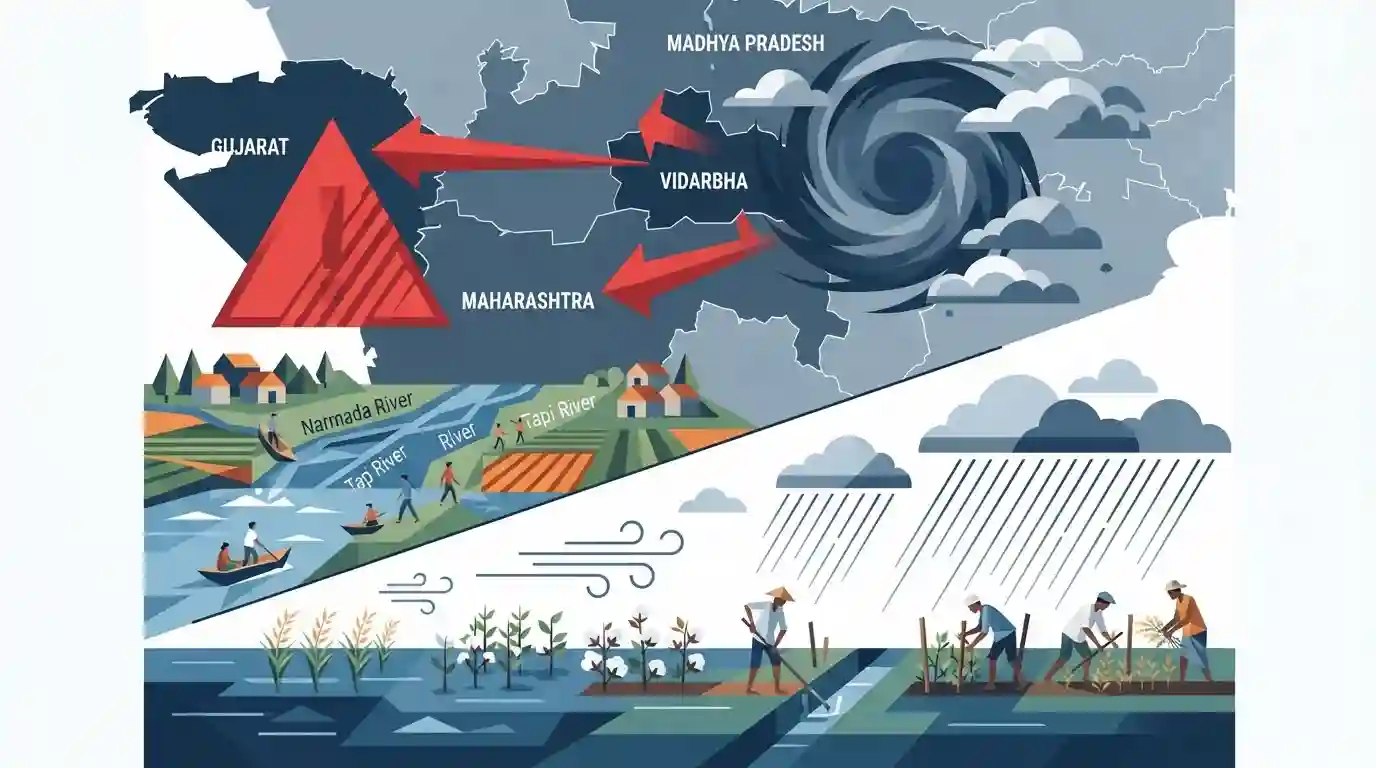
The India Meteorological Department (IMD) has issued a red alert for Gujarat and parts of Maharashtra, forecasting extremely heavy rainfall driven by a deep depression situated over Vidarbha and adjoining South Madhya Pradesh. High flash flood risks are anticipated in districts like Vadodara, Narmada, and Tapi. Consequently, urgent agromet advisories have been issued to help farmers protect their crops from waterlogging and strong winds, emphasizing the increasing impact of severe weather events on regional agriculture and infrastructure.
મુખ્ય મુદ્દા
- The IMD issued a red alert for Gujarat and parts of Maharashtra, predicting extremely heavy rainfall due to a deep depression over Vidarbha and South Madhya Pradesh.
- A flash flood alert has been issued for several Gujarat districts, including Kheda, Anand, Panchmahal, Mahisagar, Dahod, Vadodara, Chhota Udepur, Narmada, and Tapi.
- The deep depression, moving west-northwestwards, is expected to bring widespread thunderstorms and gusty winds to Gujarat until 2 August.
- Agromet advisories instructed farmers to drain excess rainwater from crop fields and provide strong staking for tall crops to avoid prolonged waterlogging and damage.
મહત્વપૂર્ણ શબ્દો
India Meteorological Department (IMD)

The principal government agency under the Ministry of Earth Sciences responsible for meteorological observations, weather forecasting, seismology, and issuing early warnings for weather-related hazards in India.
UPSC context
GS Papers 1 and 3. Crucial for questions on climatology, monsoon forecasting, and institutional frameworks for disaster management.
IMD Colour Codes (Red Alert)
A four-tier warning system (Green, Yellow, Orange, Red) used by the IMD. A
UPSC context
GS Paper 3 (Disaster Management). Tests knowledge of early warning systems, risk communication, and disaster mitigation strategies.
Deep Depression
A low-pressure weather system where maximum sustained surface wind speeds reach 50-61 km/h. It is a more intense stage than a depression but weaker than a cyclonic storm.
UPSC context
GS Paper 1 (Geography). Important for understanding tropical cyclone formation, monsoon dynamics, and related climatological phenomena.
Agromet Advisories
Tailored weather-based agricultural advisories provided by the IMD and partner institutes. They help farmers make informed decisions about irrigation, sowing, and crop protection during adverse or favorable weather conditions.
UPSC context
GS Paper 3 (Agriculture & Technology). Tests application of meteorological data in farming and e-technology in the aid of farmers.
પ્રિલિમ્સ ટ્રેપ
Deep depressions always rapidly dissipate upon making landfall because they lose access to their primary oceanic heat source.
Under the 'brown ocean effect,' highly saturated soil mimics warm ocean waters, providing latent heat that allows land-based depressions to maintain intensity.
સંલગ્ન સ્થિર ખ્યાલો
What do the four color-coded weather alerts issued by the IMD signify?
- Green (No Warning): No advisory issued; indicates normal weather conditions with no immediate threat to life or property.
- Yellow (Watch): Be aware; indicates severely bad weather persisting for days, warning of possible localized deterioration.
- Orange (Alert): Be prepared; indicates extremely bad weather with potential disruption to transport, power, and risk to life.
- Red (Warning): Take action; indicates exceptionally severe weather, prompting immediate action by disaster management authorities.
What is the 'Brown Ocean Effect' in tropical meteorology?
- Definition: A phenomenon where tropical cyclones or depressions maintain or intensify over land instead of dissipating.
- Source: Saturated soil acts as an alternative heat source, releasing latent heat of condensation to feed the storm.
- Indian monsoon: Allows deep depressions over Central India to sustain high wind speeds and cause extreme inland rainfall.
આંતર-વિષય પેટર્ન
Agromet Services & Climate-Resilient Agriculture
Integrates GKMS weather forecasts with micro-level agricultural planning, protecting food security and mitigating climate-induced crop damage.
River Basins & Cooperative Federalism
Rainfall in upstream states causes downstream flooding in Narmada and Tapi basins, highlighting the need for inter-state hydrological coordination.

Multi-statement questions linking the 'brown ocean effect' of land depressions to IMD's color-coded warning actions are likely in 2026.
સંલગ્ન PYQ · 2
સંલગ્ન PYQ · 2
- 2026GPSC_PRELIMSGS1
Consider the following statements regarding the winter atmospheric circulation over India: 1. Western Disturbances are shallow cyclonic depressions originating over the eastern Mediterranean Sea and traveling eastward across the Middle East. 2. The steering mechanism that brings these Western Disturbances to the Indian subcontinent is the Tropical Easterly Jet Stream. 3. The precipitation brought by these disturbances is highly beneficial for the Rabi crops in the northwestern plains of India. Which of the above statements are correct?
- 2026GPSC_PRELIMSGS1
Consider the following statements regarding climate change: 1. Floods and droughts are increasing in India. 2. There has been a sharp increase in the number of tropical cyclones in India. 3. Humidity levels are gradually increasing in the regions of central India. Which of the above statement/s is/are correct?
