Gujarat notifies data centre policy targeting green AI capacity
Source:ianslive ↗
Why It Matters
This article highlights the convergence of state economic policy, digital infrastructure, and green energy. For GPSC Prelims, understanding key infrastructure policies (like the Viksit Gujarat Data Centre Policy), critical investment zones (Dholera SIR, GIFT City), and the integration of renewable energy mandates in industrial policies is highly relevant. Past questions have directly targeted specific mega-projects (e.g., the Jamnagar Data Centre) and Gujarat's infrastructure rankings.
Summary
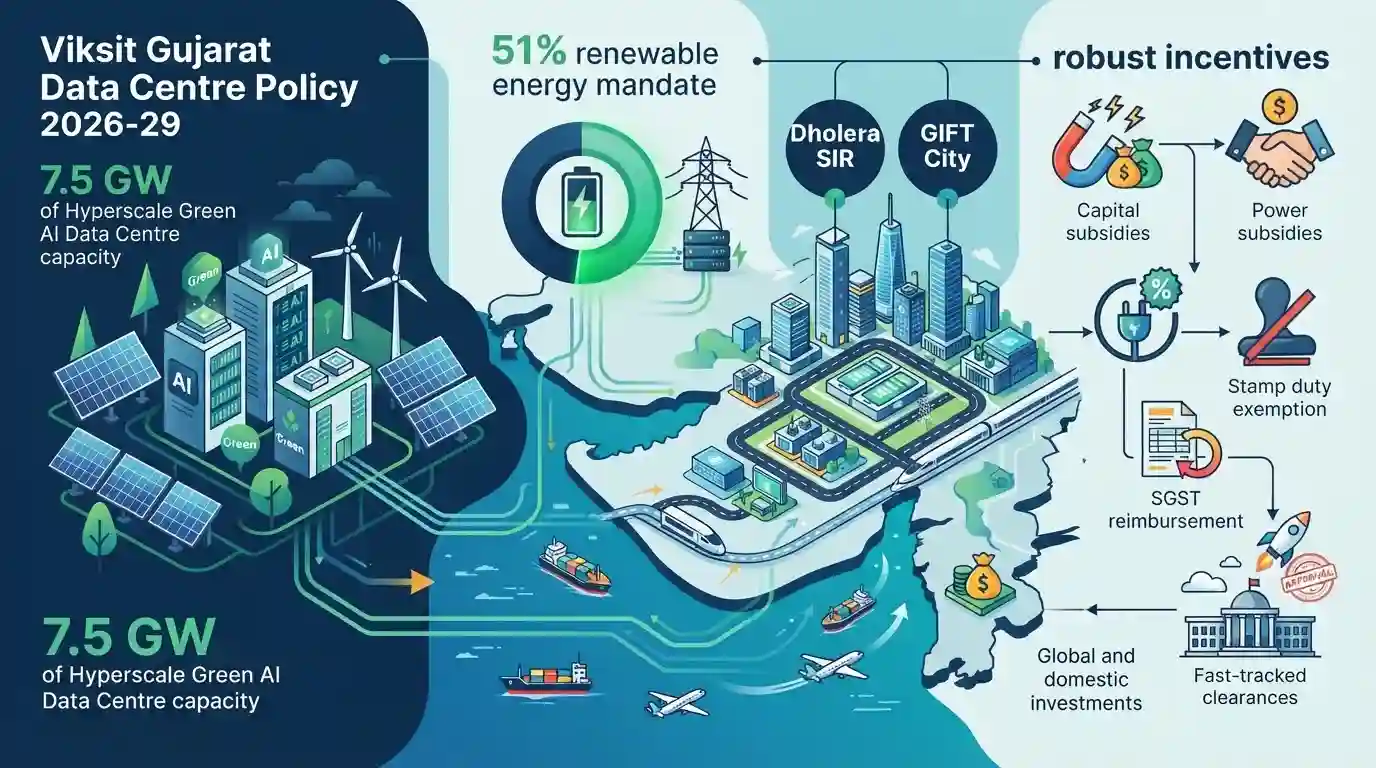
Gujarat has officially notified the 'Viksit Gujarat Data Centre Policy 2026-29', aiming to develop 7.5 GW of Hyperscale Green AI Data Centre capacity by 2029. To promote sustainable digital infrastructure, the policy mandates that at least 51% of the operational electricity used by these data centres must be sourced from renewable energy. Key zones like Dholera Special Investment Region (SIR) and GIFT City are targeted for this development. The state government is offering robust incentives including capital and power subsidies, stamp duty exemptions, SGST reimbursements, and fast-tracked regulatory clearances to attract global and domestic investments.
Key Points
- The Gujarat government has notified the 'Viksit Gujarat Data Centre Policy 2026-29' to build 7.5 GW of Hyperscale Green AI Data Centre capacity by 2029.
- Dholera Special Investment Region (SIR) and GIFT City are positioned to become key global hubs for hyperscale data centres.
- To ensure environmental sustainability, the policy mandates that data centres source at least 51% of their operational electricity from renewable and green energy.
- The policy provides comprehensive incentives including capital subsidies, power tariff subsidies, stamp duty exemptions, and SGST reimbursements, along with expedited regulatory clearances.
Important Terms
Viksit Gujarat Data Centre Policy 2026-29

A Gujarat state policy aiming to build 7.5 GW of Hyperscale Green AI Data Centre capacity by 2029, mandating 51% green energy use and offering massive fiscal incentives to attract tech investments.
UPSC context
GS-3 (Infrastructure, IT). Highlights state-level policy push for digital infrastructure and renewable energy mandates in India's tech growth.
Hyperscale Green AI Data Centre
Massive, highly scalable computing facilities designed for intensive artificial intelligence workloads, powered primarily by renewable or green energy sources to minimize their carbon footprint.
UPSC context
GS-3 (IT, Environment). Integrates the booming digital economy and AI computing with India's climate change and net-zero commitments.
Dholera Special Investment Region (SIR)
A greenfield smart industrial city in Gujarat under the Delhi-Mumbai Industrial Corridor. It is being developed as a major hub for high-tech manufacturing, semiconductor fabs, and large-scale data centers.
UPSC context
GS-3 (Infrastructure). An important example of smart urbanization, special economic zones, and targeted industrial corridors boosting domestic manufacturing.
GIFT City (Gujarat International Finance Tec-City)
India’s first operational smart city and International Financial Services Centre (IFSC) located in Gujarat. It functions as a multi-service Special Economic Zone to attract global financial, offshore, and tech services.
UPSC context
GS-3 (Economy). Highly relevant for understanding offshore financial hubs, International Financial Services Centres, and foreign investment promotion.
Prelims Trap
"All new hyperscale data centres in India are legally mandated by the Centre to source 100% of their electricity from renewable energy."
While state policies may mandate high RE usage (like Gujarat's 51%), there is no national mandate requiring 100% green energy for all data centres across India.
Static Concepts Connected
What defines a "Hyperscale" Data Centre and why is it distinct?
- Massive scale: Facilities housing thousands of servers (usually >5,000) specifically designed for massive, scalable workloads like advanced AI training and cloud computing.
- Power intensity: Their extreme power density for computation and cooling requires specialized infrastructure and makes green energy integration vital for environmental sustainability.
What distinguishes a Special Investment Region (SIR) like Dholera?
- Statutory backing: SIRs are typically governed by state-level legislation (e.g., Gujarat SIR Act) creating autonomous regional development authorities for streamlined administration.
- DMIC integration: Dholera is a major greenfield smart industrial city developed as a key node under the Delhi-Mumbai Industrial Corridor (DMIC).
Cross-Topic Patterns
Infrastructure status & fiscal incentives
Data centres have 'Infrastructure' status in India. State-level policies offering SGST and stamp duty exemptions complement this national status, easing credit access and driving the AI-infrastructure boom.
The energy footprint of AI
The exponential computational power required for AI directly strains power grids. Mandatory renewable integration (like Gujarat's 51% rule) bridges GS-3 IT with GS-3 Climate Mitigation.

The intersection of hyperscale AI infrastructure and power grid capacity (Green AI) is a prime candidate for a GS-3 Mains question.
Linked PYQs · 2
Linked PYQs · 2
- 2025GPSC_PRELIMSGS1
Reliance industries has announced plans to build the world's largest data centre in ______
- 2025GPSC_PRELIMSGS1
According to the Socio-Economic Review, 2024-2025 of Gujarat, Gujarat comes in ______ category in Logistic Ease Across Different States (LEADS), 2024.
