Gujarat State Environmental Impact Assessment and Project Clearances
Source:indianmasterminds ↗
Why It Matters
The constitution of SEAC and its role in environmental clearances are crucial for balancing rapid industrial and infrastructure development with environmental sustainability. Questions on the EIA framework, statutory bodies, and environmental regulation processes frequently appear in civil services exams.
Summary
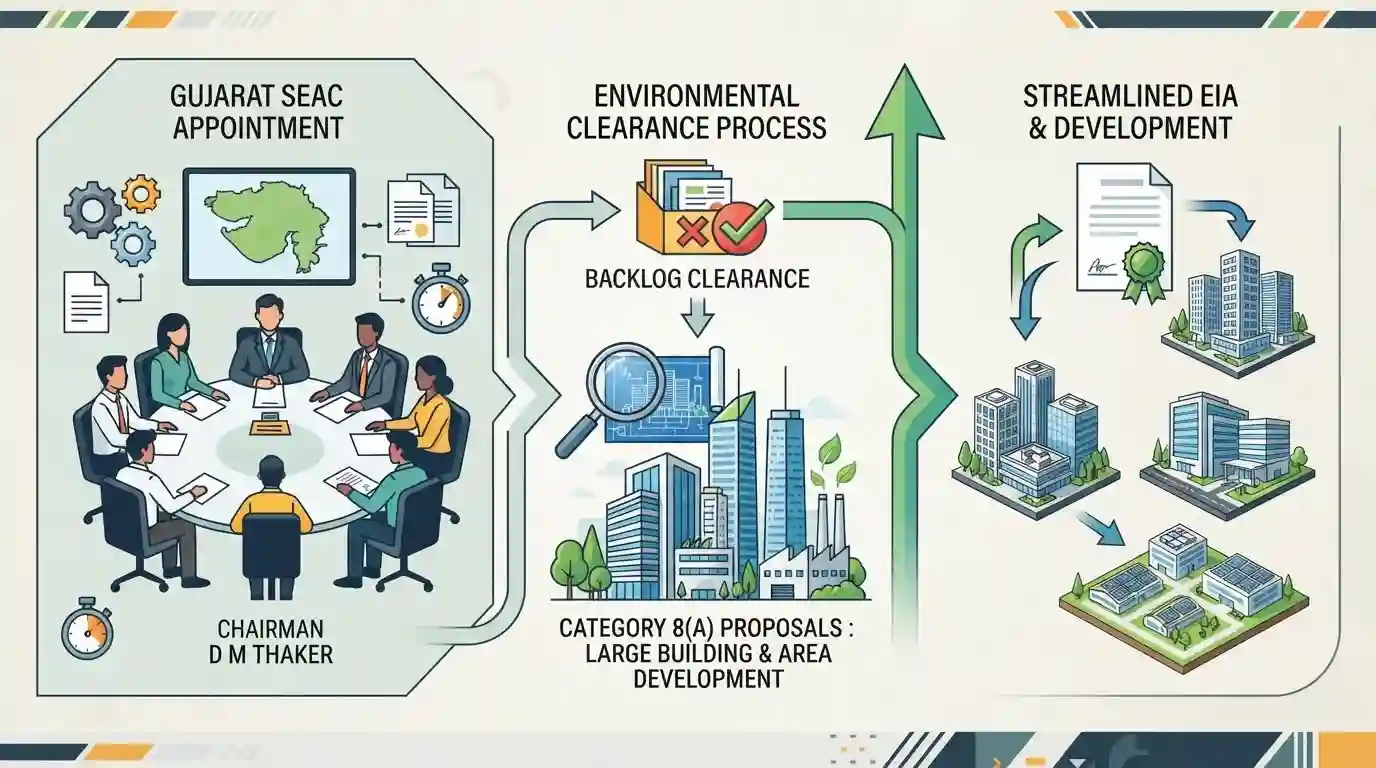
Gujarat has appointed a new 6-member State Level Expert Appraisal Committee (SEAC), chaired by former GPCB member secretary D M Thaker, to resolve the backlog of environmental clearances for infrastructure and industrial projects. The SEAC evaluates crucial Category 8(a) proposals, such as large building and area development projects, streamlining the Environmental Impact Assessment process at the state level.
Key Points
- Gujarat has constituted a new 6-member State Level Expert Appraisal Committee (SEAC) to clear environmental clearances for infrastructure and industrial projects.
- The new committee will evaluate proposals like building and construction projects with a built-up area exceeding 20,000 sq m and area development projects spanning 50 hectares or more.
- D M Thaker, former Member Secretary of the Gujarat Pollution Control Board, chairs the new panel, which has a 4-year term.
- The formation follows a logjam in clearances after the previous committee's tenure ended on June 12.
Important Terms
State Level Expert Appraisal Committee (SEAC)

A technical advisory body under the EIA Notification, 2006, that evaluates Category 'B' project proposals and recommends environmental clearance decisions to the state authority.
UPSC context
GS Paper III: Environmental Impact Assessment. Tests understanding of decentralized regulatory institutions and project appraisal frameworks in India.
Gujarat Pollution Control Board (GPCB)
A statutory body established under the Water Act, 1974, responsible for enforcing pollution control laws and monitoring environmental compliance of industries in Gujarat.
UPSC context
GS Paper III: Environmental Pollution. Tests knowledge of state-level statutory bodies and environmental regulatory enforcement.
Environmental Impact Assessment (EIA)
A systematic process of identifying, predicting, and mitigating the environmental and socio-economic consequences of proposed developmental projects prior to decision-making and project approval.
UPSC context
GS Paper III: Sustainable Development. Tests tools and frameworks used to balance industrial development with ecological protection.
State Level Environment Impact Assessment Authority (SEIAA)
A state-level regulatory authority empowered under the EIA Notification, 2006, to grant or reject environmental clearances for Category 'B' developmental projects.
UPSC context
GS Paper III: Environmental Governance. Tests decentralized project clearance structures and administrative roles in environmental preservation.
Environmental Clearance (EC)
A mandatory administrative and regulatory approval required in India prior to starting major industrial or infrastructure projects, certifying adherence to stipulated ecological safeguards.
UPSC context
GS Paper III: Environmental Impact Assessment. Tests regulatory compliance, project approval processes, and sustainable developmental paradigms.
Prelims Trap
Category B projects are always appraised by the State Level Environment Impact Assessment Authority (SEIAA) regardless of geographic location.
Under the EIA Notification 2006 'General Condition', Category B projects shift to Category A (Central appraisal) if within 10km of Protected Areas, Eco-Sensitive Zones, or borders.
Static Concepts Connected
What is the 4-stage EIA process under the 2006 Notification?
- Screening phase: Determines whether a Category B project requires a full EIA (B1) or is exempt (B2). Category A bypasses screening.
- Scoping phase: Establishes the detailed Terms of Reference (ToR) for compiling the draft environmental impact report.
- Public Consultation: Gathers feedback from local stakeholders, though certain projects like building construction (8a) are exempt.
- Appraisal phase: Detailed scrutiny of the final report by SEAC/EAC before making a recommendation to the clearance authority.
Who constitutes the SEIAA and SEAC under Indian law?
- Central authority: The Union Ministry of Environment, Forest and Climate Change (MoEFCC) formally constitutes both bodies.
- State consultation: Members are nominated by the respective state government, but notified officially by the Center.
- Statutory basis: These bodies derive their authority from the Environment (Protection) Act, 1986, via the 2006 Notification.
Cross-Topic Patterns
Environmental Federalism under EPA 1986
State-level clearances (SEAC) are centrally notified, showcasing the administrative hierarchy where state environmental decisions remain bound by central executive frameworks.
Regulatory Bottlenecks and Economic Growth
Delays in reconstituting appraisal committees stall infrastructure development, illustrating the tension between ease of doing business and mandatory ecological compliance.

Expect multi-statement questions testing the spatial triggers (10-km rule) that elevate Category B state projects to Category A.
Linked PYQs · 2
Linked PYQs · 2
- 2024GPSC_PRELIMSGS1
The National Environmental Policy Act required, all federal agencies to conduct prior before taking any major action.
- 2025GPSC_PRELIMSGS1
Which of the following statements correctly describe/(s) the powers and responsibilities of statutory and quasi-judicial bodies in India? 1. The Election Commission of India (ECI) is a quasi-judicial body that has the power to adjudicate the disputes related to political parties under the Tenth Schedule. 2. The National Green Tribunal (NGT) is a statutory body that exclusively handles environmental disputes under the NGT Act, 2010. 3. The Central Vigilance Commission (CVC) is a constitutional body responsible for investigating corruption cases in the country. 4. The Securities and Exchange Board of India (SEBI) regulates financial markets but does not have quasi-judicial powers. Select the correct answer using the codes given below:
