Gujarat launches plastic waste management near Nalsarovar
Source:indian-masterminds ↗
Why It Matters
Provides a replicable model for community-driven conservation and solid waste management (specifically single-use plastics) in ecologically sensitive areas like Ramsar Sites, combining environmental goals with rural livelihood generation.
Summary
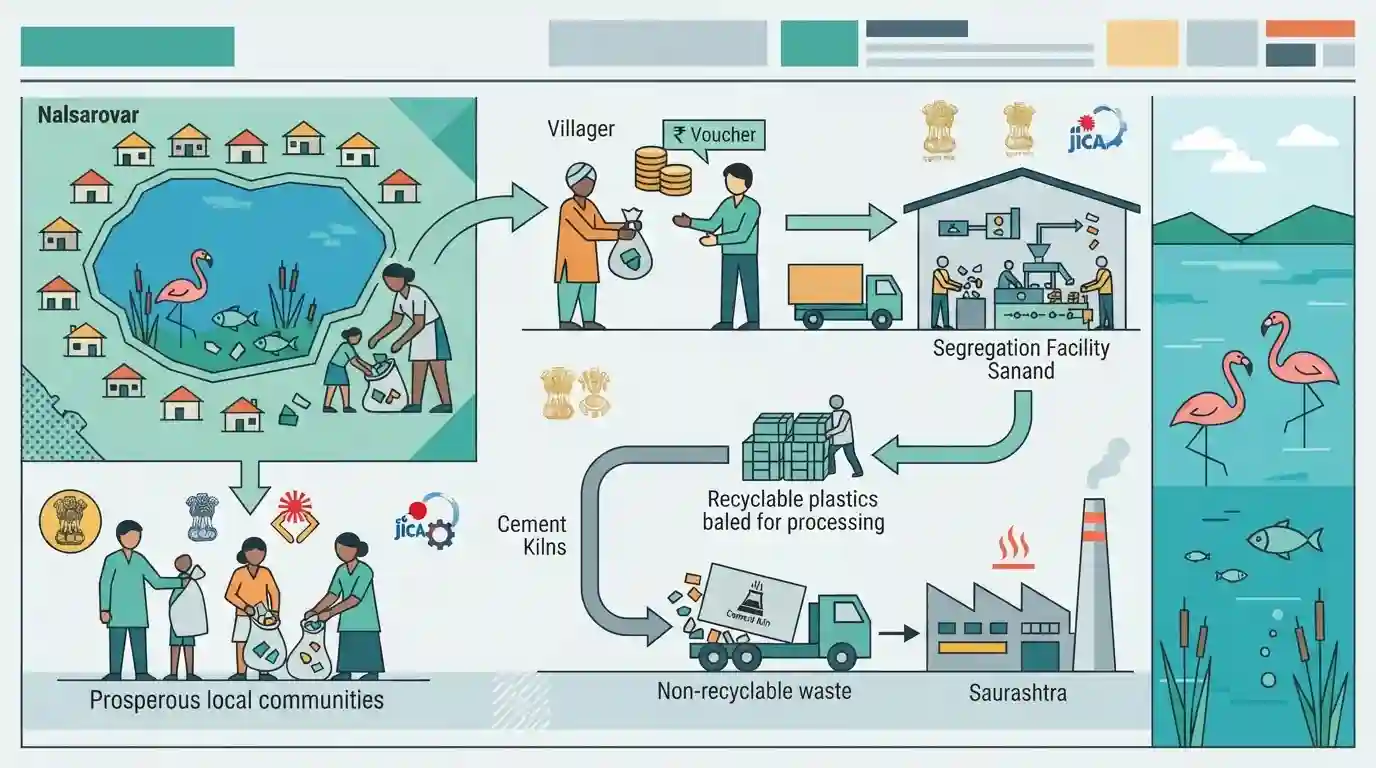
The Gujarat Forest Department, with support from the Japan International Cooperation Agency (JICA) under the Project for Eco-Restoration in Gujarat, has initiated a novel plastic waste management program around the Nalsarovar Ramsar Site. Involving 14 surrounding villages, the program pays locals for collecting low-value, single-use plastics that are normally discarded, providing an economic incentive for environmental conservation. The collected waste is segregated at a facility in Sanand, and the non-recyclable portion is sent to cement factories in Saurashtra for safe disposal. This effort tackles the growing threat of plastic pollution in sensitive wetland ecosystems while generating livelihood opportunities for the local communities.
Key Points
- The Gujarat Forest Department launched a waste management initiative around the Nalsarovar Ramsar Site covering 14 local villages.
- The project specifically incentivizes the collection of low-value and single-use plastics that are typically ignored by ragpickers due to low resale value.
- Locals receive monetary rewards directly via Direct Benefit Transfer (DBT) or bank transfers for the plastic waste they collect.
- The initiative is supported by the Project for Eco-Restoration in Gujarat, funded by the Japan International Cooperation Agency (JICA).
- Collected plastic is sorted at a Materials Recovery Facility (MRF) in Sanand and non-recyclable plastic is transported to cement factories in Saurashtra for eco-friendly co-processing.
Important Terms
Project for Eco-Restoration in Gujarat

A state-run environmental initiative supported by the Japan International Cooperation Agency (JICA). It funds conservation efforts, such as incentivizing local villagers to collect and manage plastic waste around the Nalsarovar wetland.
UPSC context
Relevant for GS-3 (Conservation) and GS-2 (Bilateral Funding), illustrating community-led conservation models and international environmental cooperation.
Gujarat Forest Department
The state nodal agency responsible for managing Gujarat's wildlife, forests, and wetlands. It implements conservation projects, enforces anti-pollution measures, and collaborates with local communities and international bodies for eco-restoration.
UPSC context
Relevant for GS-3 (Environment) and GS-2 (Governance), demonstrating the role of state agencies in executing decentralized conservation and waste management.
Japan International Cooperation Agency (JICA)
An agency executing Japan's Official Development Assistance (ODA). It provides bilateral aid, technical cooperation, and loans to developing countries for infrastructure, healthcare, and ecological projects like Gujarat's Eco-Restoration initiative.
UPSC context
Important for GS-2 (Bilateral Agreements) evaluating foreign aid, developmental partnerships, and Japan's role in India's socio-economic projects.
Nalsarovar Ramsar Site
Gujarat's largest natural wetland and a relict sea, designated a Ramsar site in 2012. It serves as a vital stopover on the Central Asian Flyway for migratory birds and supports endangered species.
UPSC context
Crucial for GS-3 (Environment) and Prelims mapping questions on Indian wetlands, Ramsar sites, and migratory bird habitats.
Eco-Development Committees (EDCs)
Village-level institutions that involve local communities in protected area management. In the Nalsarovar project, EDCs appoint 'Swachhta Praharis' to encourage residents to segregate and properly dispose of plastic waste.
UPSC context
Fits GS-3 (Environment) and GS-2 (Governance), highlighting decentralized environmental governance and community participation in biodiversity conservation.
Ramsar Convention
An international treaty adopted in 1971 in Iran for the conservation and sustainable use of wetlands. Sites designated under it hold global ecological importance for biodiversity, water management, and avian habitats.
UPSC context
Essential for GS-3 (Environment) and Prelims; tests knowledge on global environmental treaties and India's protected wetland network.
Prelims Trap
Co-processing of plastic waste in cement factories is banned under India's environmental laws due to toxic emissions.
Under India's Solid Waste Management framework, non-recyclable, high-calorific waste is explicitly mandated to be diverted for co-processing in cement kilns.
Static Concepts Connected
How is co-processing of plastic waste in cement kilns beneficial?
- Energy Recovery: High-calorific, non-recyclable plastic waste acts as an alternative fuel, substituting fossil fuels like coal in cement manufacturing.
- Zero Residue: High temperatures in kilns completely destroy plastics without leaving ash, drastically reducing the burden on landfills.
- Emission Control: The alkaline environment inside cement kilns absorbs acidic gases, neutralizing toxic emissions that would otherwise occur during open burning or standard incineration.
What are the key ecological features of Nalsarovar?
- Ramsar Site: Designated in 2012, it is a large, natural shallow-water lake located in the Bhal region of Gujarat.
- Migratory Hub: It serves as a crucial wintering stopover on the Central Asian Flyway for migratory birds journeying from Europe and Siberia.
- Avian Diversity: The wetland hosts massive flocks of indigenous and migratory birds, including flamingos, pelicans, and waterfowl.
Cross-Topic Patterns
Wetland Conservation + Amrit Dharohar
Community-incentivized eco-restoration mirrors the Ministry of Environment's Amrit Dharohar scheme, which actively integrates local livelihoods and capacity building with Ramsar site preservation.
Soft Diplomacy via JICA ODA
JICA's role in India extends far beyond hard infrastructure (like the bullet train) to funding crucial state-level biodiversity, forestry, and eco-restoration projects via Official Development Assistance.

Community-led wetland management (Amrit Dharohar) + plastic co-processing in kilns likely to merge in a 2026 eco-restoration question.
Linked PYQs · 2
Linked PYQs · 2
- 2021GPSC_PRELIMSGS1
Statement: A large number of people in the city die every year due to polluted drinking water. Courses of action: 1. The government should make necessary arrangements to provide safe drinking water to the people of the city. 2. The government should educate people about the dangers of drinking contaminated water.
- 2026GPSC_PRELIMSGS1
Consider the following statements regarding Aravallis: 1. The region is home to important lakes and wetlands including Sambhar, Sultanpur, Pushkar, Fatehsagar and Jaisamand. 2. It is one of the main watersheds, separating the drainage of the Bay of Bengal, through rivers like Chambal and other tributaries of the Yamuna, from that of the Arabian Sea through the Mahi, Sabarmati, Luni and other rivers. 3. The mountain range is home to lead, zinc, copper, gold, tungsten and has reserves of critical minerals such as tin, graphite, molybdenum, niobium, nickel, lithium and rare earth elements (REEs). These are considered to be of strategic relevance for energy transition, high-technology manufacturing and national security. 4. Rocks in the Aravallis are highly fractured, weathered and porous, allowing rainwater to percolate deep into the ground instead of running off the surface. Any disruption to this recharge system, through mining, construction or deforestation poses a direct and serious threat to regional water availability. 5. The Aravalli hills and range are 'green lungs' of North-Western India and serve as the indispensable ecological and socio-economic backbone of the region, functioning as the primary geographical barrier separating the arid North-Western desert from the fertile Northern Indian plains. Which of the above statements are correct?
