Gujarat MSME credit disbursal surpasses target to reach record high
Source:big-news-network ↗
Why It Matters
Understanding credit flow trends, institutional coordination bodies like the SLBC, and digital infrastructure developments (like CAM and Udyam) is crucial for analyzing structural improvements in India's MSME ecosystem, financial inclusion, and overall economic performance.
Summary
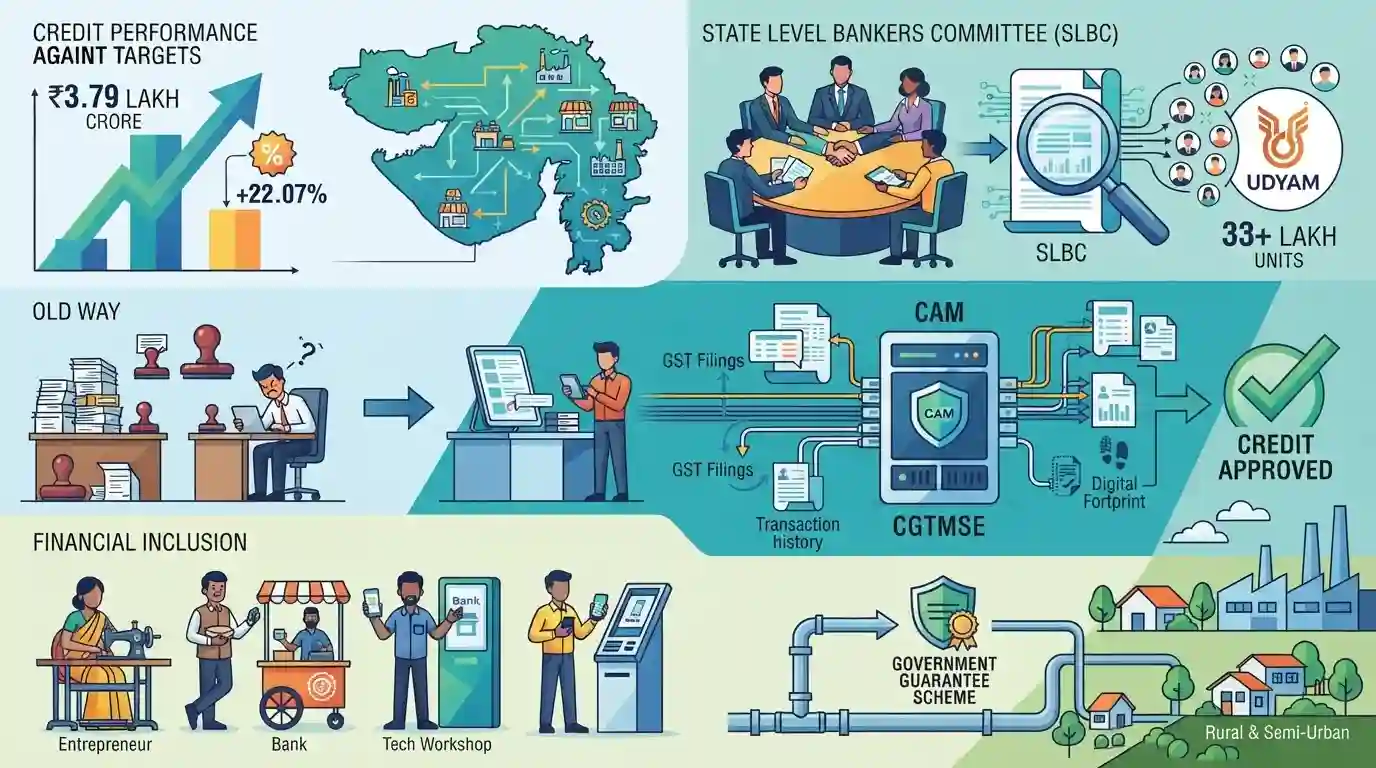
Gujarat's MSME credit disbursal surpassed its 2025-26 annual plan target by 22.07%, reaching ₹3.79 lakh crore. The State Level Bankers Committee (SLBC) metrics highlight robust credit access, bolstered by the Udyam portal registration of over 33 lakh units in the state. Furthermore, public sector banks' implementation of the digital 'Credit Assessment Model' (CAM) integrated with the CGTMSE has transformed MSME credit assessment from manual paperwork to real-time digital footprint evaluation.
Key Points
- Gujarat's MSME credit disbursal reached ₹3,79,535 crore in 2025-26 against a target of ₹3,10,917 crore, achieving 122.07% of its target (exceeding it by ₹68,618 crore).
- This performance was highlighted during the 190th meeting of the State Level Bankers Committee (SLBC) in Gandhinagar, presided over by Chief Minister Bhupendra Patel.
- National Small Industry Day is celebrated across India on August 30 annually to recognise and promote the importance of small businesses.
- Gujarat has over 33 lakh MSME units registered on the central government's Udyam portal, reflecting strong grassroots entrepreneurship.
- Public sector banks introduced the 'Credit Assessment Model' (CAM) in 2025, which automates credit decisions using digital footprints (GST filings, tax returns, e-verified bank statements, KYC) instead of traditional paperwork, significantly speeding up credit access.
- The CAM system integrates with central schemes like CGTMSE to allow small businesses to secure loans digitally and without the need for physical collateral.
Important Terms
Udyam portal

A paperless, self-declaration-based online registration platform launched in July 2020 by the MSME Ministry to simplify and automate micro, small, and medium enterprise recognition.
UPSC context
GPSC Class 1/2 Mains GS-III: Industrial growth, MSME categorization, and digital governance initiatives in Gujarat.
Credit Assessment Model (CAM)
A data-driven digital framework launched in 2025 by public sector banks to automate MSME credit appraisal using digital footprints like PAN, GST, and transaction behavior.
UPSC context
GPSC Mains GS-III: Banking reforms, financial inclusion, and technology-driven ease of doing business in India.
State Level Bankers Committee (SLBC)
An inter-institutional apex state-level forum under the RBI's Lead Bank Scheme coordinating financial institutions and state governments to ensure effective priority-sector lending and developmental banking.
UPSC context
GPSC Mains GS-III: Indian Banking structure, institutional credit flow, Lead Bank Scheme, and Gujarat's socio-economic development.
Credit Guarantee Fund Trust for Micro and Small Enterprises (CGTMSE)
A trust established in 2000 by the MSME Ministry and SIDBI to provide collateral-free credit guarantee cover (up to 85%) to lenders financing small businesses.
UPSC context
GPSC GS-III: Capital availability for MSMEs, government-backed credit guarantees, and formalization of informal businesses.
Pradhan Mantri Mudra Yojana (PMMY)
A flagship scheme launched in 2015 offering collateral-free loans up to Rs. 20 lakh (categories: Shishu, Kishore, Tarun, Tarun Plus) to micro-enterprises in non-farm sectors.
UPSC context
GPSC Mains GS-III: Central financial schemes for vulnerable groups, entrepreneurship, and rural employment development in India.
Stand Up India Scheme
A central scheme launched in 2016 to facilitate bank loans between Rs. 10 lakh and Rs. 1 crore for greenfield projects to women and SC/ST entrepreneurs.
UPSC context
GPSC Mains GS-III: Social sector initiatives, women empowerment, economic inclusion of marginalized groups, and greenfield industrialization.
Prelims Trap
MSME classification turnover limits include both domestic and export turnover when determining eligibility under the revised 2025 criteria.
Export turnover is completely excluded from the turnover calculation to protect export-focused MSMEs from losing their classification benefits. Additionally, older 2020 limits are often still tested or confused with the new 2025 limits.
Static Concepts Connected
What is the State Level Bankers' Committee (SLBC) and its role?
- Origin & Mandate: Established under RBI's Lead Bank Scheme (1969) to coordinate commercial banks, cooperative banks, and state government machinery.
- Structure & Frequency: An inter-institutional forum meeting quarterly to monitor state credit plans, priority sector lending, and financial inclusion.
- Leadership: Usually chaired by the Chief Minister or Chief Secretary; a designated public sector bank acts as the Convenor (e.g., Bank of Baroda in Gujarat).
How does the CGTMSE facilitate collateral-free MSME credit?
- Joint Venture: Set up jointly by the Ministry of MSME and SIDBI to catalyze flow of institutional credit to micro and small enterprises.
- Guarantee Mechanism: Provides credit guarantee covers to lenders (up to 75-85%) in case of default, replacing the need for third-party guarantees or collateral.
- Eligibility Limit: Only micro and small enterprises are eligible; medium enterprises are excluded from this specific trust guarantee.
Cross-Topic Patterns
Digital footprints + informal economy formalisation
Integration of GST, Income Tax, and Udyam portals with CAM replaces physical collateral, accelerating the structural shift of informal micro-enterprises into the formal banking system.
Cooperative federalism + priority sector lending
State-level credit targets via SLBC executing central schemes (CGTMSE) show how financial federalism relies on state-administered banking machinery to achieve credit depth.

Revised 2025 MSME thresholds and digital credit assessment models (CAM) likely to be tested via statement-based questions on MSME reforms.
Linked PYQs · 3
Linked PYQs · 3
- 2018GPSC_PRELIMSGS1
Which of the following statement(s) is(are) correct? 1. Erstwhile Ministry of Small Scale Industries and the Ministry of Agro and Rural Industries were merged to form the Ministry of Micro, Small and Medium Enterprises. 2. In Service Sector, Micro Enterprise Category investment should not exceed INR 25 lakhs in Equipments. 3. In Manufacturing Sector, Medium Enterprise Category investment should be more than INR 5 crores but should not exceed INR 10 crores in plant and machinery.
- 2022GPSC_PRELIMSGS1
Which one of the following schemes is aimed at increasing the confidence of young, educated or skilled workers who would now be able to aspire to become first generation entrepreneurs?
- 2022GPSC_PRELIMSGS1
Which of the following schemes facilitates bank loans to at least one Scheduled Caste/ Scheduled Tribe borrower and at least one woman borrower per bank branch for setting up greenfield enterprises?
