Gujarat health ministry manages seasonal H1N1 influenza surge
Source:ndtv ↗
Why It Matters
Public health management, particularly concerning seasonal outbreaks of infectious and vector-borne diseases, is a critical governance topic. Questions on viral strains (like H1N1), roles of apex bodies like ICMR, and government preparedness during monsoons frequently appear in Science & Tech and Governance sections of the exam.
Summary
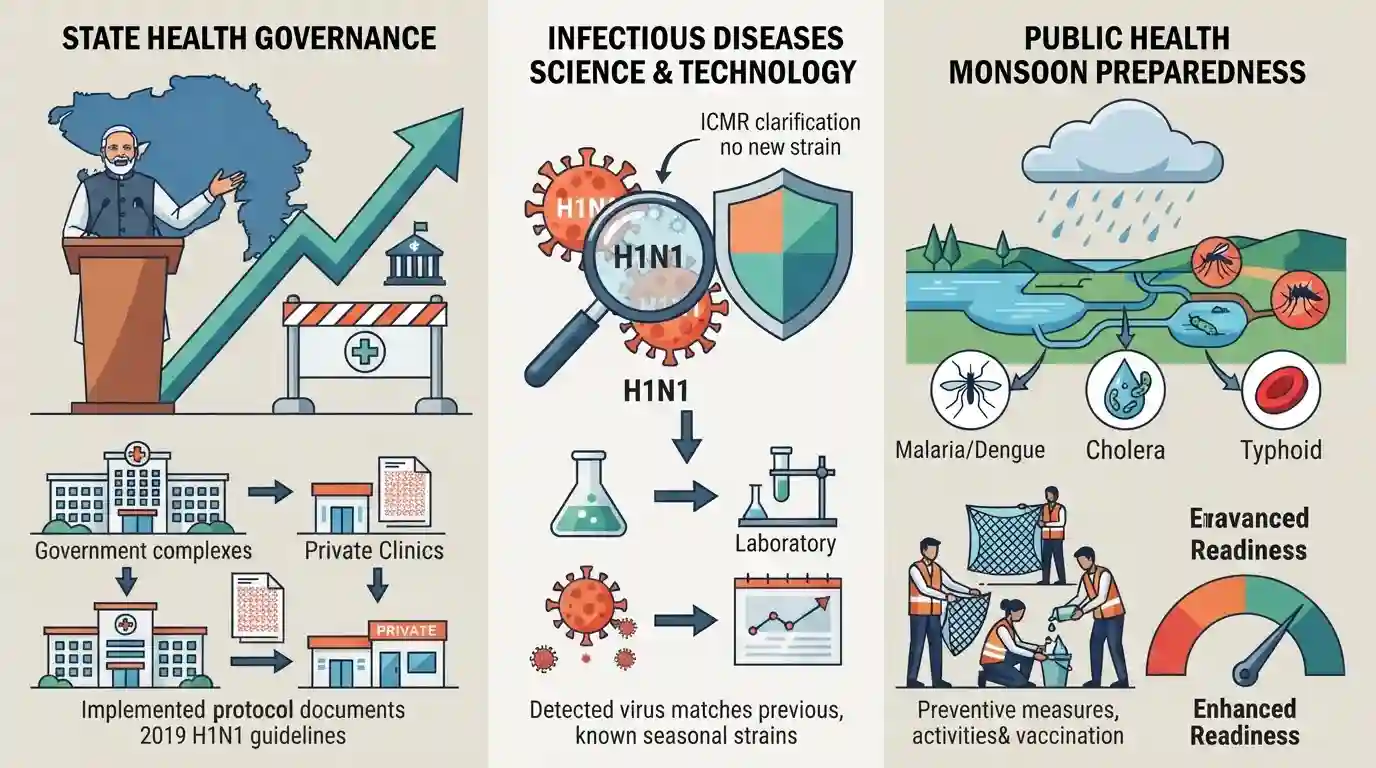
Gujarat Health Minister Rushikesh Patel has assured the public that the H1N1 (swine flu) situation in the state remains under control despite an uptick in cases during the monsoon. He directed all government and private hospitals to strictly implement the 2019 H1N1 guidelines. Furthermore, citing the Indian Council of Medical Research (ICMR), he clarified that the infections are caused by standard seasonal strains, and no new viral strain has been detected in India. Health authorities are also actively monitoring and enhancing preparedness for other monsoon-related ailments, including water-borne and vector-borne diseases like malaria, dengue, cholera, and typhoid.
Key Points
- Gujarat's Health Minister confirmed that the recent spike in H1N1 (Swine Flu) cases is under control.
- Hospitals have been instructed to stringently follow the 2019 H1N1 management guidelines.
- The Indian Council of Medical Research (ICMR) stated that no new strain of H1N1 is present; the currently circulating virus is a typical seasonal strain.
- The state is also ramping up preparedness and monitoring for monsoon-induced water-borne and vector-borne diseases like cholera, typhoid, malaria, and chikungunya.
Important Terms
2019 H1N1 Guidelines

Health protocols mandated by the Indian government specifying standard operating procedures for the triage, patient sampling, laboratory testing, and clinical treatment of seasonal H1N1 influenza cases.
UPSC context
Relevant to Public Health and Governance; evaluates understanding of institutional health protocols, epidemic response, and hospital preparedness frameworks.
Indian Council of Medical Research (ICMR)
India's apex body for the formulation, coordination, and promotion of biomedical research. It monitors circulating viral strains, confirms seasonal disease trends, and issues vital public health data and advisories.
UPSC context
Highly relevant for Science & Technology and Health Policy; tests knowledge of national institutional bodies in public health and research.
Gujarat Health Department
The state authority responsible for implementing public health initiatives, executing monsoon action plans, operating 24x7 control rooms, and ensuring medical preparedness across Gujarat's districts and municipal corporations.
UPSC context
Essential for State Administration and Public Administration; tests candidates' knowledge of local health governance and emergency response structures.
H1N1 Influenza (Swine Flu)
An acute respiratory infection caused by the H1N1 subtype of the influenza A virus. Originally a 2009 pandemic strain, it now broadly circulates as a standard seasonal flu.
UPSC context
Crucial for Science & Technology (General Science); tests candidates on viral diseases, pathogen classification, and seasonal health challenges.
Prelims Trap
"The recent surge in H1N1 cases in Gujarat is driven by a newly mutated viral strain."
ICMR has explicitly stated no new strain is present; it is a standard seasonal strain. Aspirants often mistakenly assume any reported spike implies a novel mutation.
Static Concepts Connected
How are common monsoon-related diseases classified biologically?
- Viral infections: Dengue and Chikungunya (spread by Aedes mosquito), and Swine Flu/H1N1 (Influenza A virus).
- Bacterial infections: Cholera (Vibrio cholerae) and Typhoid (Salmonella typhi), which are primarily water-borne.
- Parasitic infections: Malaria, caused by the Plasmodium parasite and transmitted by the female Anopheles mosquito.
What distinguishes an endemic disease from an epidemic or pandemic?
- Endemic: A disease consistently present within a specific region or population, such as the seasonal H1N1 flu today.
- Epidemic: A sudden, unexpected increase in disease cases localized to a specific geographical area.
- Pandemic: An epidemic that has spread across multiple countries or continents, affecting a large number of people.
Cross-Topic Patterns
Climate Change & Disease Vectors
Changing monsoon patterns and prolonged humidity directly expand the breeding windows for Aedes and Anopheles mosquitoes, linking climate change geography to public health crises.
Evolution of Pandemic to Endemic
The 2009 H1N1 pandemic influenza has transitioned into a standard seasonal endemic strain, illustrating the natural epidemiological lifecycle of global viral outbreaks.

Expect a match-the-following question pairing monsoon diseases (Malaria, Dengue, Typhoid) with their pathogens (Parasite, Virus, Bacteria).
