Gujarat Panchayati Raj Financial Audit and Local Body Accountability
Source:ddindia ↗
Why It Matters
The initiative highlights innovative state-level mechanisms to enforce financial discipline and accountability in grassroots democratic institutions (PRIs). It is highly relevant for GS-2 (Governance and Devolution of Powers) as it addresses the chronic issue of unresolved audit objections and weak financial oversight in local bodies.
Summary
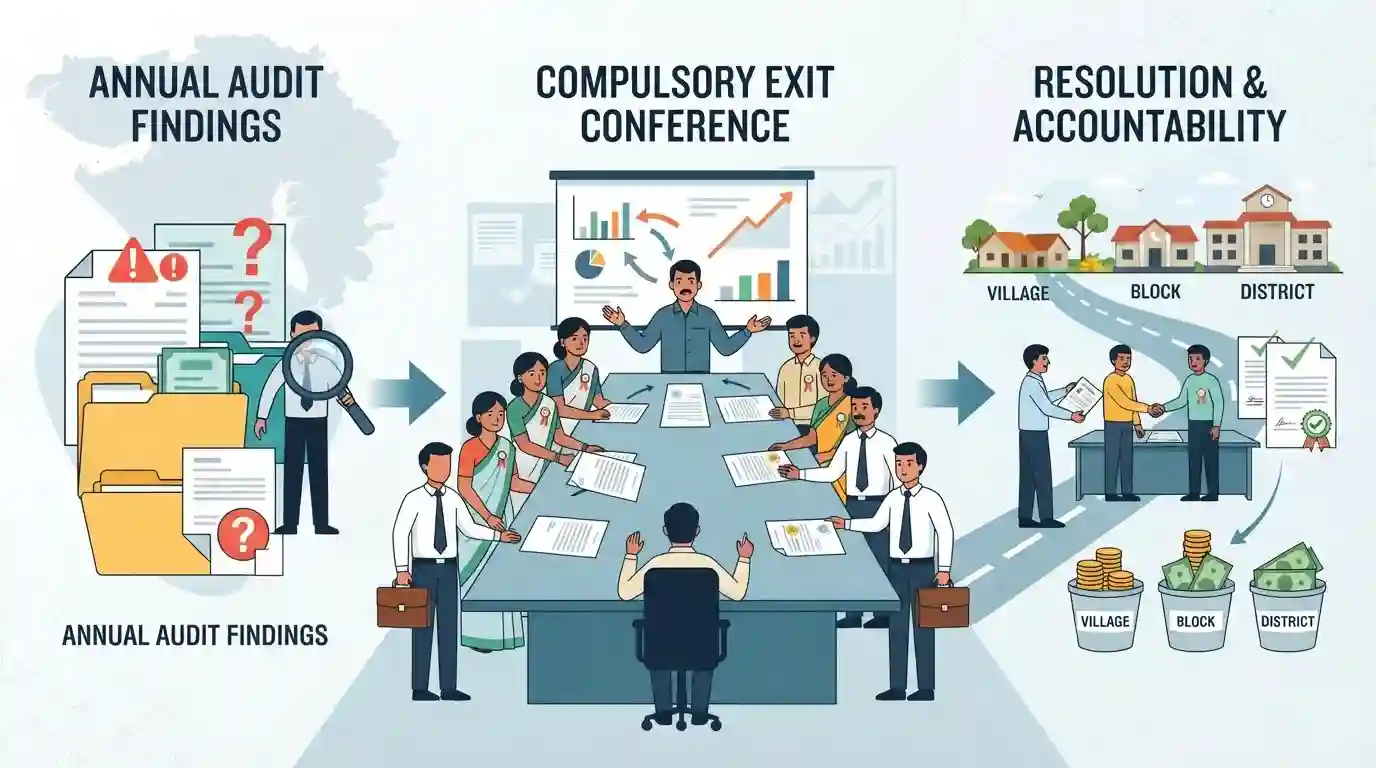
In a significant move to enhance transparency and financial accountability in local self-government, the Gujarat state government has mandated compulsory post-audit 'Exit Conferences' for all Panchayati Raj Institutions. Designed to expedite action on irregularities detected during annual reviews by the Local Fund Audit Department, these conferences will be convened by the respective District Development Officers (DDOs). The policy targets systemic delays in addressing audit objections, bringing elected representatives and auditing officials together to swiftly resolve administrative and financial anomalies at the village, block, and district levels.
Key Points
- The Gujarat government has made post-audit 'Exit Conferences' mandatory for all three tiers of Panchayati Raj Institutions (Gram, Taluka, and District Panchayats).
- The mandate aims to ensure rapid resolution of financial and administrative irregularities identified during the annual audits of these local bodies.
- District Development Officers (DDOs) are tasked with convening these conferences immediately after the Local Fund Audit Department concludes its yearly review.
- Elected representatives and concerned officers will review the audit reports alongside an examiner from the Local Fund Audit department to expedite pending compliance issues.
Important Terms
Panchayati Raj Institutions

Constitutional rural local self-government bodies in India established under the 73rd Constitutional Amendment Act, 1992, managing local administration at village, block, and district levels.
UPSC context
GS Paper II (Polity & Governance). Tests understanding of decentralized governance and local democracy.
Local Fund Audit Department
A statutory state government audit wing responsible for evaluating the financial accounts, expenditures, and fiscal compliance of local self-governments like Panchayats and municipalities.
UPSC context
GS Paper II (Accountability & Transparency). Evaluates knowledge of grassroots financial oversight and audit mechanisms.
District Development Officer
A senior administrative officer serving as the chief executive head of the District Panchayat, overseeing development programs and administrative execution at the district level.
UPSC context
GS Paper II (Executive Structure & Local Bodies). Assesses understanding of administrative machinery in decentralized setups.
Panchayat, Rural Housing and Rural Development Department
A state-level executive department tasked with formulating policies, administering welfare schemes, and supervising the functioning, infrastructure development, and funding of rural local governance.
UPSC context
GS Paper II (Welfare Schemes & Governance). Focuses on executive machinery for rural upliftment and decentralization.
Exit Conference
A formal, mandatory post-audit meeting between auditors and administrators to directly address major financial discrepancies and agree upon immediate corrective and legal actions before finalizing report outcomes.
UPSC context
GS Paper II (Accountability & Good Governance). Explores administrative reforms ensuring transparency and swift anti-corruption enforcement.
Prelims Trap
The CAG is constitutionally mandated as the primary statutory auditor for all Panchayati Raj Institutions in India.
Under Article 243-J, the state legislature, not the Parliament or the CAG, holds the power to make provisions for auditing Panchayat accounts. CAG only plays a supervisory/guidance role (TGS).
Static Concepts Connected
How is the auditing of Panchayati Raj Institutions (PRIs) structured under the Constitution?
- Constitutional Provision: Article 243-J empowers the State Legislature to make laws regarding the maintenance and auditing of Panchayat accounts.
- State-Level Auditing: Primary statutory audits are conducted by state-level agencies like the Directorate of Local Fund Audit, not directly by the CAG.
- CAG's TGS Role: The CAG provides Technical Guidance and Supervision (TGS) to state audit departments and conducts sample test audits.
What did the Second ARC recommend for strengthening local body audits?
- DLFA Independence: Recommended making the Director of Local Fund Audit (DLFA) independent of regular state executive departments to ensure objective oversight.
- Audit Committees: Proposed setting up District-level Audit Committees to clear audit objections and hold administrative officers accountable.
Cross-Topic Patterns
Local Audit Standards & Fiscal Devolution
Delayed PRI audits regularly bottleneck the release of Central Finance Commission grants, linking local administrative efficiency directly to the macro-fiscal health of state local bodies.
Digital Public Infrastructure & Local Audits
Integrating digital accounting tools like e-GramSwaraj and AuditOnline with physical exit conferences closes the implementation gap in public auditing and rural service delivery.

Expect questions combining Article 243-J, the CAG's TGS role in local audits, and the impact of audit compliance on devolution of grants.
Linked PYQs · 3
Linked PYQs · 3
- 2024GPSC_PRELIMSGS1
Consider the following statements regarding 73rd Constitution Amendment Act of 1992. 1. The Act has given a practical shape to Article 40 of the Constitution. 2. The Act gives a constitutional status to the Panchayati raj institutions. 3. It has brought the Panchayati raj institutions under the purview of the justiciable part of the Constitution. Which of the above statements is/are correct?
- 2020GPSC_PRELIMSGS1
Which report of the Second Administrative Reforms Commission is related with recommendations on Panchayati Raj?
- 2020GPSC_PRELIMSGS1
The Comptroller and Auditor General of India conducts all kinds of Audit except
