Gujarat mandates post audit exit conferences for gram panchayats
Source:dd-india ↗
Why It Matters
Financial accountability and effective administrative oversight are persistent challenges in decentralized local governance. The introduction of 'Exit Conferences' by the Gujarat government serves as a practical model for ensuring transparency and timely error-correction in Panchayati Raj Institutions, making it highly relevant for Polity and Governance studies.
Summary
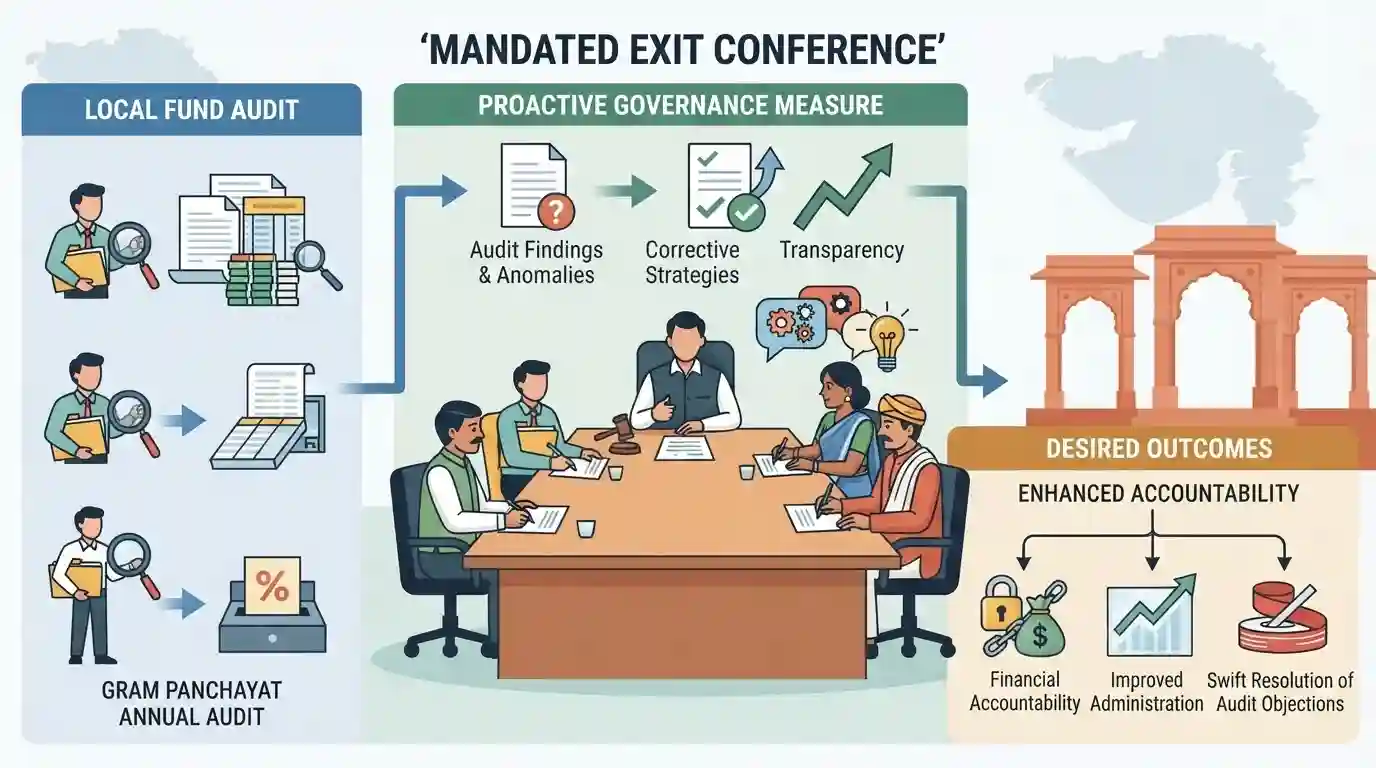
The Gujarat government has introduced a mandate for post-audit 'Exit Conferences' to promptly address irregularities found during the annual audits of Gram Panchayats. Conducted by the Local Fund Audit Department, these audits frequently uncover financial and administrative anomalies. Under the new directive, the District Development Officer (DDO) will organize and chair these conferences, bringing together auditors and local panchayat officials to discuss major findings and formulate corrective strategies. This proactive governance measure is designed to enhance transparency, ensure strict financial accountability, and improve the overall administration of Panchayati Raj Institutions by streamlining the resolution of audit objections.
Key Points
- The Gujarat government has mandated post-audit 'Exit Conferences' for Gram Panchayats to address financial and administrative irregularities identified during annual audits.
- These Exit Conferences are to be convened and chaired by the District Development Officer (DDO), serving as a platform for auditors and local officials to discuss major audit findings.
- The initiative aims to expedite corrective actions, address systemic administrative bottlenecks, and initiate swift action against misconduct at the grassroots level.
- This institutional mechanism bolsters financial discipline, transparency, and accountability within Panchayati Raj Institutions (PRIs), strengthening local self-government.
Important Terms
Panchayati Raj Institutions (PRIs)

A constitutional three-tier system of local self-government in rural India (Gram, Taluka, and District Panchayats), mandated under the 73rd Amendment Act, 1992, to enable grassroots democracy and decentralized development.
UPSC context
GS Paper II (Polity & Governance): Tests understanding of democratic decentralization, local self-governance, and fiscal devolution.
Local Fund Audit Department
A statutory state government agency responsible for auditing local self-government institutions (panchayats and municipalities) to ensure financial discipline, statutory compliance, and the proper utilization of public funds.
UPSC context
GS Paper II (Polity & Governance): Tests understanding of public financial accountability and institutional oversight of local bodies.
District Development Officer (DDO)
A senior administrative officer who serves as the executive head of the District Panchayat, managing developmental administration and coordinating central and state welfare scheme implementation.
UPSC context
GS Paper II (Polity & Governance): Tests knowledge of district administration, civil services' role, and rural development execution.
Audit Exit Conference
A formal meeting held between auditors and officials of an audited entity immediately post-audit to discuss findings, clarify objections, and agree on immediate corrective actions.
UPSC context
GS Paper II (Polity & Governance): Tests understanding of good governance, administrative transparency, and immediate audit resolution mechanisms.
Surcharge
A financial recovery order or legal penalty imposed on public officials or local representatives to reclaim public funds lost due to negligence, misconduct, or unauthorized expenditure.
UPSC context
GS Paper II & IV (Governance & Ethics): Tests knowledge of financial accountability and ethical governance in local bodies.
Prelims Trap
The Comptroller and Auditor General (CAG) is constitutionally mandated to directly conduct annual audits of all Gram Panchayats.
Under Article 243J, the State Legislature, not the CAG, is empowered to make laws for auditing Panchayats. State Local Fund Audit departments conduct them, with CAG providing only Technical Guidance (TGS).
Static Concepts Connected
How are Panchayat accounts constitutionally audited in India?
- Article 243J: Empowers state legislatures to enact laws for the maintenance and auditing of Panchayat accounts.
- State DLFA: The Directorate of Local Fund Audit, a state-level entity, conducts the primary statutory audits of local bodies.
- CAG Role: CAG does not audit directly but provides Technical Guidance and Supervision (TGS) to improve state audit quality.
What administrative role does a DDO play in PRIs?
- Executive Authority: Acts as the Chief Executive Officer of the Zilla Panchayat, overseeing administrative and developmental operations.
- Disciplinary Oversight: Empowered to review audit reports and initiate corrective or disciplinary actions against lower-tier Panchayat irregularities.
Cross-Topic Patterns
Decentralization vs Bureaucratic Oversight
Analyzes the tension between local self-governance autonomy under Part IX and state-led bureaucratic interventions through DDOs to curb financial irregularities.
Audit compliance and federal grants
Connects grassroots financial transparency with Finance Commission mandates, which increasingly condition local body grants on timely, audited account submissions.

2026 Prelims may test Article 243J audit provisions alongside CAG's TGS framework to examine federal financial accountability of local bodies.
Linked PYQs · 4
Linked PYQs · 4
- 2024GPSC_PRELIMSGS1
Consider the following statements regarding 73rd Constitution Amendment Act of 1992. 1. The Act has given a practical shape to Article 40 of the Constitution. 2. The Act gives a constitutional status to the Panchayati raj institutions. 3. It has brought the Panchayati raj institutions under the purview of the justiciable part of the Constitution. Which of the above statements is/are correct?
- 2025GPSC_PRELIMSGS1
Which of the following statements about Local Self-Government in India is correct? 1. The Panchayati Raj System is based on the recommendations of the Balwant Rai Mehta Committee (1957). 2. The 73ʳᵈ Amendment Act, 1992 provided for the establishment of three-tier Panchayati Raj institutions in all states. 3. The 11ᵗʰ Schedule of the Indian Constitution deals with powers and responsibilities of Panchayati Raj institutions. 4. The State Election Commission is responsible for conducting elections to both Panchayati Raj institutions and State Legislatures. Select the correct answer using the codes below:
- 2026GPSC_PRELIMSGS1
Consider the following Assertion and Reason: Assertion (A): The Constitution of India now provides a mechanism for a regular flow of funds to Panchayati Raj Institutions. Reason (R): Panchayati Raj institutions have been greatly handicapped in the performance of their assigned duties by paucity of funds. Which of the following is correct with respect to the above?
- 2024GPSC_PRELIMSGS1
Public Administration is the study of
