Gujarat Mandates Panchayat Audit Exit Conferences for Transparency
Source:ani ↗
આ શા માટે મહત્વનું છે
Local self-government (Panchayati Raj Institutions) is a fundamental part of the Indian polity (73rd Amendment). Financial autonomy and accountability are critical issues for PRIs. Measures like 'Exit Conferences' serve as administrative reforms to enhance transparency and financial discipline, which are highly relevant for the Governance and Polity sections of the GPSC examination.
સારાંશ
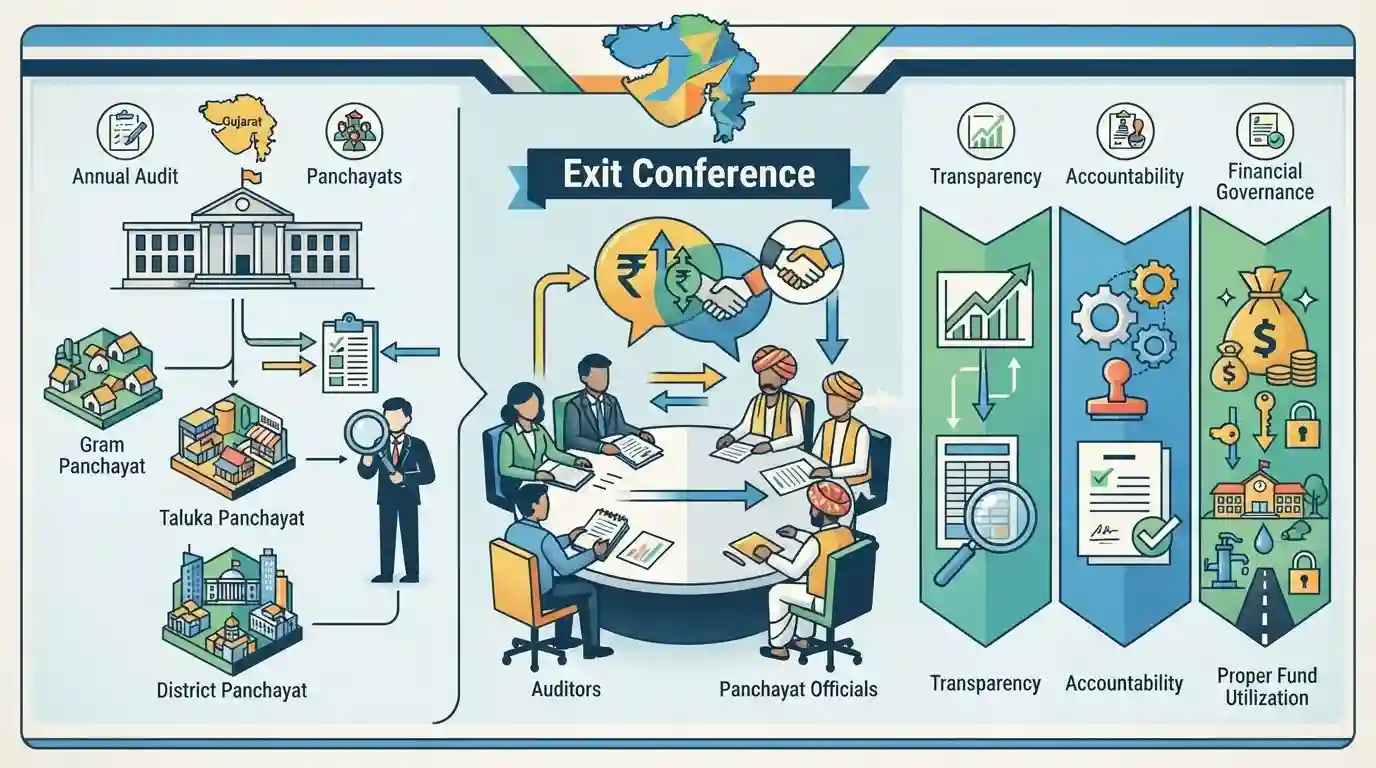
The Gujarat state government has introduced a mandate requiring 'Exit Conferences' to be conducted immediately following the annual audits of Gram, Taluka, and District Panchayats. This policy is designed to address and curb financial irregularities, administrative lapses, and corruption at the grassroots level. By facilitating direct discussions between auditors and local self-government officials regarding preliminary audit findings, the government aims to enhance transparency, improve accountability, and ensure the proper utilization of public funds distributed to Panchayati Raj Institutions.
મુખ્ય મુદ્દા
- The Gujarat government has made 'Exit Conferences' mandatory after the annual audits of Gram Panchayats, Taluka Panchayats, and District Panchayats.
- This directive aims to reduce financial irregularities, administrative lapses, and corruption in local self-government bodies.
- The exit conferences will serve as a platform for auditors and panchayat officials to discuss audit findings before finalizing the reports.
- Such measures aim to foster transparency and accountability at the grass-roots level, supporting good governance and effective utilization of public funds.
મહત્વપૂર્ણ શબ્દો
Exit Conferences

A mandatory post-audit review meeting held between auditors and administrative officials immediately after local body audits to promptly address, discuss, and initiate corrective action on serious financial and administrative irregularities.
UPSC context
GS Paper II: Governance, Transparency & Accountability. Tests measures to check corruption and improve financial administration in local self-governments.
Gram Panchayats
The basic, village-level tier of local self-government in India’s Panchayati Raj system, responsible for grassroots democracy, planning for economic development, and social justice.
UPSC context
GS Paper II: Panchayati Raj Institutions (73rd Amendment). Tests structure, devolution of powers, and grassroots implementation of social sector schemes.
Taluka Panchayats
The intermediate or block-level tier of local self-government in Gujarat, responsible for coordinating developmental plans between village-level Gram Panchayats and apex District Panchayats.
UPSC context
GS Paper II: Panchayati Raj Institutions. Tests understanding of regional local governance variations and the coordination mechanism in a three-tier system.
District Panchayats
The apex, district-level tier of the three-tier Panchayati Raj system in Gujarat, responsible for district planning, administration, and monitoring public schemes across rural regions.
UPSC context
GS Paper II: Local Governance & Federalism. Tests the role of district-level planning committees and financial devolution to local bodies.
Local Fund Audit Department
The state department authorized to conduct financial audits of local self-government bodies, municipal authorities, and local funds to ensure legislative compliance and prevent fiscal misconduct.
UPSC context
GS Paper II: Financial Accountability and Statutory Audit. Tests the oversight mechanisms governing public expenditure in decentralized administrative institutions.
પ્રિલિમ્સ ટ્રેપ
The 73rd Constitutional Amendment mandates that the CAG of India must directly audit the accounts of all Panchayati Raj Institutions.
Article 243J vests the authority to make provisions for auditing accounts of Panchayats exclusively with State Legislatures, not the CAG. The CAG only steps in if authorized under state laws or Governor mandates.
સંલગ્ન સ્થિર ખ્યાલો
What are the constitutional provisions for accounting and auditing of Panchayats?
- Constitutional Basis: Article 243J (and Article 243Z for Municipalities) vests the power to frame audit laws exclusively in State Legislatures.
- State Discretion: The 73rd/74th Amendments did not create a uniform national audit body, leaving procedures to state-level Local Fund Audit departments.
- CAG Role: The CAG can provide Technical Guidance and Supervision (TGS) to state audit agencies if requested by the Governor or state legislation.
How do statutory financial audits of PRIs differ from Social Audits?
- Statutory Audit: Focuses on accounting accuracy, financial compliance, and legal expenditures, conducted by formal government/state auditors.
- Social Audit: Focuses on performance, actual ground impact, and citizen feedback, mandated directly through the Gram Sabha (e.g., under MGNREGA).
આંતર-વિષય પેટર્ન
Devolution vs Fiscal Discipline
As the 15th Finance Commission ties grants to timely audited accounts, state-level audit reforms like exit conferences directly determine the flow of central funds to PRIs.
Audit Tech & e-GramSwaraj
Integrating physical exit conferences with digital audit tools like AuditOnline operationalizes real-time financial tracking, plugging leakages in central-sector schemes.

2026 Prelims may test Article 243J/243Z nuances, contrasting state-level statutory audit powers with CAG's advisory role in PRIs.
સંલગ્ન PYQ · 4
સંલગ્ન PYQ · 4
- 2024GPSC_PRELIMSGS1
Consider the following statements regarding 73rd Constitution Amendment Act of 1992. 1. The Act has given a practical shape to Article 40 of the Constitution. 2. The Act gives a constitutional status to the Panchayati raj institutions. 3. It has brought the Panchayati raj institutions under the purview of the justiciable part of the Constitution. Which of the above statements is/are correct?
- 2025GPSC_PRELIMSGS1
Which of the following statements about Local Self-Government in India is correct? 1. The Panchayati Raj System is based on the recommendations of the Balwant Rai Mehta Committee (1957). 2. The 73ʳᵈ Amendment Act, 1992 provided for the establishment of three-tier Panchayati Raj institutions in all states. 3. The 11ᵗʰ Schedule of the Indian Constitution deals with powers and responsibilities of Panchayati Raj institutions. 4. The State Election Commission is responsible for conducting elections to both Panchayati Raj institutions and State Legislatures. Select the correct answer using the codes below:
- 2022GPSC_PRELIMSGS1
In relation to the 73rd Constitutional Amendment, consider the following: a. Provides four-tier Panchayati Raj System b. Assured duration of five years c. Devolution of powers to Panchayats is vested with the Union Government d. Gram Sabha is the foundation of the Panchayati Raj System
- 2024GPSC_PRELIMSGS1
Public Administration is the study of
