Gujarat leadership in mangrove cultivation under coastal scheme
Source:ians ↗
Why It Matters
The conservation of coastal ecosystems, particularly mangroves, is a recurrent topic in civil services exams due to its importance for climate resilience and biodiversity. Awareness of specific initiatives like the MISHTI scheme and the geographical ranking of states regarding natural resources (such as mangrove cover) is critical for objective questions in GPSC Prelims.
Summary
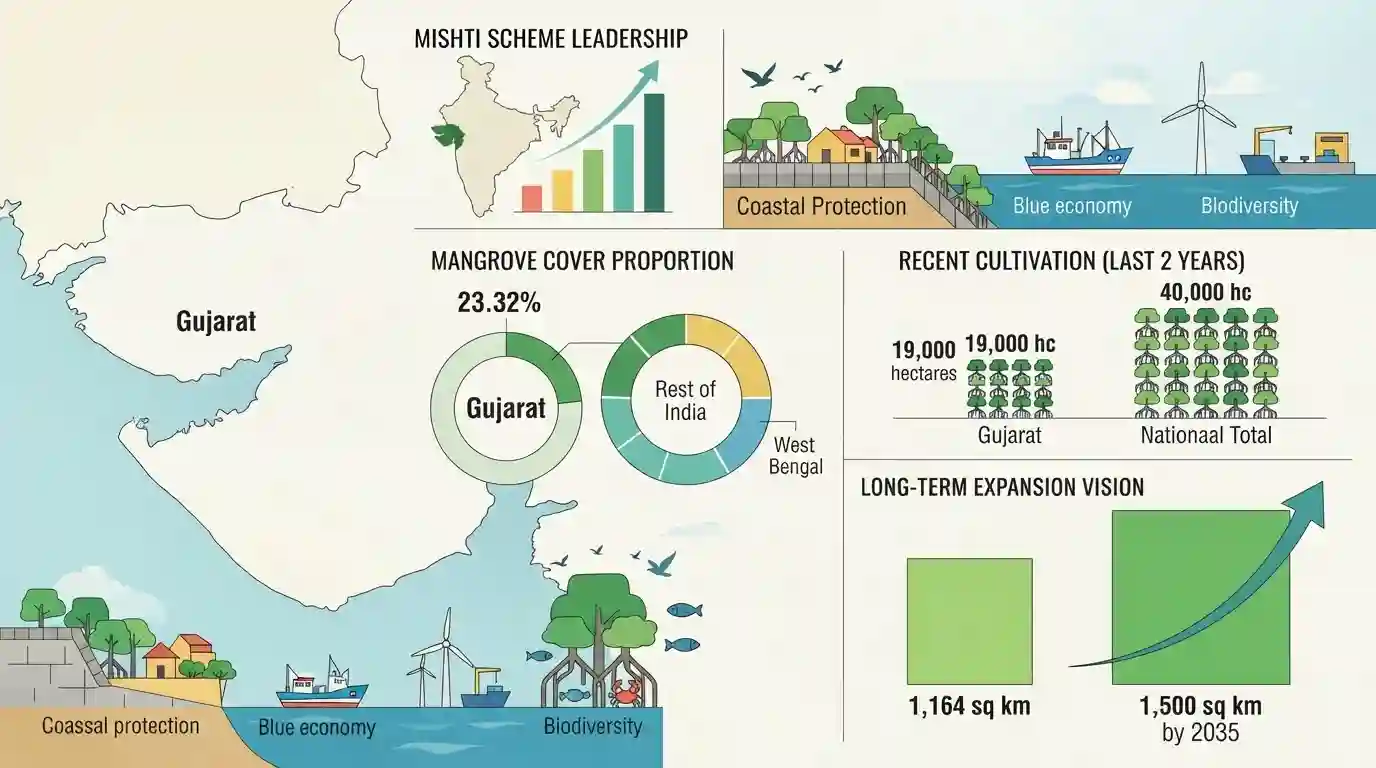
Gujarat is leading India's mangrove cultivation efforts under the MISHTI (Mangrove Initiative for Shoreline Habitats & Tangible Incomes) scheme. The state, which has the second-largest mangrove cover after West Bengal, currently represents 23.32% of the country's total mangrove area. Over the last two years, Gujarat added more than 19,000 hectares of mangroves out of a national total of 40,000 hectares restored or planted over three years. With a vision for long-term coastal protection and blue economy development, Gujarat aims to expand its mangrove footprint from 1,164 sq km to 1,500 sq km by 2035.
Key Points
- Gujarat has emerged as the leading state in mangrove cultivation under the national MISHTI scheme.
- The state currently accounts for 23.32% of India's total mangrove cover, holding the second-largest area in the country after West Bengal.
- In the past two years alone, Gujarat has successfully planted mangroves across more than 19,000 hectares.
- The Gujarat government has set a target to expand its mangrove cover from the current 1,164 sq km to 1,500 sq km by 2035.
- Mangroves are critical for coastal states; they serve as natural protective shields against extreme weather, sustain marine biodiversity, and support the blue economy.
Important Terms
MISHTI Scheme

The Mangrove Initiative for Shoreline Habitats & Tangible Incomes is a central scheme launched in 2023. It aims to comprehensively expand mangrove cover along India's coastlines and salt pans, promoting coastal resilience and community livelihoods.
UPSC context
Highly relevant for GS Paper 3 (Environment & Conservation). Tests knowledge of climate adaptation schemes and coastal ecology initiatives.
Mangroves
Mangroves are salt-tolerant (halophytic) trees and shrubs growing in tropical and subtropical intertidal zones. They feature specialized roots and act as vital blue carbon sinks, biodiversity nurseries, and natural bio-shields against coastal erosion.
UPSC context
Crucial for GS Paper 1 (Geography) and GS Paper 3 (Environment). Frequently tested on their ecological significance and geographic distribution.
Blue Economy
The Blue Economy refers to the sustainable harnessing of ocean and marine resources to drive economic growth, create jobs, and improve livelihoods while strictly preserving the health and biodiversity of marine ecosystems.
UPSC context
Essential for GS Paper 3 (Economy & Environment). Tests understanding of sustainable maritime development and India's ocean resource strategies.
Ministry of Environment, Forest and Climate Change (MoEFCC)
The nodal central ministry in India responsible for planning, coordinating, and implementing environmental, forestry, and climate change programs. It launched the MISHTI scheme to fulfill India's international ecological and climate mitigation commitments.
UPSC context
Relevant for GS Paper 2 (Governance) and GS Paper 3. Tests knowledge of the administrative bodies steering national environmental policy.
Gujarat Forest Department
The state-level authority managing Gujarat's forests and wildlife. Under the national MISHTI scheme, it has notably spearheaded India's mangrove restoration, adding over 19,000 hectares to achieve long-term coastal protection and blue economy development.
UPSC context
Fits GS Paper 3 (Environment). Illustrates state-level implementation of national ecological targets and federalism in conservation efforts.
Prelims Trap
Gujarat holds the largest mangrove cover in India following its recent success under the MISHTI scheme.
Aspirants conflate "leading in recent cultivation" with "largest absolute cover". West Bengal still retains the largest total mangrove area in India.
Static Concepts Connected
What are the unique physiological adaptations of mangrove vegetation?
- Pneumatophores: Upward-growing aerial roots that facilitate gas exchange in oxygen-poor, waterlogged coastal soils.
- Vivipary: Seeds germinate while still attached to the parent tree, ensuring early survival before dropping into harsh saline water.
- Salt Excretion: Specialized leaf glands excrete excess absorbed salt, while root membranes actively filter and exclude salt from entering the plant.
What are the core operational features of the MISHTI scheme?
- Funding Convergence: It operates without an independent budget, instead converging resources from CAMPA, MGNREGS, and other existing state/central funds.
- Geographical Scope: Targets intensive mangrove afforestation along coastlines and degraded salt pan lands across 11 coastal states and 2 UTs.
- Tangible Incomes: Focuses on generating sustainable alternative livelihoods and tangible incomes for coastal communities alongside shoreline protection.
Cross-Topic Patterns
Bio-shields & Arabian Sea Cyclones
Increasing cyclone intensity in the Arabian Sea makes Gujarat's mangrove expansion a highly relevant nature-based solution for coastal Disaster Management and infrastructure resilience.
Blue Carbon & Climate Targets
Mangroves sequester carbon up to 4 times faster than terrestrial forests, acting as Blue Carbon sinks that directly support India's Nationally Determined Contributions (NDCs).

Expect a multi-statement Prelims question contrasting state mangrove covers (WB vs Gujarat) and MISHTI's funding overlap with MGNREGS.
Linked PYQs · 3
Linked PYQs · 3
- 2026GPSC_PRELIMSGS1
The 'Great Indian Bustard (GIB)' (Ghorad) is frequently seen in the news in the context of wildlife conservation efforts in western India. Consider the following statements regarding this species: 1. Currently, the highest surviving wild population of the Great Indian Bustard in India is located in the semi-arid grasslands of Gujarat. 2. It is a long-distance migratory bird that travels from Central Asia to the Indian subcontinent to escape harsh winters. Which of the above statement(s) is/are correct?
- 2025GPSC_PRELIMSGS1
In which states of India are Tropical evergreen forests found? 1. On the eastern slopes of the Western Ghats 2. In the Andaman and Nicobar islands 3. On the Aravalli mountain range 4. On the hills of the north-eastern region Select the correct option from the following.
- 2022GPSC_PRELIMSGS1
Which garden of Gujarat has the trees and plants of rare species?
