Gujarat leads India in wind power capacity and electricity generation
Source:indianmasterminds ↗
આ શા માટે મહત્વનું છે
Tracking the state-level progress in renewable energy capacity, specifically wind power, is crucial for assessing India's trajectory towards its 2030 climate goals. Understanding the specific central government policies driving this sector is directly relevant to energy infrastructure topics in the GPSC syllabus.
સારાંશ
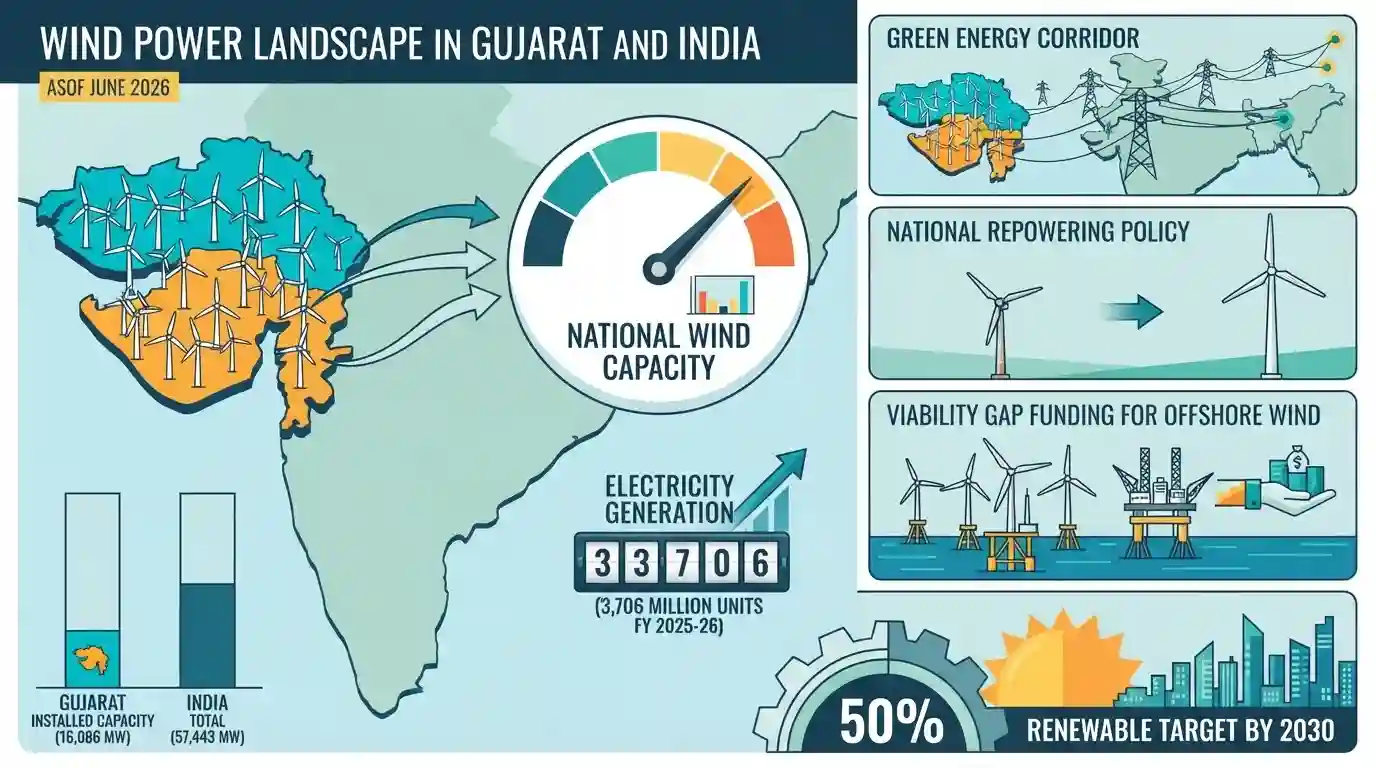
As of June 2026, Gujarat has emerged as India's leading state in wind power, topping the nation in both installed capacity (16,086 MW) and electricity generation (33,706 million units in FY 2025-26). India's overall wind energy capacity reached 57,443 MW, and Gujarat contributes nearly a third of the nation's wind generation. The state's rapid growth supports India's ambitious vision to achieve 50% of its electricity from renewable sources by 2030. The expansion is bolstered by favorable central initiatives such as the Green Energy Corridor, the National Repowering and Life Extension Policy for Wind Power Projects-2023, and Viability Gap Funding for offshore wind.
મુખ્ય મુદ્દા
- Gujarat tops all Indian states in both installed wind power capacity (16,086 MW) and wind electricity generation (33,706 MU in FY 2025-26).
- Gujarat accounts for nearly one-third of India's total wind power generation, supporting the national goal of meeting 50% electricity requirements from renewable energy by 2030.
- India's overall installed wind power capacity has reached 57,443 MW, with annual generation of 106 billion units in FY 2025-26.
- Central policies supporting this growth include the Green Energy Corridor, ISTS charge relief, National Repowering and Life Extension Policy-2023, and Offshore Wind Energy Lease Rules-2023.
મહત્વપૂર્ણ શબ્દો
Green Energy Corridor

A dedicated power transmission network developed to evacuate and integrate electricity generated from renewable energy sources, like solar and wind, into the national grid, preventing grid instability and curtailment.
UPSC context
GS Paper 3 (Infrastructure/Energy); tests knowledge of grid stability and evacuation infrastructure for integrating renewable power.
National Repowering and Life Extension Policy for Wind Power Projects-2023
A framework allowing developers to upgrade older, inefficient wind turbines with modern technology before their design life ends, maximizing energy yield per square kilometer.
UPSC context
GS Paper 3 (Energy/Environment); highlights mechanisms to maximize energy yield from aging wind infrastructure without extra land acquisition.
Viability Gap Funding (VGF) Scheme for Offshore Wind Projects
A government financial mechanism offering grants to bridge the gap in commercial viability for infrastructure. The offshore wind scheme provides ₹7,453 crore to support the initial 1 GW capacity.
UPSC context
GS Paper 3 (Infrastructure); tests financial mechanisms used to lower power generation costs and attract private investment in nascent sectors.
Offshore Wind Energy Lease Rules-2023
Regulations notified to govern the leasing of offshore areas within India's Exclusive Economic Zone for the installation and operation of offshore wind energy and transmission projects.
UPSC context
GS Paper 2 (Governance) and Paper 3 (Energy); outlines regulatory authority and leasing mechanisms over India's maritime zones.
Ministry of New and Renewable Energy (MNRE)
The nodal central ministry of the Government of India responsible for research, development, commercialization, and deployment of renewable energy systems to supplement the nation's energy requirements.
UPSC context
GS Paper 2 (Polity); foundational knowledge for evaluating the implementation agency driving India's climate commitments and renewable energy targets.
પ્રિલિમ્સ ટ્રેપ
"Tamil Nadu currently holds the highest installed wind power capacity among all Indian states."
Historically true, Tamil Nadu has now been overtaken by Gujarat in both installed capacity and generation. Aspirants relying on outdated NCERTs frequently fall for this.
સંલગ્ન સ્થિર ખ્યાલો
Why are western and southern coasts best suited for wind power in India?
- Topography & Monsoons: The uninterrupted coastal plains and peninsular plateau edges face strong, consistent monsoon winds, creating ideal wind velocity profiles.
- Offshore potential: Shallow continental shelves off the Gujarat and Tamil Nadu coasts make them prime candidates for seabed-fixed offshore wind turbines.
What is the core objective of the National Repowering Policy for Wind Power?
- Land optimization: Replacing older, sub-MW class wind turbines installed before 2000 with modern, high-capacity models to maximize yield from prime wind sites.
- Grid efficiency: Upgraded larger turbines produce smoother power curves, improving grid stability and maximizing the utility of existing transmission infrastructure.
આંતર-વિષય પેટર્ન
Offshore Wind & Maritime Zones
Expanding offshore wind involves UNCLOS rules. Leasing seabed for wind farms invokes India's sovereign rights in the EEZ, bridging energy infrastructure with international maritime geography.
Green Energy Corridors & Grid Balancing
High localized generation in states like Gujarat stresses local grids. ISTS charge waivers are critical to incentivize transferring this power to energy-deficit states without punishing tariffs.

A 2026 Prelims question will likely test Gujarat's new wind dominance alongside the land-use mechanics of the 2023 Repowering Policy.
સંલગ્ન PYQ · 1
સંલગ્ન PYQ · 1
- 2026GPSC_PRELIMSGS1
Which of the following statement/s is/are correct regarding Renewable Energy Installed Capacity in India? 1. Wind energy is second only to solar energy in the Indian renewable sector. 2. Biomass power capacity accounts for around 30% of India's total renewable energy. 3. India ranks among the top three countries in the world in Hydropower Installed Capacity. Choose the correct option from the following.
