Gujarat Agricultural Growth Driven By Irrigation Reforms
Source:chinimandi ↗
Why It Matters
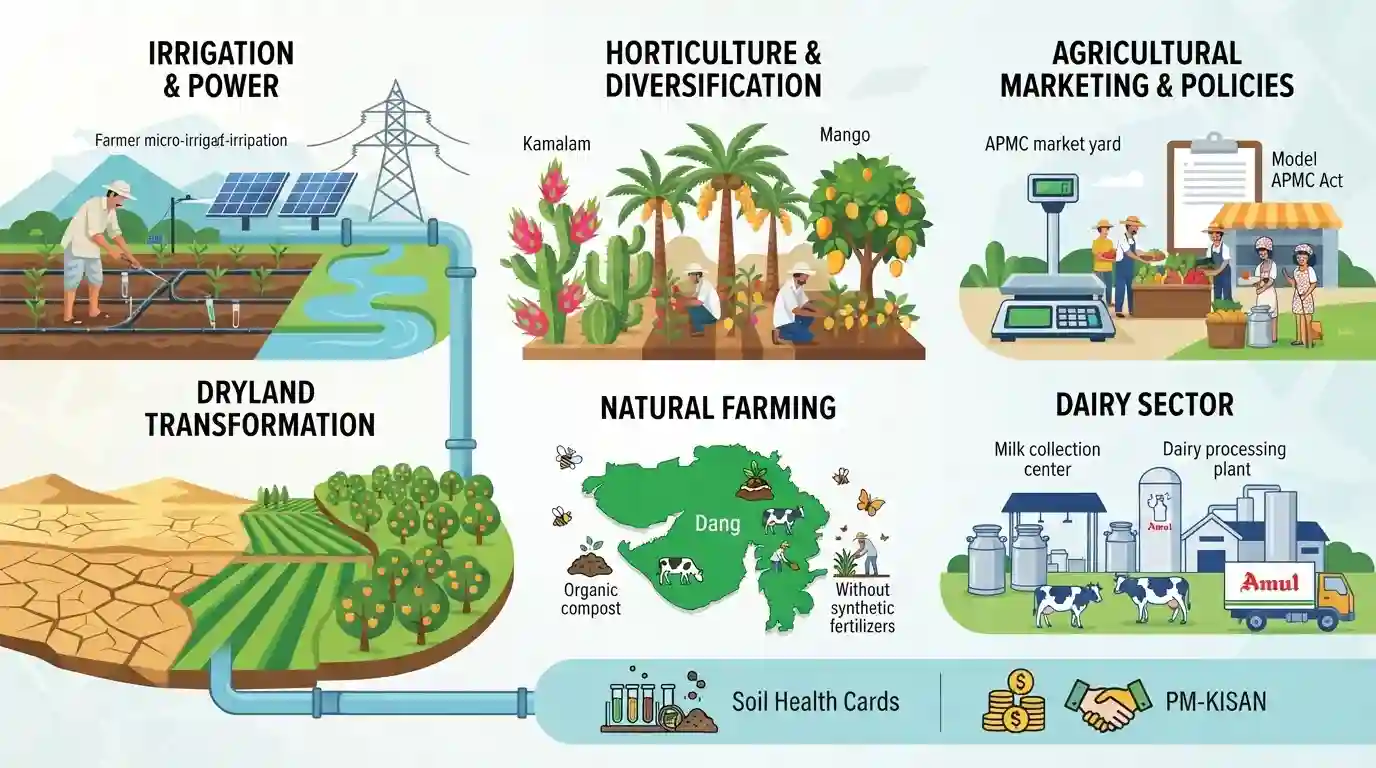
Gujarat's multi-pronged strategy—encompassing irrigation innovation, APMC reforms, robust dairy cooperatives, and large-scale natural farming—serves as an exemplary model for addressing India's agrarian challenges and doubling farmers' income.
Summary
Gujarat has achieved remarkable agricultural excellence through a combination of policy reforms, technology adoption, and diversification. By pioneering micro-irrigation and ensuring continuous rural power through the Jyotigram Scheme, the state transformed drylands like Banaskantha and Kutch into agricultural powerhouses. Early adoption of the Model APMC Act and strong dairy cooperatives like Amul have bolstered farmers' incomes. Additionally, Gujarat leads in natural farming—with Dang as a 100% natural farming district—and has seen significant growth in horticulture by adopting high-value crops such as Kamalam (dragon fruit), dates, and mangoes, supported by initiatives like Soil Health Cards and PM-KISAN.
Key Points
- Gujarat has pioneered agricultural growth by converting arid regions like North Gujarat and Kutch into productive agricultural zones through the promotion of micro and drip irrigation systems and the Jyotigram Scheme for continuous power.
- The state was an early adopter of the Model APMC Act, enhancing transparent pricing and market access, supplemented by robust commercial dairy cooperatives following the Amul model.
- Horticulture diversification has been a major success, with farmers cultivating high-value crops like dates, Kamalam (dragon fruit), mangoes, and bananas instead of solely traditional grains.
- Dang district has been designated as a 100% natural farming district, reflecting the state's push towards organic, chemical-free agriculture guided by universal Soil Health Card distribution.
Important Terms
Jyotigram Scheme

A Gujarat government initiative that separated rural power feeders to provide 24-hour three-phase electricity to non-agricultural rural consumers and rationed, high-voltage power for agricultural tubewells.
UPSC context
GS Paper III (Infrastructure & Agriculture); tests rural electrification, feeder separation, and groundwater conservation strategies.
Pradhan Mantri Kisan Samman Nidhi (PM-KISAN)
A Central Sector Scheme launched in 2019 that provides direct income support of ₹6,000 per year in three equal installments to all landholding farmer families across India.
UPSC context
GS Paper III (Agriculture); tests knowledge of direct benefit transfers, farmer welfare measures, and agricultural input subsidies.
Soil Health Card
A printed report issued to farmers every three years assessing their soil's health across 12 parameters and recommending optimal crop-specific fertilizer and nutrient applications.
UPSC context
GS Paper III (Agriculture); tests understanding of farm inputs, soil conservation, and balanced fertilizer utilization.
Model APMC Act
A draft legislation recommended by the Central Government to encourage states to reform agricultural marketing, allow private markets, direct sales, and contract farming.
UPSC context
GS Paper III (Agricultural Marketing); tests knowledge of market deregulation, cooperative federalism, and trade barriers.
APMC
Agricultural Produce Market Committees are statutory marketing boards established by state governments in India to regulate agricultural trade and safeguard farmers from exploitation by intermediaries.
UPSC context
GS Paper III (Agricultural Marketing); tests issues related to APMC monopolies, agricultural pricing, and marketing reforms.
Amul
A cooperative brand managed by the Gujarat Cooperative Milk Marketing Federation, which pioneered the three-tier cooperative model in Anand, Gujarat, driving India’s White Revolution.
UPSC context
GS Paper III (Cooperative Sector/Dairy); tests understanding of the cooperative movement, dairy sector growth, and rural income diversification.
Prelims Trap
The Jyotigram scheme achieves rural transformation by supplying continuous 24/7 power specifically to agricultural irrigation pumps.
The Jyotigram scheme supplies 24/7 power only to rural households, schools, and non-farm industries. Power to agricultural pumps is deliberately scheduled and restricted (usually to 8 hours daily) to conserve groundwater.
Static Concepts Connected
What is rural feeder separation and what are its policy objectives?
- Feeder Segregation: Physically separates transmission wires supplying agricultural pumps from those supplying domestic households and non-farm industries in rural areas.
- Domestic objective: Provides 24/7 uninterrupted power to rural homes, schools, and businesses to enhance quality of life and boost non-farm economic activities.
- Agricultural objective: Supplies scheduled, regulated power (typically 8 hours/day) to pumps to check unscientific groundwater depletion and lower state agricultural subsidies.
What are the 12 parameters evaluated under the Soil Health Card Scheme?
- Macronutrients: Measures Nitrogen (N), Phosphorus (P), Potassium (K), and the secondary nutrient Sulphur (S) to determine primary chemical needs.
- Micronutrients: Analyses crucial trace minerals including Zinc (Zn), Iron (Fe), Copper (Cu), Manganese (Mn), and Boron (B).
- Physical indicators: Assesses pH levels (acidity/alkalinity), Electrical Conductivity (EC) to measure salinity, and Organic Carbon (OC) representing organic matter.
Cross-Topic Patterns
Feeder separation + Groundwater conservation
Connects rural electricity reform to the conservation of critical/semi-critical aquifers, demonstrating how energy subsidization policies directly impact hydrological sustainability.
Model APLM + Constitutional federalism
Examines how the Seventh Schedule (State List Entry 14 & 28) limits federal power, forcing the Centre to rely on "Model" acts to drive uniform market reforms.

Constitutional limits of Model APLM Act paired with the 12 parameters of Soil Health Cards will likely feature in GS-3/Prelims 2026.
Linked PYQs · 3
Linked PYQs · 3
- 2026GPSC_PRELIMSGS1
Consider the following statements about commercial dairy farming. 1. It is a high labour intensive activity. 2. It is highly commercial, wherein, efficient transport, refrigeration and pasteurization processes are its major facilitators. Which of the above statement(s) is/are correct?
- 2025GPSC_PRELIMSGS1
Which of the following major crops are covered under the Minimum Support Price Policy of Government of India? 1. Sorghum 2. Maize 3. Cotton 4. Sugarcane
- 2025GPSC_PRELIMSGS1
In a significant milestone for India's agricultural exports, the Agricultural and Processed Food Products Export Development Authority (APEDA) successfully completed India's first-ever commercial shipments of premium Sangola and Bhagwa pomegranates to ______.
