Samras Vidya Setu Dropout Re Enrolment Campaign in Gujarat
Source:punjabkesari ↗
આ શા માટે મહત્વનું છે
Gujarat-specific welfare and education schemes such as 'Samras Vidya Setu', 'Shala Praveshotsav', and 'Kanya Kelavani' are highly important for GPSC Class 1-2 Prelims. It highlights the state's efforts to implement NEP 2020 mandates and Right to Education provisions through specialized tracking and community integration tools.
સારાંશ
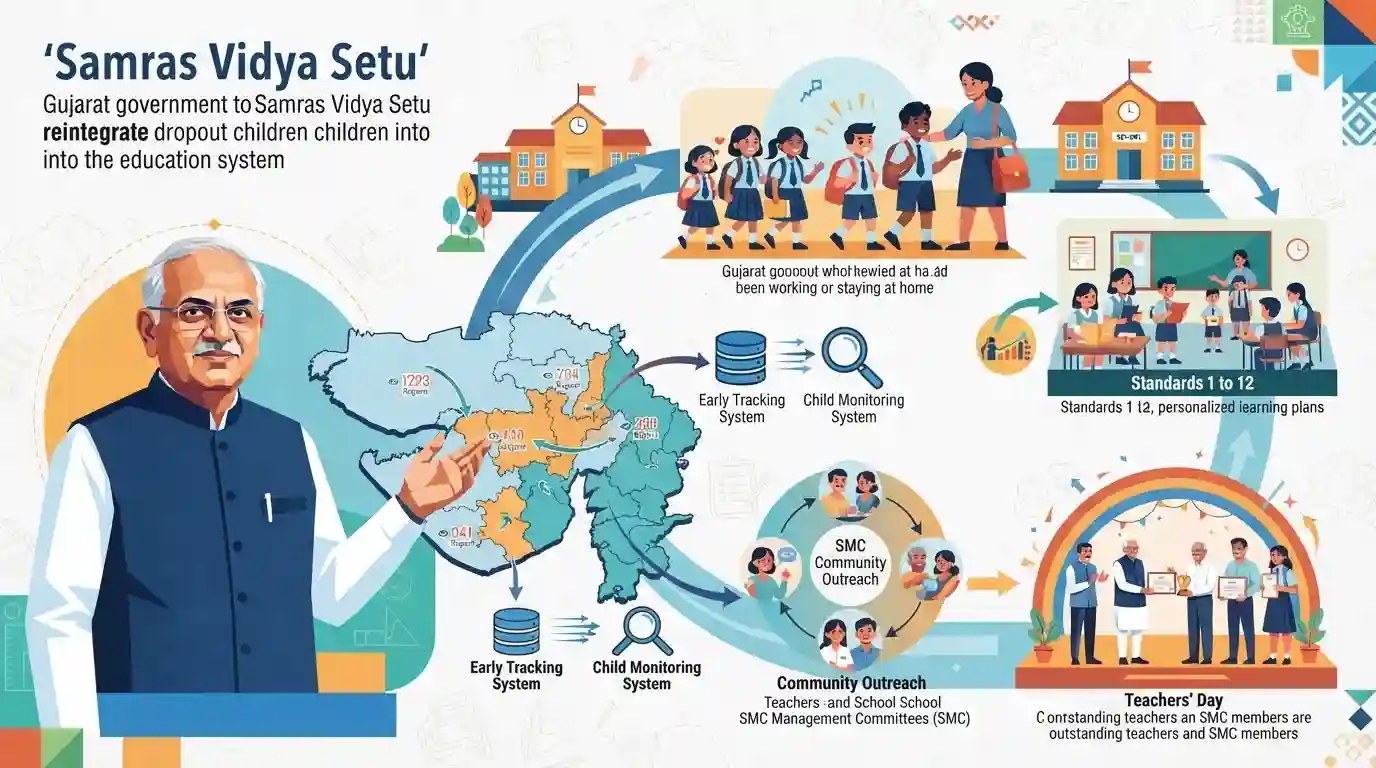
The Gujarat government, led by Chief Minister Bhupendra Patel, has launched a major statewide campaign titled 'Samras Vidya Setu' to bring over 80,000 dropout children back into the education system and achieve a "zero dropout" goal. Under the campaign, children will be re-enrolled in age-appropriate classes from Standards 1 to 12, with necessary bridge courses and academic support provided. The initiative aligns with the National Education Policy 2020 and utilizes mechanisms like the Early Tracking System and Child Monitoring System. Key stakeholders, including teachers and School Management Committees, are involved in community outreach, and high performers will be recognized on Teachers' Day. This effort continues the legacy of previous educational reforms in the state such as 'Shala Praveshotsav' and 'Kanya Kelavani'.
મુખ્ય મુદ્દા
- The Gujarat government launched the 'Samras Vidya Setu' mega campaign in Ahmedabad to re-enrol over 80,000 school dropouts in Standards 1 to 12.
- The state aims to achieve a "zero dropout" rate by providing special academic support, remedial classes, and bridge learning arrangements for the reintegrated students.
- Advanced monitoring mechanisms like the Early Tracking System and Child Monitoring System are being utilized to trace and assist dropout children.
- The initiative builds on historic state educational programs such as 'Shala Praveshotsav' and 'Kanya Kelavani', aligning with the National Education Policy (NEP) 2020.
- High-performing districts, teachers, and School Management Committees will be honored on Teachers' Day for their efforts in the campaign.
મહત્વપૂર્ણ શબ્દો
Samras Vidya Setu

A statewide mega campaign launched by Gujarat in July 2026 to re-enrol over 80,000 dropout children into age-appropriate classes (Standards 1 to 12) with bridge courses.
UPSC context
GS Paper II: Education & Social Justice. Tests knowledge of state-level interventions to eliminate school dropout rates.
Shala Praveshotsav
An annual school enrollment drive started by Gujarat in 2003 to welcome new Class 1 students, improve enrollment rates, and reduce primary school dropouts.
UPSC context
GS Paper II: Governance & Welfare. Evaluates decentralized educational campaigns and grassroots primary education mobilization.
Kanya Kelavani
A social movement and educational campaign in Gujarat focused on enhancing female literacy and boosting school enrollment and retention among girl children.
UPSC context
GS Paper II: Social Justice & Gender Issues. Tests awareness of targeted state schemes for girl-child education.
National Education Policy (NEP) 2020
A comprehensive national framework designed to restructure India's educational system across school and higher education levels, promoting flexible, multidisciplinary, and equitable learning.
UPSC context
GS Paper II: Education Policy. Tests critical analysis of systemic reforms, foundational literacy, and modern pedagogical frameworks.
Right to Education (RTE) Act
Landmark legislation enacted under Article 21-A of the Indian Constitution, guaranteeing free and compulsory elementary education to all children aged 6 to 14.
UPSC context
GS Paper II: Constitutional Provisions & Governance. Tests comprehension of fundamental rights and statutory standards in school administration.
Mission Schools of Excellence
A massive infrastructure and pedagogy upgrade program launched by Gujarat in 2022, co-funded by the World Bank, to modernize around 40,000 government schools.
UPSC context
GS Paper II: Education Infrastructure. Analyzes institutional upgrades, technological integration, and multilateral school financing models.
School Management Committees
Decentralized governance bodies mandated by the RTE Act 2009, consisting mostly of parents, to monitor school operations, manage grants, and plan school development.
UPSC context
GS Paper II: Governance & Decentralization. Tests understanding of community participation and parent-led accountability in public education.
પ્રિલિમ્સ ટ્રેપ
School Management Committees (SMCs) under RTE are advisory bodies dominated by government-nominated domain experts and local administrators.
Under Section 21 of the RTE Act 2009, SMCs are mandatory for government/aided schools, and 75% of their members must be parents/guardians, not government bureaucrats or external experts.
સંલગ્ન સ્થિર ખ્યાલો
What are the statutory provisions governing School Management Committees (SMCs) under the RTE Act?
- Legal Mandate: Mandated under Section 21 of the Right of Children to Free and Compulsory Education (RTE) Act, 2009.
- Parental Majority: Requires that at least 75% of the committee members must be parents or guardians of the enrolled children.
- Gender Representation: Mandates that 50% of the total members of the SMC must be women to ensure gender parity in governance.
- Core Functions: Tasked with monitoring school functioning, preparing School Development Plans, and supervising the utilization of government grants.
What targets does the National Education Policy (NEP) 2020 set for school enrollment and dropouts?
- GER target: Aims to achieve a 100% Gross Enrolment Ratio (GER) from preschool to secondary level by 2030.
- Re-enrolment Goal: Proposes bringing 2 crore out-of-school children back into the mainstream educational fold.
- Tracking Mechanism: Advocates robust tracking mechanisms, dual-pathway learning (formal and non-formal), and infrastructure support to prevent dropouts.
આંતર-વિષય પેટર્ન
Decentralized governance + educational outcomes
Leveraging local statutory bodies like SMCs to reduce school dropouts demonstrates how decentralized governance underpins effective social sector delivery.
Digital tracking + Right to Education
Integrating Child Tracking Systems with welfare delivery showcases the transition of e-governance from passive records to active rights enforcement.

RTE Act SMC composition rules vs. NEP 2020 secondary-level GER targets will likely be contrasted in a 2026 Prelims statement.
સંલગ્ન PYQ · 1
સંલગ્ન PYQ · 1
- 2019GPSC_PRELIMSGS1
Who among the following was the education minister of Gujarat as well as the recipient of the Padmashree award?
