Gujarat Implements El Nino Preparedness Plan For Agriculture
Source:indianmasterminds ↗
Why It Matters
Provides crucial insights into state-level disaster mitigation and climate-resilient agriculture policies in response to El Nino, which is a frequent theme in civil services examinations.
Summary
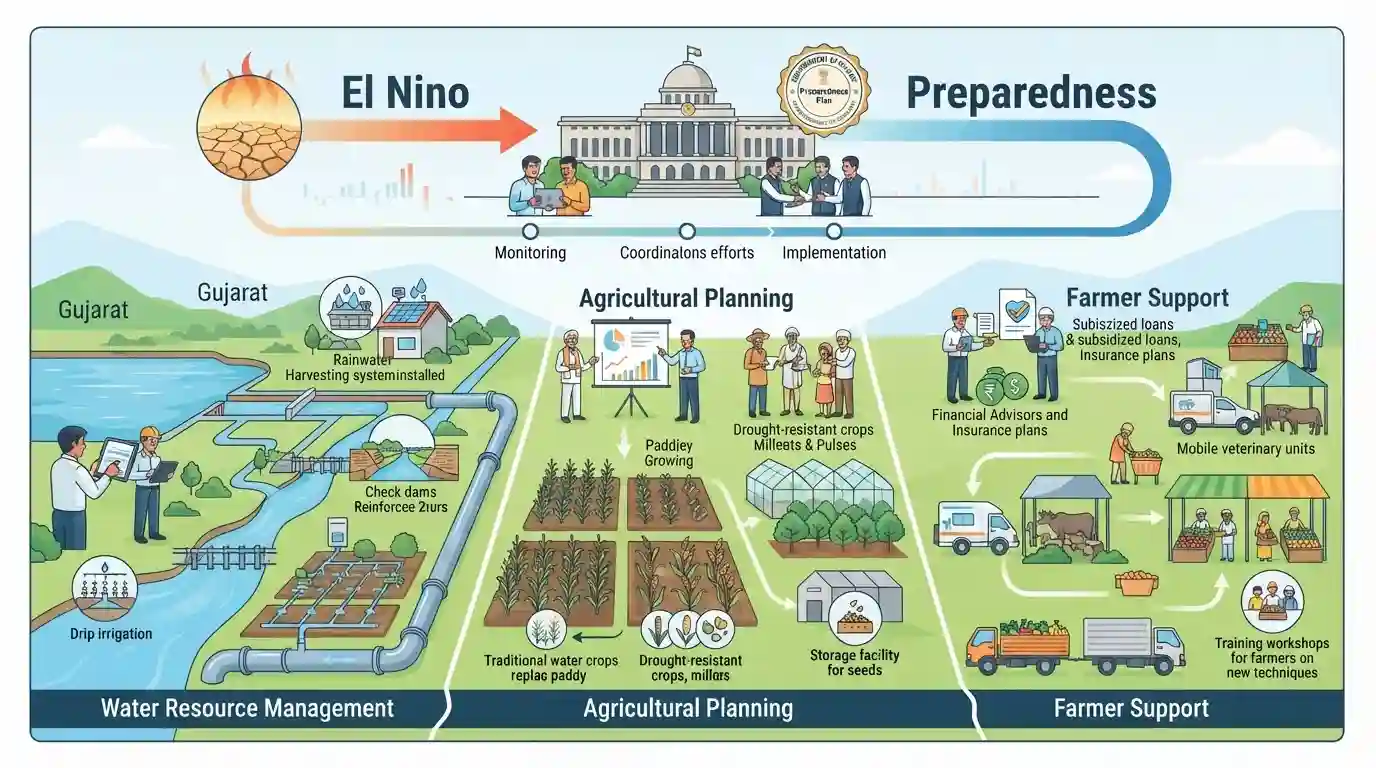
The Government of Gujarat has introduced an El Nino Preparedness Plan focusing on water conservation, agricultural planning, and farmer support to counteract the potential drought and dry spell risks associated with the El Nino weather pattern.
Key Points
- Gujarat has launched a comprehensive El Nino Preparedness Plan to mitigate potential adverse impacts on water security, agriculture, and rural livelihoods.
- The plan emphasizes proactive water resource management, agricultural advisory services, and support mechanisms for farmers to handle dry spells or deficient monsoon rainfall.
- El Nino is a climate phenomenon characterized by the warming of sea surface temperatures in the tropical Pacific Ocean, which heavily impacts the Indian monsoon and can trigger drought-like conditions.
Important Terms
El Nino Preparedness Plan

A multi-departmental strategic framework introduced by Gujarat to counteract potential drought and dry spell risks associated with the El Nino weather pattern, focusing on water conservation, agricultural planning, and farmer support.
UPSC context
Crucial for GPSC Paper 3 (Disaster Management, Agriculture, and Water Resource Management), testing proactive state policies against climate change risks.
Government of Gujarat
The state executive body that implemented multi-departmental micro-planning involving the Agriculture, Water Supply, and Narmada departments to secure drinking water and agricultural resilience against monsoon deficits.
UPSC context
Relevant for GPSC administration and state governance topics, testing implementation of welfare and disaster mitigation schemes.
Prelims Trap
El Nino always results in a complete and uniform failure of rainfall across all regions of India.
Aspirants often assume El Nino only causes uniform seasonal droughts across India, ignoring that it can simultaneously trigger localized extreme rainfall events and flash floods.
Static Concepts Connected
What are the key mechanisms and impacts of the El Nino Southern Oscillation (ENSO) on Indian monsoon?
- Warming Phase: Abnormal warming of sea surface temperatures in the central and eastern tropical Pacific Ocean disrupts normal atmospheric circulation.
- Monsoon Suppression: It generally weakens the Walker Circulation, resulting in reduced moisture transport and suppressed summer monsoon rainfall over the Indian subcontinent.
- ENSO Phases: ENSO has a positive phase (El Nino) and a negative phase (La Nina), often interacting with the Indian Ocean Dipole (IOD).
Cross-Topic Patterns
El Nino Preparedness + Climate Change Missions
El Nino drought planning intersects with the National Action Plan on Climate Change (NAPCC) and state-level disaster mitigation frameworks under the NDMA guidelines.
Water Grid Infrastructure + Agricultural Drought Resilience
Linking Narmada canal networks and SAUNI Yojana with micro-irrigation schemes showcases how state water grids buffer agricultural vulnerabilities.

El Nino mechanism + Gujarat's water grid schemes (SAUNI/Sujalam Sufalam) likely in a multi-statement prelims question.
Linked PYQs · 2
Linked PYQs · 2
- 2026GPSC_PRELIMSGS1
Consider the following statements: 1. When the temperature decrease in the South Pacific Ocean, India receives deficient rainfall. 2. El Nino is an important factor in the drought situation in India. 3. El Nino is a warm current that flows along the coast of Peru in December. Which of the above statement/s is/are correct?
- 2026GPSC_PRELIMSGS1
Consider the following statements about El Niño: 1. El Nino is a weather phenomenon that directly affects the global environment. 2. El Nino is related to environmental factors in the Pacific Ocean. 3. El Nino starts in the Atlantic Ocean and ends in the Pacific Ocean. 4. El Nino only affects the regularity of the monsoon. Which of the above statements are not correct?
