Gujarat launches Data Centre Policy 2026 to 2029
Source:revoi ↗
Why It Matters
Highlights a strategic state-level policy shift towards capturing the burgeoning data economy and digital infrastructure sector. It is highly relevant for GPSC Prelims as it covers Gujarat-specific infrastructure initiatives, economic goals, renewable energy utilization, and state-backed incentives for technological advancement.
Summary
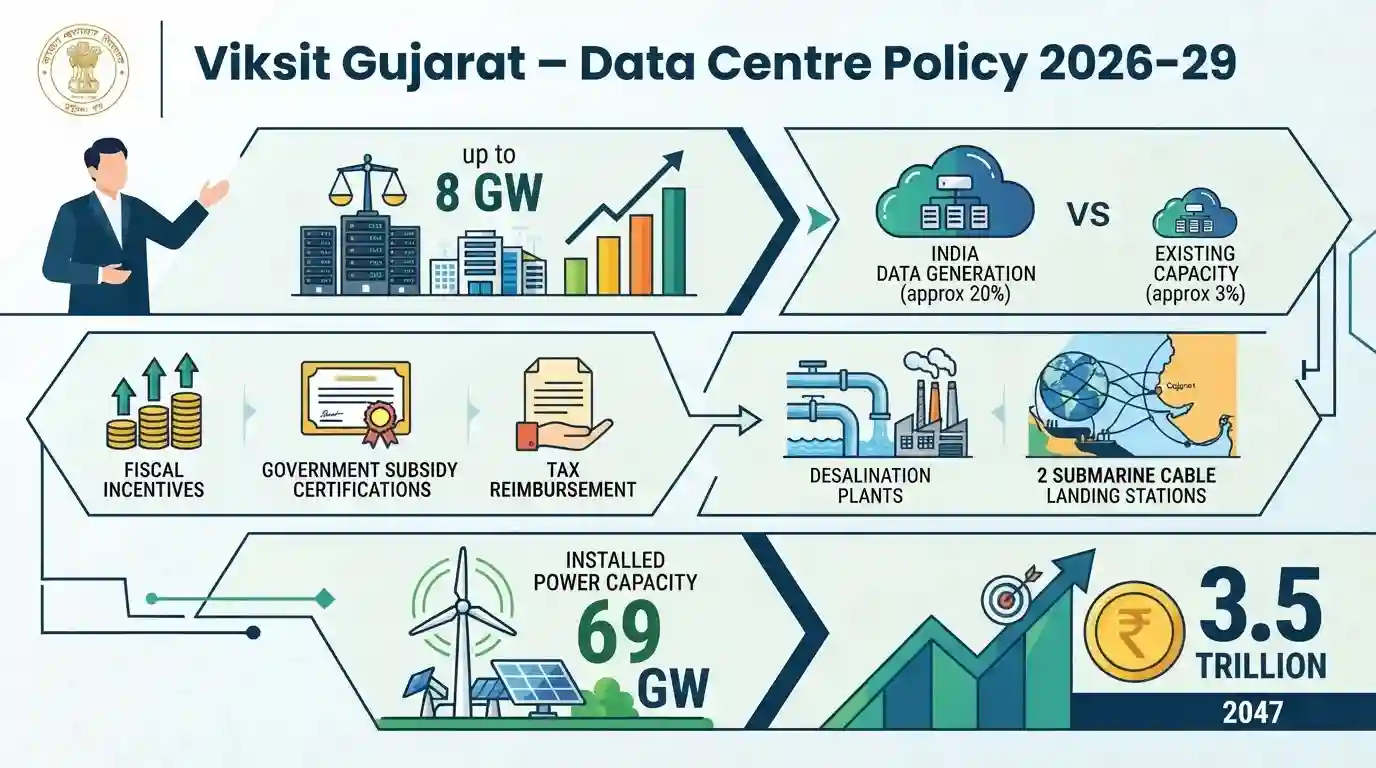
The Government of Gujarat has introduced the 'Viksit Gujarat – Data Centre Policy 2026-29' to establish the state as a leading global digital infrastructure hub. Unveiled by Chief Minister Bhupendra Patel, the policy aims to attract substantial investments in hyperscale data centres, artificial intelligence ecosystems, and high-speed digital connectivity. Recognizing that India generates nearly 20% of global data but houses only 3% of the world's data centre capacity, Gujarat aims to independently develop up to 8 GW of this critical infrastructure. The policy offers robust fiscal incentives, including capital and interest subsidies, tax reimbursements, and financial support for desalination plants. Additionally, it plans to set up two cable landing stations to enhance international internet bandwidth. Backed by an existing 69 GW installed power capacity with a heavy emphasis on renewable energy, Gujarat aims to leverage this digital infrastructure to accelerate its journey towards becoming a USD 3.5 trillion economy by 2047.
Key Points
- Gujarat Chief Minister Bhupendra Patel launched the 'Viksit Gujarat – Data Centre Policy 2026-29' to attract investments in hyperscale data centres, AI infrastructure, and digital services.
- The policy aims to develop up to 8 GW of data centre capacity in Gujarat, significantly boosting India's current overall capacity of 2-3 GW.
- A key focus of the policy is improving international connectivity by establishing two cable landing stations in the state.
- Extensive fiscal incentives are offered, including capital and interest subsidies, SGST and electricity duty reimbursements, and power tariff support.
- The state intends to leverage its 69 GW installed power capacity (including 47 GW from renewables) to power these energy-intensive data hubs, aligning with its goal to achieve a USD 3.5 trillion economy by 2047.
Important Terms
Viksit Gujarat – Data Centre Policy 2026-29

A state framework aiming to build up to 8 GW of data centre capacity. It provides fiscal incentives, such as tax reimbursements and power subsidies, to establish Gujarat as a green hyperscale digital infrastructure hub.
UPSC context
GPSC GS Paper 2 (Government Policies). Evaluates knowledge of state-level digital infrastructure and investment-attraction initiatives.
Hyperscale Data Centres
Massive, highly scalable computing facilities that house thousands of servers. They are designed to efficiently process, store, and manage enormous volumes of data required for cloud computing and artificial intelligence.
UPSC context
GPSC GS Paper 3 (Science & Technology). Tests understanding of modern digital infrastructure crucial for the data economy and AI expansion.
Cable Landing Stations (CLS)
Infrastructure facilities where submarine telecommunications cables make landfall. They connect domestic networks to the global internet, providing high-speed international bandwidth and enhancing reliable digital connectivity.
UPSC context
GPSC GS Paper 3 (Infrastructure). Assesses awareness of telecommunications infrastructure and its role in boosting a region's digital connectivity.
USD 3.5 Trillion Economy Vision
Gujarat's long-term macroeconomic roadmap for 2047, driven by strategic investments in digital infrastructure, artificial intelligence, renewable energy, and advanced manufacturing to significantly expand the state's gross domestic product.
UPSC context
GPSC GS Paper 3 (Economy). Tests knowledge of state-specific economic growth targets aligning with the national 'Viksit Bharat' vision.
Captive Desalination Plants
Facilities that remove salt from seawater to produce fresh water, established specifically for industrial use. The policy supports them to meet data centres' massive cooling needs without straining local freshwater.
UPSC context
GPSC GS Paper 3 (Environment/Infrastructure). Tests understanding of sustainable industrial practices and water resource management in tech infrastructure.
Prelims Trap
"India currently houses 20% of global data centre capacity."
Aspirants often confuse data generation with physical hosting. India generates ~20% of global data but currently houses only about 3% of global data centre capacity.
Static Concepts Connected
What is a Cable Landing Station (CLS) in digital telecom?
- Definition: A secure facility where a submarine or subsea telecommunications cable makes landfall on the coast.
- Function: It acts as a gateway, connecting international oceanic cable networks with domestic terrestrial internet grids.
- Significance: Vital for handling international internet bandwidth, reducing data latency, and attracting hyperscale data centre investments.
Why do hyperscale data centres require desalination and heavy RE infrastructure?
- Thermal Management: Servers generate extreme heat and run 24/7, requiring massive amounts of water for cooling systems (chillers), which desalination plants can provide without stressing local freshwater.
- Energy Intensity: Operating constantly, hyperscale centres consume vast amounts of electricity, demanding highly reliable, high-capacity power grids.
- Green Mandates: Global tech companies mandate strict ESG compliance, making Gujarat's existing 47 GW of renewable energy capacity a primary attraction for data hosting.
Cross-Topic Patterns
IT Infrastructure + Water Resource Mgmt
Subsidizing desalination plants for data centres highlights how modern digital infrastructure policies must account for local physical resource constraints, specifically high-volume industrial water consumption for cooling systems.
Coastline Geography + Digital Sovereignty
Gujarat is leveraging its extensive 1600-km coastline beyond traditional maritime ports and trade, shifting toward digital sovereignty and connectivity gateways via subsea cable landing stations.

Expect a multi-statement GPSC question linking the 8 GW Data Centre target, desalination incentives, and cable landing stations.
Linked PYQs · 3
Linked PYQs · 3
- 2025GPSC_PRELIMSGS1
Reliance industries has announced plans to build the world's largest data centre in ______
- 2026GPSC_PRELIMSGS1
What is the primary objective of the BharatNet project?
- 2026GPSC_PRELIMSGS1
Which of the following initiatives are primarily aimed at strengthening digital governance and digital public infrastructure in India? 1. Digital India 2. Aadhaar 3. Unified Payments Interface (UPI) Choose the correct option from the following.
