Gujarat kharif sowing reaches 85 percent with cotton leading
Source:deshgujarat ↗
Why It Matters
Knowledge of Gujarat's cropping pattern is essential for GPSC aspirants. The dominance of commercial crops like cotton and groundnut impacts state agricultural policies, water resource management, and economic development. It also directly links to topics like Minimum Support Price (MSP) for crops.
Summary
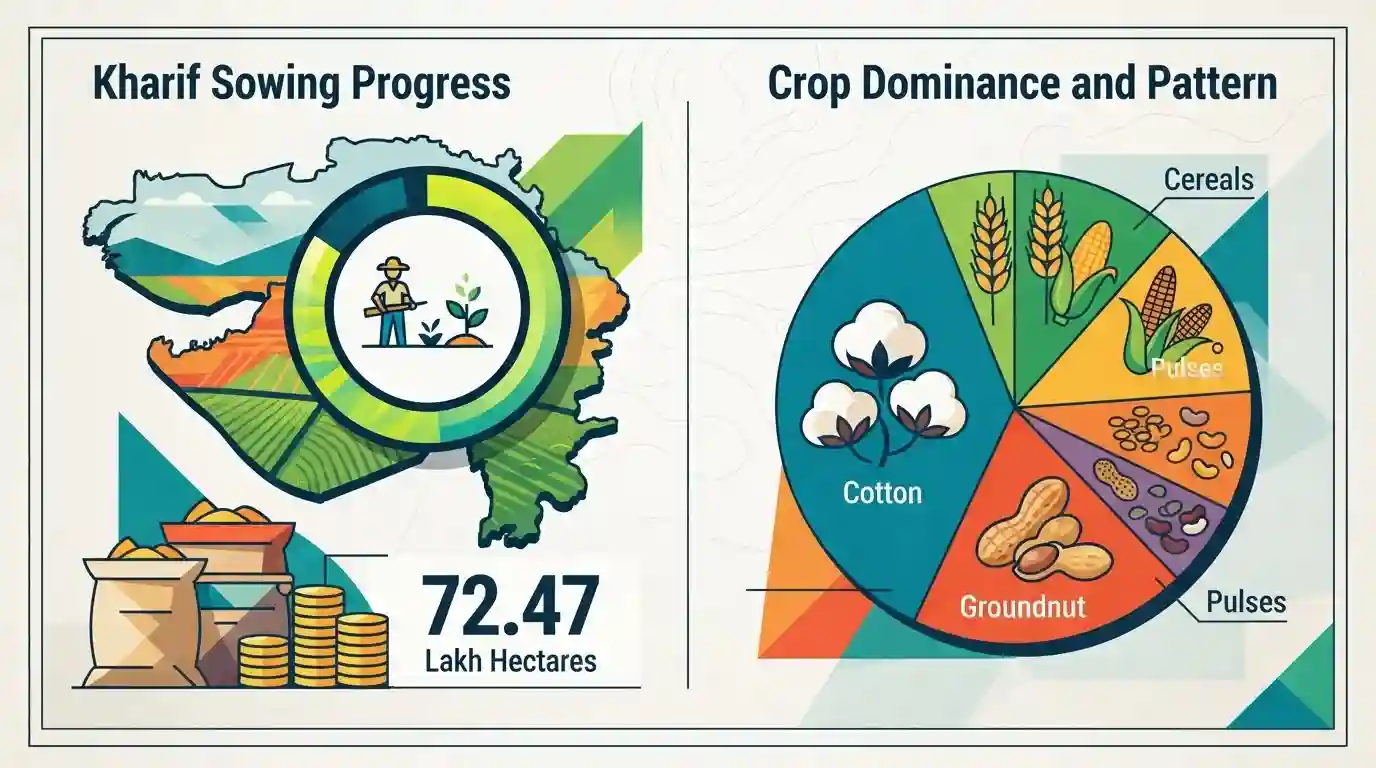
Gujarat's Kharif sowing for the 2026 season has reached 85% of its normal average, with a total sown area of 72.47 lakh hectares. The sowing pattern highlights a strong preference for commercial crops, with cotton and groundnut leading the chart, collectively accounting for more than 57% of the total cultivated area. Other crop categories include cereals and pulses, reflecting the state's diverse but cash-crop-heavy agricultural profile.
Key Points
- Gujarat's Kharif sowing has achieved 85% of its normal average, covering 72.47 lakh hectares out of the 85.39 lakh hectares average.
- Cotton and groundnut dominate the state's cropping pattern, accounting for 22.86 lakh hectares and 18.73 lakh hectares, respectively.
- Together, cotton and groundnut comprise over 57% of Gujarat's total Kharif sown area.
- Cereals (including paddy, bajra, jowar, maize) cover 11.23 lakh hectares, while pulses (tur, moong, moth bean, urad) cover 3.32 lakh hectares.
- Other significant crops include soybean, castor, and sesame.
Prelims Trap
All major commercial and oilseed crops of Gujarat, including Cotton, Groundnut, and Castor seed, are covered under the Minimum Support Price (MSP).
Castor seed, despite India/Gujarat being a global leader in its production, is not among the 22 federally mandated crops covered under the MSP framework.
Static Concepts Connected
What are the geographic and soil requirements for Cotton and Groundnut?
- Cotton Requirements: Requires warm climates (21-30°C), 50-100 cm rainfall, a minimum of 210 frost-free days, and well-drained deep black (Regur) soil.
- Groundnut Requirements: Thrives in warm, dry climates (20-30°C), 50-75 cm rainfall, and well-drained sandy loams or light black soils. Susceptible to frost.
Which oilseeds and commercial crops are covered under the MSP scheme?
- Covered Oilseeds: Groundnut, Rapeseed-Mustard, Soybean, Sesame, Sunflower, Safflower, and Nigerseed are the 7 officially covered oilseeds.
- Covered Commercial Crops: Cotton (medium & long staple), Raw Jute, and Copra. Sugarcane is covered under the Fair and Remunerative Price (FRP) mechanism.
- Notable Exclusions: Castor seed, horticultural crops, and minor spices do not have an officially declared central MSP.
Cross-Topic Patterns
Edible oil security vs import dependency
Increasing domestic groundnut and soybean yields in Gujarat directly targets India's high reliance on edible oil imports, aligning with the objectives of the National Mission on Edible Oils.
Water-stressed cash crops & micro-irrigation
As high-water-footprint cotton dominates semi-arid Saurashtra, integrating micro-irrigation under PMKSY is crucial to prevent groundwater depletion in Gujarat's cash-crop belts.

UPSC may couple cash crop geography (cotton/groundnut) with their MSP status and water-use efficiency in semi-arid zones.
Linked PYQs · 1
Linked PYQs · 1
- 2025GPSC_PRELIMSGS1
Which of the following major crops are covered under the Minimum Support Price Policy of Government of India? 1. Sorghum 2. Maize 3. Cotton 4. Sugarcane
