Gujarat Kharif Sowing Reaches Seventy Percent Led by Cotton
Source:deshgujarat ↗
Why It Matters
Knowledge of state-level cropping patterns, particularly for major commercial crops like cotton and groundnut in Gujarat, is essential for understanding India's agricultural economy, edible oil security, and textile industry raw material supply.
Summary
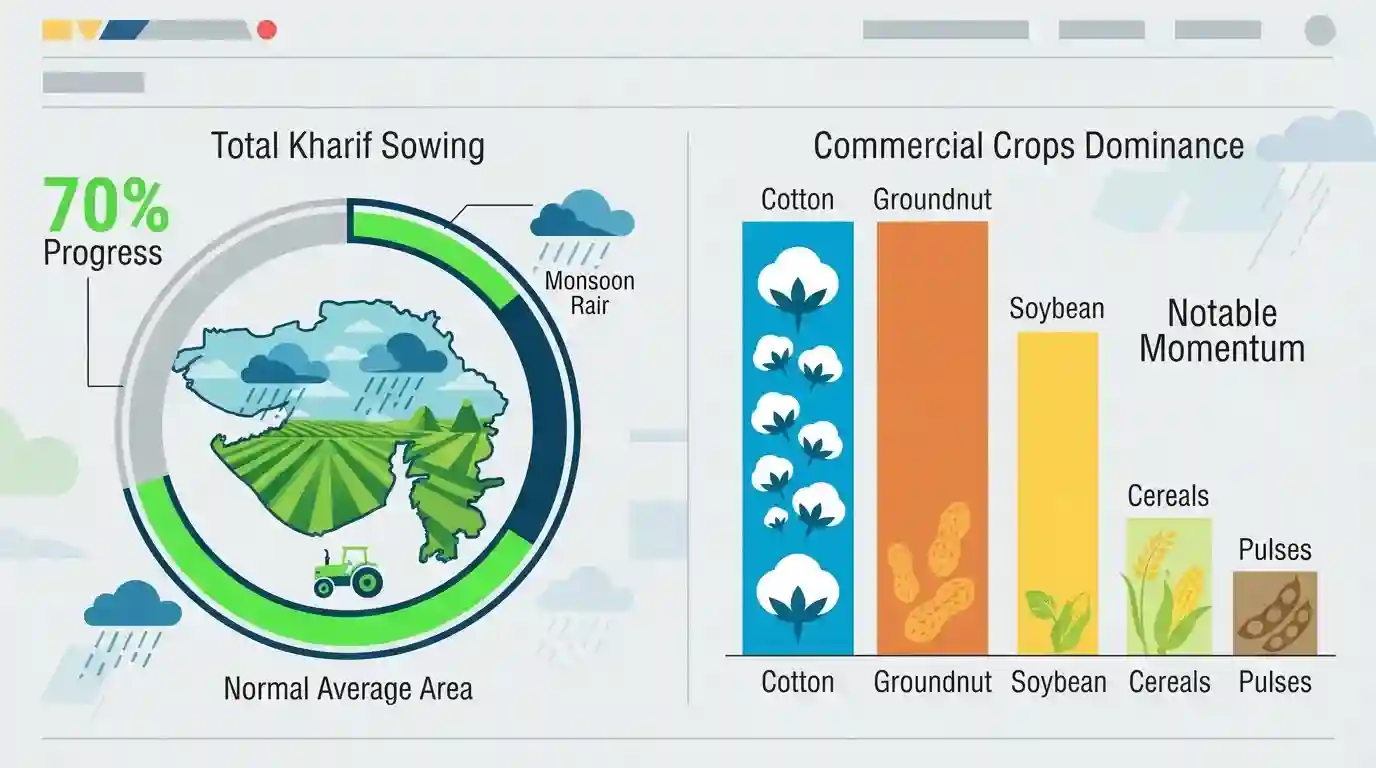
Kharif sowing in Gujarat has made robust progress, reaching 70% of its normal average area (59.26 lakh hectares) aided by widespread seasonal rainfall. The state's agricultural activity is heavily led by commercial crops, with cotton and groundnut making up the vast majority of the sown area. There is also notable momentum in the sowing of soybean, which has nearly reached its full normal average, alongside steady progress in various cereals and pulses.
Key Points
- Gujarat's Kharif sowing has achieved 70% of its normal average, covering over 59.26 lakh hectares due to widespread rainfall.
- Cotton and groundnut dominate the sowing landscape, collectively accounting for more than 63% of the total sown area in the state.
- Soybean sowing has been particularly strong, reaching 99% of its normal average area.
- The cultivation of cereals like maize and paddy, along with pulses such as tur, urad, and moong, is also progressing significantly.
Important Terms
Kharif Season

The monsoon-dependent agricultural cropping season in India, lasting from June to October, where crops are sown with the onset of southwest monsoons and harvested in autumn.
UPSC context
GS Paper 3 (Cropping Patterns); tests knowledge of agricultural cycles, monsoon dependency, and geographical crop distribution.
Cropping Patterns
The spatial and temporal arrangement of crops, including the proportion of area under various crops and crop rotation, practiced in a specific region over a year.
UPSC context
GS Paper 3 (Major crops cropping patterns); tests understanding of crop diversification, policy impact, and agricultural resource efficiency.
Cash Crops
Agricultural crops grown primarily for sale in domestic or international markets to generate commercial profit, rather than for the grower's personal subsistence.
UPSC context
GS Paper 3 (Agriculture and Economy); tests insights on farmer income, commercial agriculture economics, and raw material supply chains.
Cotton
A premier cash and fibre crop in India, primarily grown during the Kharif season, requiring high temperatures, moderate rainfall, and well-drained deep black clayey soils.
UPSC context
GS Paper 1 and 3 (Geographic distribution of resources/Agriculture); tests soil types, climatic requirements, and textile sector linkages.
Groundnut
A major Kharif oilseed and legume crop grown in semi-arid and tropical regions, thriving in sandy loam or medium-black soils, with Gujarat being India's leading producer.
UPSC context
GS Paper 3 (Agriculture and Oilseeds); tests climate requirements, geographic concentration, and legume crop benefits to soil fertility.
Oilseeds
Crops grown primarily for extracting edible or industrial oil from their seeds, representing a crucial component of India's import substitution strategy and dietary energy.
UPSC context
GS Paper 3 (Agriculture, Food Security); tests self-reliance strategies, import bill reductions, and edible oil security missions.
Prelims Trap
Groundnut is strictly a Kharif crop in India and cannot be cultivated during the Rabi season.
Groundnut is primarily a Kharif crop but is also grown during Rabi and summer seasons, especially in southern states and Gujarat under irrigated conditions, making 'strictly Kharif' false.
Static Concepts Connected
What are the specific agro-climatic requirements for Cotton cultivation in India?
- Soil type: Thrives best in deep, moisture-retentive black cotton soil (Regur) of the Deccan trap.
- Climate: Requires uniformly high temperatures (21°C to 30°C) and at least 210 frost-free days with bright sunshine.
- Rainfall: Needs moderate rainfall (50-100 cm); waterlogging is highly destructive to the crop.
How does the MSP framework classify oilseeds and commercial crops?
- Mandated oilseeds: Groundnut and soybean are among the seven oilseeds protected under the Minimum Support Price (MSP) regime.
- Commercial crops: Cotton (medium/long staple) is covered under MSP, whereas sugarcane is supported by Fair and Remunerative Price (FRP).
Cross-Topic Patterns
Cash crops vs. Food security
Shift towards commercial crops like cotton in semi-arid regions impacts local coarse cereal production, driving discussions on regional food security and crop diversification.
Virtual water export in agriculture
Exporting water-intensive cotton and oilseeds from water-stressed regions like Saurashtra represents a massive virtual water export, challenging sustainable irrigation planning.

Multi-statement questions linking crop climatic requirements (like cotton's frost-free days) with MSP eligibility remain a UPSC favorite.
Linked PYQs · 1
Linked PYQs · 1
- 2025GPSC_PRELIMSGS1
Which of the following major crops are covered under the Minimum Support Price Policy of Government of India? 1. Sorghum 2. Maize 3. Cotton 4. Sugarcane
