High industrial land prices constrain manufacturing growth in Gujarat
Source:businesstoday ↗
Why It Matters
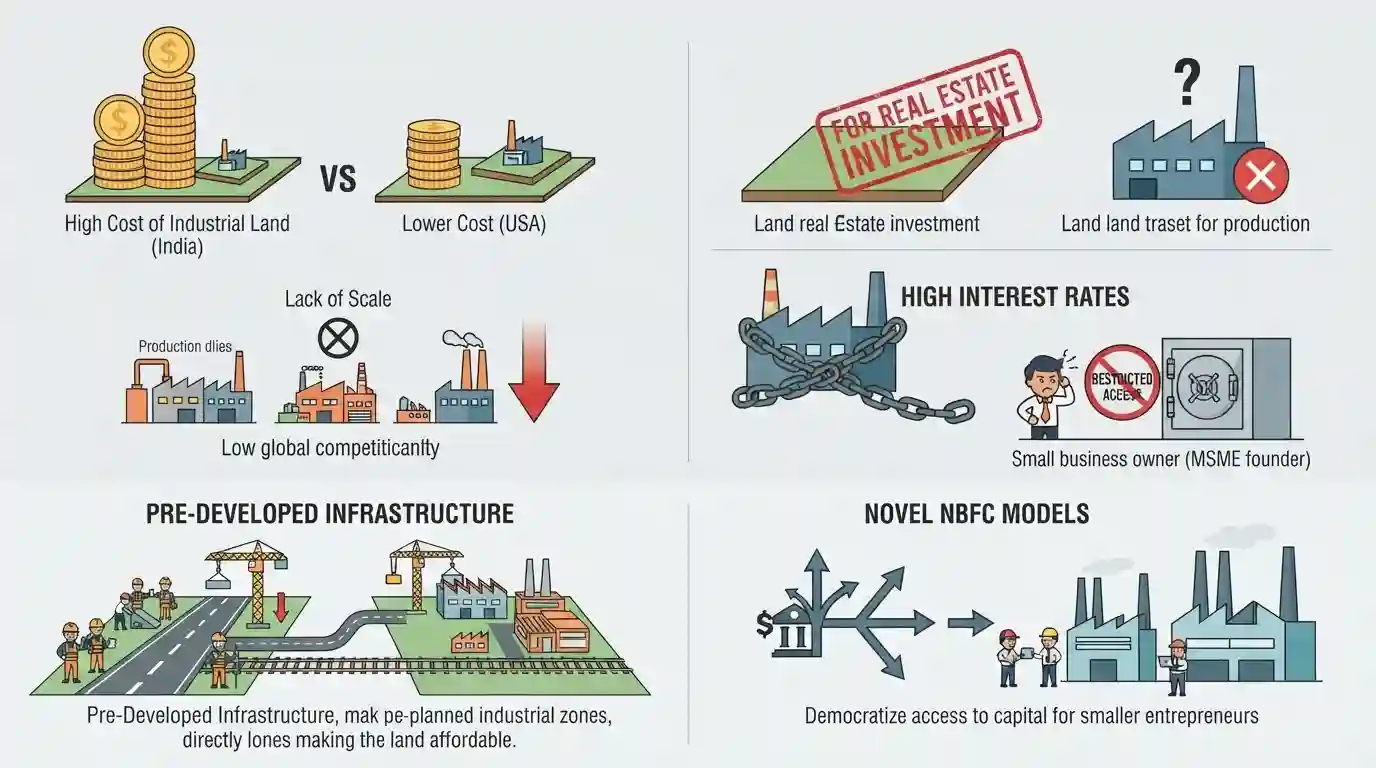
It exposes critical bottlenecks in India's 'Make in India' ambitions, illustrating how land economics, high borrowing costs, and infrastructure deficits directly hinder industrial scale and economic growth. Understanding these microeconomic realities is essential for evaluating national industrial and infrastructural policies.
Summary
The article highlights systemic barriers to manufacturing in India, particularly the unsustainable cost of industrial land in states like Gujarat. Founders from Titan Additive and Zoho point out that industrial land is significantly more expensive in India than in parts of the US, leading to small-scale operations that lack global competitiveness. This high cost turns industrial plots into real estate investments rather than productive assets. Coupled with high interest rates, capital-intensive manufacturing is heavily constrained. Suggested solutions include pre-developing infrastructure like highways and railways to make land affordable and utilizing novel NBFC models to democratize access to capital.
Key Points
- The cost of industrial land in Gujarat's GIDC estates is significantly higher (₹5,000 to ₹7,000 per sq ft) compared to developed regions like Detroit, USA (₹1,200 per sq ft).
- Exorbitant land costs force manufacturers to operate in small, sub-optimal factories, restricting their ability to achieve economies of scale and global competitiveness.
- Instead of serving as a productive base for manufacturing, industrial land often functions as an appreciating real estate asset.
- High interest rates and expensive capital access are identified as major, compounding hurdles for manufacturing investments in India.
- Industry leaders suggest that developing robust infrastructure (highways and railways) prior to industrial zoning can make land affordable, while localized NBFC models could ease capital access.
Important Terms
Gujarat Industrial Development Corporation (GIDC)

A statutory body in Gujarat responsible for developing industrial estates and providing infrastructure. Its plot allocations are central to the state's industrial policy, though speculative land pricing currently hampers manufacturing.
UPSC context
Crucial for GPSC Paper 3 (Economy of Gujarat) regarding industrial policy, infrastructure development, and structural barriers to the ease of doing business.
Non-Banking Financial Companies (NBFCs)
Financial institutions providing banking services like loans without a full banking license. They play a crucial role in bridging the credit gap for MSMEs by offering flexible, accessible capital solutions.
UPSC context
Tests GS Paper 3 (Indian Economy) knowledge on financial inclusion, MSME credit availability, and the impact of the cost of capital.
Titan Additive
A Gujarat-based manufacturing company that recently sparked discussions on India's industrial policy by highlighting how speculative industrial land prices make scaling operations unsustainable compared to global counterparts.
UPSC context
Serves as a practical case study in GS Paper 3 for analyzing systemic barriers to manufacturing, capital intensity, and real estate speculation.
Zoho
An Indian technology company known for pioneering rural development models. Its leadership frequently emphasizes the need for balanced corporate cultures and structural reforms to support domestic manufacturing and operations.
UPSC context
Useful as a contemporary example in GS Paper 3 (Economic Development) and Ethics for decentralized, indigenous growth models.
Prelims Trap
"GIDC industrial estates are immune to market speculation due to strict state-subsidized pricing."
While GIDC initially allocates land, a massive secondary market exists. Speculation in this market drives prices to prohibitive levels, acting as a structural bottleneck.
Static Concepts Connected
What are the primary structural bottlenecks for MSME manufacturing growth in India?
- Cost of Capital: Structurally higher domestic interest rates compared to developed nations penalize capital-intensive setups.
- Land Acquisition Costs: Secondary market speculation in designated industrial zones turns land into an appreciating asset rather than a productive factor.
- Logistics & Infrastructure: Inadequate pre-developed infrastructure (highways/railways) limits the supply of viable industrial land, driving up fixed costs.
How do NBFCs support MSME and industrial financing differently than scheduled commercial banks?
- Flexible Credit Access: NBFCs can deploy more localized, flexible credit models compared to the rigid collateral requirements of traditional commercial banks.
- Regulatory Distinction: Unlike banks, NBFCs cannot accept demand deposits or issue cheques, but they play a critical role in last-mile credit delivery.
Cross-Topic Patterns
MSME Dwarfism & Land Speculation
High land prices force MSMEs into sub-optimal factory sizes ("dwarfism"), preventing them from achieving the economies of scale needed for global export competitiveness.
PM Gati Shakti & Land Affordability
Pre-developing multimodal transport links expands the supply of accessible land, directly countering localized real estate speculation in saturated traditional industrial hubs.

Expect a multi-statement question linking MSME 'dwarfism', high cost of capital, and the impact of land speculation on manufacturing.
Linked PYQs · 5
Linked PYQs · 5
- 2018GPSC_PRELIMSGS1
Which of the following statement(s) is(are) correct? 1. Erstwhile Ministry of Small Scale Industries and the Ministry of Agro and Rural Industries were merged to form the Ministry of Micro, Small and Medium Enterprises. 2. In Service Sector, Micro Enterprise Category investment should not exceed INR 25 lakhs in Equipments. 3. In Manufacturing Sector, Medium Enterprise Category investment should be more than INR 5 crores but should not exceed INR 10 crores in plant and machinery.
- 2025GPSC_PRELIMSGS1
Consider the following statements regarding Industrial Policy Resolution of 1956: 1. This policy was based on P.C. Mahalanobis model 2. The emphasis was on setting up small and medium industries in the backward regions 3. Industries were classified in three categories in this policy Which of the statements given above is/are correct?
- 2026GPSC_PRELIMSGS1
Which of the statement/s given below is/are correct? 1. Liquidity Adjustment Facility (LAF) refers to the Reserve Bank's operations through which it injects/absorbs liquidity into/from the banking system. 2. Marginal Standing Facility (MSF) is the penal rate at which banks can lend, on an overnight basis, from the Reserve Bank. 3. Unlike LAF, MSF can be obtained without pledging any collateral securities by the bank. Choose the correct option from the following.
- 2025GPSC_PRELIMSGS1
Recently, RBI has decreased Cash Reserve Ratio (CRR). Such a step may allow banks to cut the interest rates for loans because of which one of the following reasons?
- 2026GPSC_PRELIMSGS1
Consider the following statements regarding India's inland water transport infrastructure: 1. National Waterway 1 (NW-1) is the longest navigable inland waterway in the country, extending from Prayagraj to Haldia along the Ganga-Bhagirathi-Hooghly river system. 2. The Jal Marg Vikas Project (JMVP), implemented with technical and financial assistance from the World Bank, is primarily focused on capacity augmentation of the Brahmaputra River (NW-2). 3. The West Coast Canal (NW-3) maintains a highly consistent navigable draft year-round, facilitated by the natural topography of estuarine backwaters (Koyals) in Kerala. Which of the above statement/s is/are correct?
