Gujarat government executes bureaucratic reshuffle
Source:bureaucracy-buzz ↗
Why It Matters
Bureaucratic reshuffles highlight the operational mechanics of state administration. Understanding the roles of key departments like the General Administration Department (GAD) and regulatory bodies like the Gujarat Electricity Regulatory Commission (GERC) is essential for grasping how state policies and development schemes (e.g., Samagra Shiksha) are implemented on the ground.
Summary
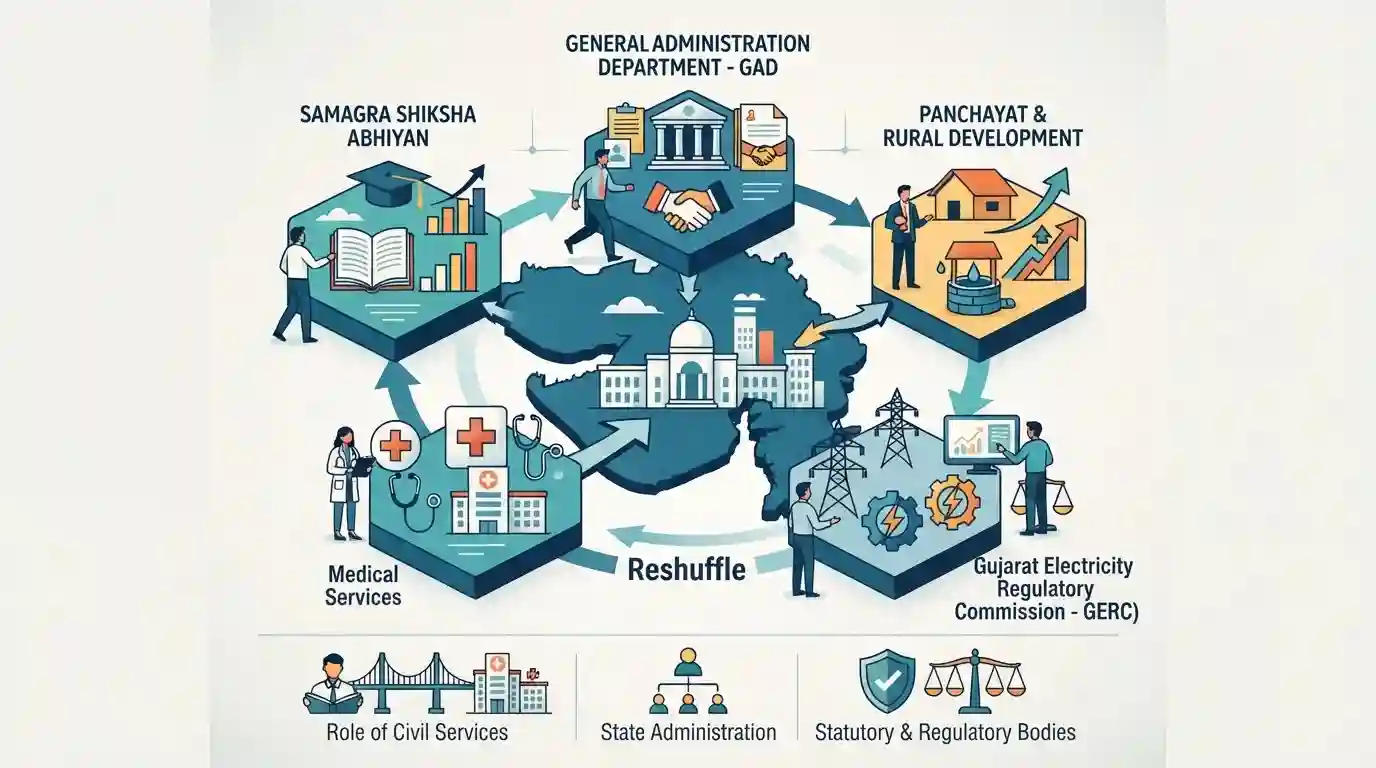
The Gujarat state government has announced a bureaucratic reshuffle involving the transfer of five Indian Administrative Service (IAS) officers. Key appointments include Anchu Wilson as Joint Secretary in the General Administration Department (GAD) and M. Y. Daxini as Joint Secretary in the Panchayat, Rural Housing, and Rural Development Department. Other officers were assigned significant roles in the Gujarat Electricity Regulatory Commission (GERC), Medical Services, and the Samagra Shiksha Abhiyan, reflecting the state's ongoing administrative realignment to bolster governance and policy implementation.
Key Points
- The Gujarat state government executed a reshuffle of five Indian Administrative Service (IAS) officers to various state departments.
- Anchu Wilson (2018 batch) was appointed as Joint Secretary in the General Administration Department (GAD), Gandhinagar.
- M. Y. Daxini was brought back from a non-government post and appointed as Joint Secretary in the Panchayat, Rural Housing, and Rural Development Department.
- Gaurav Dahiya was transferred to serve as the Secretary of the Gujarat Electricity Regulatory Commission (GERC).
- S. K. Prajapati was appointed as the Additional State Project Director of the Samagra Shiksha Abhiyan, Gandhinagar.
Important Terms
Samagra Shiksha Abhiyan

A centrally sponsored overarching scheme integrating Sarva Shiksha Abhiyan, Rashtriya Madhyamik Shiksha Abhiyan, and Teacher Education to provide inclusive, equitable, and quality school education from pre-school to Class 12.
UPSC context
Relevant to GS-2 (Education, Government Schemes). Tests knowledge of India's human resource development, educational policy integration, and SDG-4 alignment.
General Administration Department (GAD)
The principal administrative nerve center within a state government secretariat responsible for civil service personnel matters, IAS transfers, inter-departmental coordination, and maintaining administrative continuity.
UPSC context
Important for GS-2 (State Administration, Role of Civil Services). Highlights the structural hierarchy and functioning of the permanent executive.
Gujarat Electricity Regulatory Commission (GERC)
A statutory body operating under the Electricity Regulatory Commissions Act, tasked with regulating the state's power sector, adjudicating on electricity tariffs, and overseeing power purchase agreements.
UPSC context
Relevant to GS-2 (Statutory and Regulatory Bodies). Tests understanding of independent state-level economic regulators and their role in sector governance.
Prelims Trap
State Electricity Regulatory Commissions (SERCs) regulate tariffs for both intra-state and inter-state transmission of electricity.
CERC handles central generating stations and inter-state transmission. SERCs strictly regulate intra-state electricity generation, transmission, and distribution tariffs.
Static Concepts Connected
What are the key features of the Samagra Shiksha Abhiyan?
- Funding Model: It is a Centrally Sponsored Scheme (CSS) implemented by the Department of School Education and Literacy.
- Coverage: It treats school education holistically as a continuous progression from pre-school to Class 12.
- Subsumed Schemes: It subsumed three erstwhile major schemes: Sarva Shiksha Abhiyan (SSA), Rashtriya Madhyamik Shiksha Abhiyan (RMSA), and Teacher Education.
What is the mandate of State Electricity Regulatory Commissions (SERCs)?
- Statutory Origin: They are statutory bodies established under the Electricity Act, 2003.
- Core Mandate: They determine intra-state electricity tariffs, issue licenses, and promote renewable energy within the respective state.
- Quasi-judicial powers: They possess quasi-judicial powers to adjudicate disputes between generating companies and distribution licensees.
Cross-Topic Patterns
SERCs and Power Sector Reforms
The functioning of SERCs is frequently tied to the financial restructuring of state DISCOMs under schemes like UDAY and RDSS, linking statutory bodies to core economic infrastructure.
IAS Cadre Management Mechanics
While the Ministry of Personnel (DoPT) is the cadre controlling authority for IAS at the Centre, state-level postings are managed by the General Administration Department (GAD), usually under the Chief Minister.

State-level statutory bodies like SERCs are prime targets for Prelims statements testing the limits of quasi-judicial powers.
Linked PYQs · 2
Linked PYQs · 2
- 2022GPSC_PRELIMSGS1
A State Legislature may provide for the representation of which of the following persons in a municipality? 1. Members of the Lok Sabha and the state legislative assembly representing constituencies that comprise wholly or partly the municipal area. 2. Teachers and graduates living within the municipal area. 3. Persons having special knowledge or experience in municipal administration. Select the correct answer code:
- 2025GPSC_PRELIMSGS1
Which of the following statements correctly describe/(s) the powers and responsibilities of statutory and quasi-judicial bodies in India? 1. The Election Commission of India (ECI) is a quasi-judicial body that has the power to adjudicate the disputes related to political parties under the Tenth Schedule. 2. The National Green Tribunal (NGT) is a statutory body that exclusively handles environmental disputes under the NGT Act, 2010. 3. The Central Vigilance Commission (CVC) is a constitutional body responsible for investigating corruption cases in the country. 4. The Securities and Exchange Board of India (SEBI) regulates financial markets but does not have quasi-judicial powers. Select the correct answer using the codes given below:
