Gujarat launches nationwide youth anti drug campaign in Gandhinagar
Source:lokmattimes ↗
આ શા માટે મહત્વનું છે
Government interventions targeting drug abuse among the youth are critical for harnessing India's demographic dividend. Linking anti-addiction drives with environmental campaigns ('Ek Ped Maa Ke Naam') and agricultural reform (natural farming) demonstrates an integrated approach to social empowerment and sustainable development.
સારાંશ
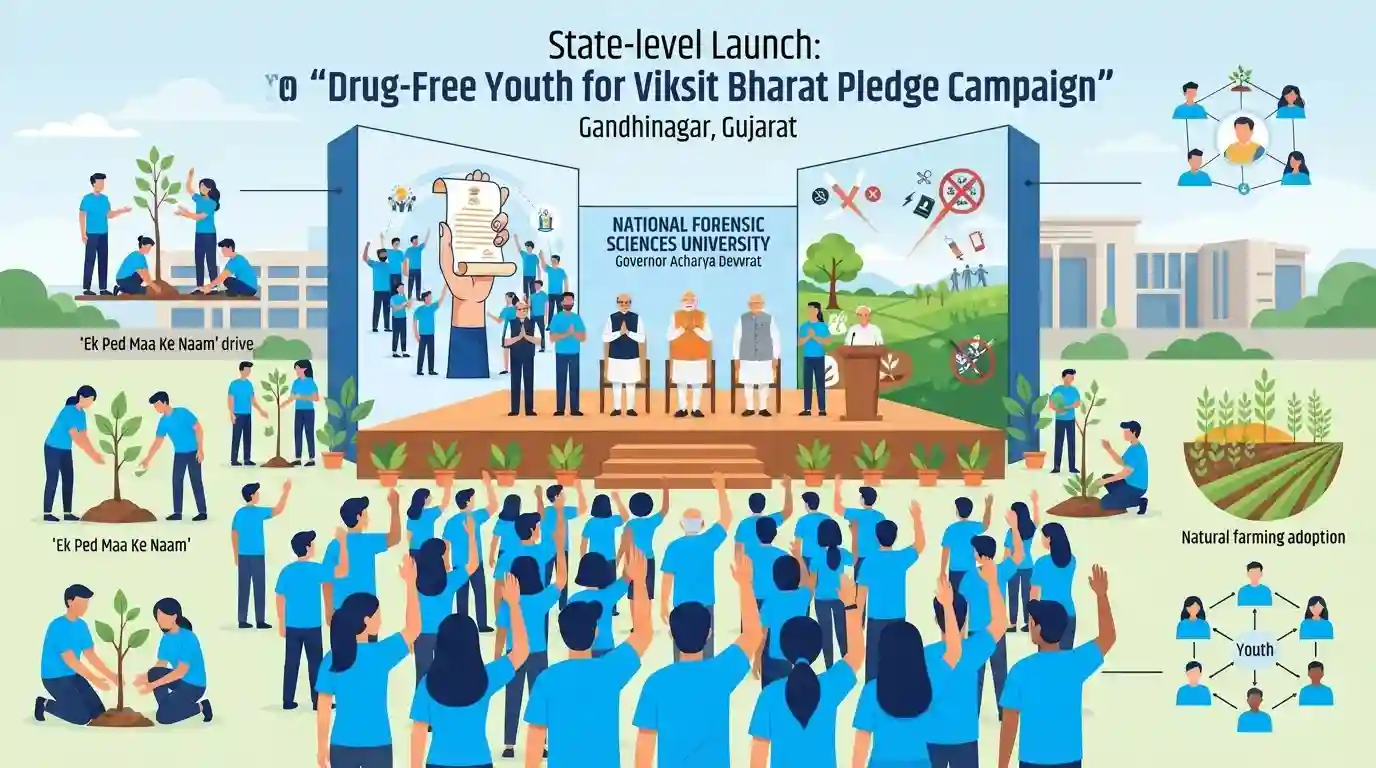
Gujarat hosted the state-level launch of the nationwide "Drug-Free Youth for Viksit Bharat Pledge Campaign" at the National Forensic Sciences University in Gandhinagar. Spearheaded by Prime Minister Narendra Modi, the initiative aims to protect Gen-Z from drug addiction, empowering them to contribute to a 'Viksit Bharat' (Developed India). During the event, Governor Acharya Devvrat and Chief Minister Bhupendra Patel urged thousands of "My Bharat" youth volunteers to commit to a drug-free life. They additionally emphasized related social and environmental imperatives, encouraging participation in the 'Ek Ped Maa Ke Naam' tree plantation drive and highlighting Gujarat's steady adoption of natural farming.
મુખ્ય મુદ્દા
- Gujarat hosted the state-level launch of the "Gen-Z Against Addiction – Drug-Free Youth for Viksit Bharat Pledge Campaign" at NFSU, Gandhinagar.
- Chief Minister Bhupendra Patel highlighted the campaign's role in building a capable youth demographic for 'Viksit Bharat' by steering them away from drugs.
- Governor Acharya Devvrat urged youth to combine the anti-drug pledge with environmental action through the 'Ek Ped Maa Ke Naam' tree plantation campaign.
- The event highlighted Gujarat's progress in sustainable agriculture, noting that over 11,000 farmers in the state have transitioned to natural farming.
મહત્વપૂર્ણ શબ્દો
Drug-Free Youth for Viksit Bharat Sankalp Abhiyan

A nationwide campaign launched by PM Modi to combat substance abuse among youth. It mobilizes students and educational institutions to take anti-drug pledges, aiming to build a physically and mentally healthy generation for a developed India.
UPSC context
GS 2 (Social Justice & Public Health). Highlights government strategies tackling substance abuse and youth empowerment.
Ek Ped Maa Ke Naam
A mega tree-plantation drive launched by the Prime Minister on World Environment Day 2024. The initiative encourages citizens to plant a sapling honoring their mothers, intertwining cultural values with environmental sustainability and afforestation goals.
UPSC context
GS 3 (Environment). Evaluates knowledge of citizen-led climate action, Mission LiFE, and afforestation programs.
Nasha Mukt Bharat Abhiyaan (NMBA)
An initiative launched in 2020 by the Ministry of Social Justice and Empowerment to address drug addiction. It focuses on community awareness, early prevention, and linking vulnerable youth to treatment and rehabilitation services nationwide.
UPSC context
GS 2 (Vulnerable Sections & Health). Important for policies on drug demand reduction and social rehabilitation.
Mera Yuva Bharat (MY Bharat)
An autonomous, technology-driven platform launched in 2023 under the Ministry of Youth Affairs and Sports. It offers phygital opportunities, blending digital access with physical volunteerism and experiential learning to harness India's demographic dividend.
UPSC context
GS 2 (Human Resources). Tests schemes bridging the skill gap, youth engagement, and participatory governance models.
National Forensic Sciences University (NFSU)
Located in Gandhinagar, NFSU is an Institution of National Importance under the Ministry of Home Affairs. It is the world's first university dedicated exclusively to forensic science, cyber security, and allied investigative disciplines.
UPSC context
GS 3 (Internal Security & Science/Tech). Relevant for institutional capacity-building in criminal justice and cyber forensics.
પ્રિલિમ્સ ટ્રેપ
"The Nasha Mukt Bharat Abhiyaan is a flagship initiative of the Ministry of Home Affairs to dismantle narcotic smuggling networks."
While drug supply control and enforcement fall under the MHA (via NCB), the NMBA focuses on demand reduction and is managed by MoSJE.
સંલગ્ન સ્થિર ખ્યાલો
How is drug control jurisdiction divided among Indian Ministries?
- Supply Control (MHA): Narcotics Control Bureau (NCB) enforces drug laws, tracks trafficking, and destroys illicit crops.
- Demand Reduction (MoSJE): Coordinates the Nasha Mukt Bharat Abhiyaan, focusing on awareness, education, and social empowerment to reduce drug consumption.
- Rehabilitation (MoHFW): Manages the treatment, de-addiction centers, and medical rehabilitation of affected individuals.
What defines an Institution of National Importance (INI) like NFSU?
- Statutory Backing: Conferred by an Act of Parliament to premier institutes that serve as pivotal players in developing highly skilled personnel within specific regions.
- Nodal Ministry: Unlike most universities under the Ministry of Education, NFSU falls directly under the Ministry of Home Affairs to align with internal security objectives.
- Unique Mandate: It is the world’s first and only university dedicated exclusively to forensic science, behavioral science, and cybersecurity.
આંતર-વિષય પેટર્ન
Demographic Dividend vs. Internal Security
India's demographic dividend goals ('Viksit Bharat') are directly threatened by narco-terrorism. Unemployed youth in border states like Gujarat and Punjab are vulnerable targets for transnational drug syndicates.
Behavioral nudges via Digital Governance
The 'Ek Ped Maa Ke Naam' campaign uses the Meri LiFE portal to log tree planting, illustrating a rising UPSC theme: merging mass behavioral campaigns with digital tracking mechanisms.

Multi-statement Qs combining MY Bharat's age criteria (15-29) with NMBA's nodal ministries (MoSJE vs MHA) are highly likely for 2026.
સંલગ્ન PYQ · 2
સંલગ્ન PYQ · 2
- 2026GPSC_PRELIMSGS1
In the context of the Pradhan Mantri Gramin Digital Saksharta Abhiyan (PMGDISHA), consider the following statements: 1. The scheme's primary goal is to make at least one person in every rural household digitally literate, specifically targeting the age group of 14 to 60 years. 2. To bridge the digital divide, the scheme gives priority to non-smartphone users, Antyodaya households and college drop-outs from marginalized communities. Which of the above statement(s) is/are correct?
- 2022GPSC_PRELIMSGS1
Which one of the following schemes is aimed at increasing the confidence of young, educated or skilled workers who would now be able to aspire to become first generation entrepreneurs?
