Methanol Poisoning Death Toll Rises in Gujarat Hooch Tragedy
Source:The Hindu ↗
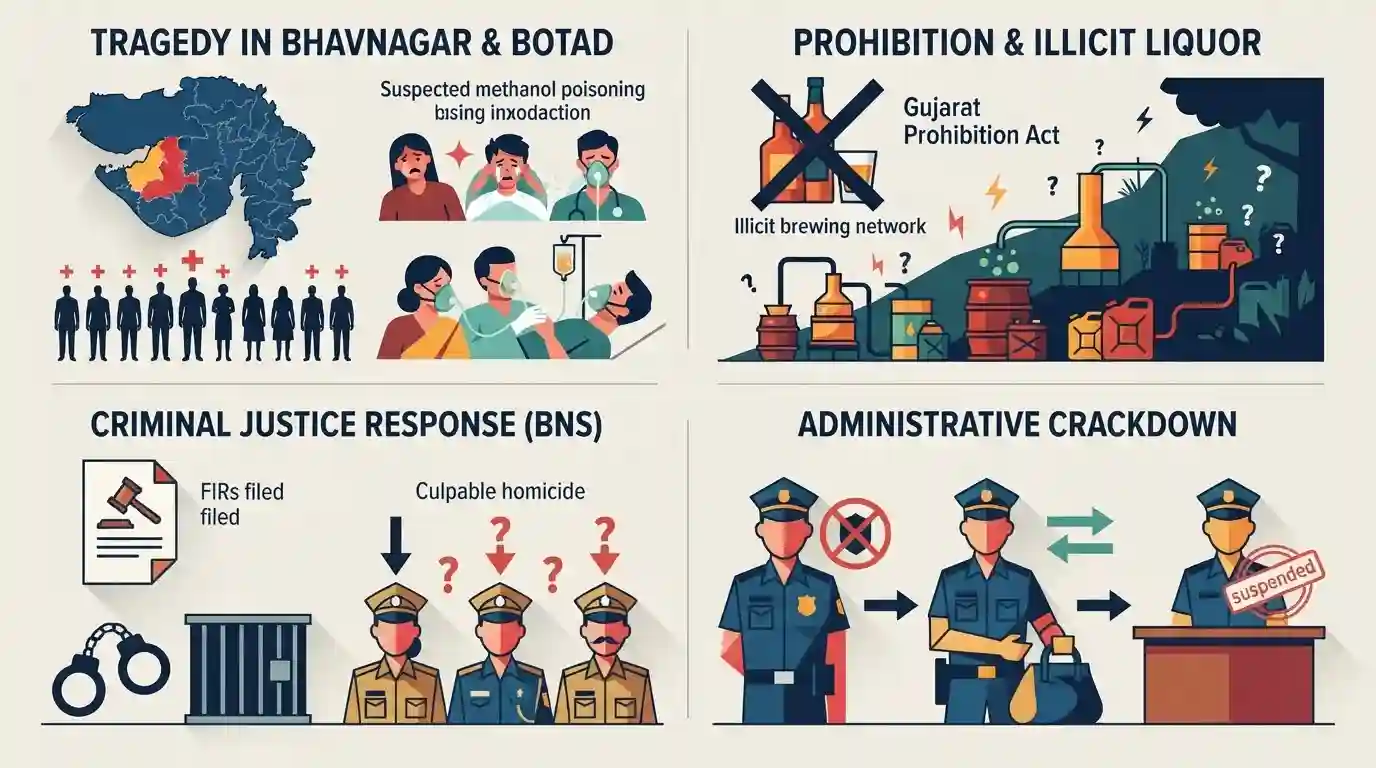
Why It Matters
Demonstrates the practical challenges and governance failures associated with enforcing strict prohibition laws, alongside the fatal public health consequences of methanol adulteration in the illicit liquor trade.
Summary
A severe hooch tragedy in Gujarat's Bhavnagar and Botad districts has claimed 13 lives, with several others undergoing treatment for suspected methanol poisoning. The spurious liquor consumption occurred despite the state's strict liquor ban under the Gujarat Prohibition Act. In response, authorities have registered FIRs under the Bharatiya Nyaya Sanhita for culpable homicide, and the State Monitoring Cell is investigating the illicit brewing networks. The incident has also led to administrative crackdowns, including the transfer and suspension of top local police officials for negligence in enforcing prohibition laws.
Key Points
- The death toll in the Gujarat hooch tragedy across the Bhavnagar and Botad districts has risen to 13 after consuming spurious liquor.
- Forensic investigations revealed that the illicit liquor was adulterated with highly toxic methanol.
- FIRs have been registered against the accused under the Bharatiya Nyaya Sanhita (BNS) for culpable homicide, alongside violations of the Gujarat Prohibition Act.
- The incident exposes significant law enforcement and governance challenges in Gujarat, a legally dry state.
Important Terms
Gujarat Prohibition Act

A 1949 state law strictly banning the manufacture, sale, and consumption of alcohol in Gujarat. It aims to eradicate liquor consumption in alignment with Gandhian principles, though limited permits are available.
UPSC context
Tests GPSC Paper 2 (Governance & State Policies), focusing on the socio-legal implications and challenges of enforcing state prohibition policies.
Bharatiya Nyaya Sanhita (BNS)
India's modernized criminal code that replaced the colonial-era Indian Penal Code (IPC). It emphasizes restorative justice, victim rights, and equitable legal processes over a purely punitive approach.
UPSC context
Crucial for GPSC Paper 2 (Criminal Justice System), testing recent legal reforms, citizen-centric governance, and modern punitive frameworks.
State Monitoring Cell (SMC)
A specialized law enforcement unit within the Gujarat Police mandated to monitor and enforce the Gujarat Prohibition Act, specifically targeting state-wide illicit liquor networks and gambling operations.
UPSC context
Relevant for GPSC Paper 2 and Paper 3, examining state administrative mechanisms, law enforcement effectiveness, and internal security issues.
Prelims Trap
"Ethanol is the toxic adulterant in spurious liquor that causes irreversible blindness and death."
Ethanol is the intoxicating agent in regular liquor and is actually used as an antidote. Methanol (methyl alcohol) is the toxic adulterant that causes blindness and death.
Static Concepts Connected
What is the constitutional and legal basis for liquor prohibition in India?
- DPSP Article 47: Directs the State to endeavor to bring about prohibition of intoxicating drinks and drugs injurious to health.
- State Subject: 'Intoxicating liquors' falls squarely under the State List (Entry 8) of the Seventh Schedule, giving state legislatures exclusive power to enact prohibition laws.
- Gujarat Prohibition Act: Implemented under the Gujarat Prohibition Act, 1949, which was originally the Bombay Prohibition Act before the state's bifurcation.
How does Methanol poisoning occur and how is it medically treated?
- Toxicity mechanism: Methanol metabolizes in the liver into highly toxic formic acid via the enzyme alcohol dehydrogenase (ADH).
- Clinical Symptoms: Accumulation of formic acid causes severe metabolic acidosis, optic nerve damage (leading to blindness), and eventually death.
- Antidote Treatment: Administration of Fomepizole or pharmaceutical-grade Ethanol, which acts as a competitive inhibitor to prevent methanol breakdown by ADH enzymes.
Cross-Topic Patterns
Prohibition (DPSP) + Methanol Biochemistry
GPSC often bridges constitutional mandates (Article 47 DPSP) with the hard science of state failures, testing the biochemistry of methanol alongside the legal framework of state prohibition laws.
IPC to BNS Transition in Policing
The shift from charging accused under IPC Section 299 to the new Bharatiya Nyaya Sanhita (BNS) Section 100 for culpable homicide will be a recurring theme in state policing questions.

Expect a multi-statement question combining Article 47 (DPSP), State List jurisdiction over liquor, and the biochemistry of methanol.
Linked PYQs · 2
Linked PYQs · 2
- 2026GPSC_PRELIMSGS1
With reference to the Supreme Court's landmark judgment in the Harish Rana vs. Union of India case, consider the following statements regarding euthanasia in India: 1. The fundamental right to live with dignity under Article 21 of the Constitution encompasses dignity until death, consequently including the right to die with dignity. 2. While the law permits the withdrawal of life-support systems under strict medical guidelines, the deliberate administration of lethal substances to accelerate a patient's death remains a criminal offense. Which of the above statement(s) is/are correct?
- 2026GPSC_PRELIMSGS1
Consider the following statements regarding the technical aspects of ethanol blending: 1. E20 means a blend of 20% ethanol by weight in petrol. 2. Higher ethanol blends may require modifications to the vehicle engine. 3. Ethanol has a lower energy value than petrol. Which of the above statements are correct?
