Social media platform X approaches Gujarat High Court
Source:livelaw ↗
Why It Matters
The development is critical for understanding digital governance and the legal framework governing cyber space in India. It illustrates the practical application and legal scrutiny of the Information Technology Act, 2000, and IT Rules, 2021, directly touching upon the fundamental right to freedom of speech and expression (Article 19) and the right to privacy (Article 21), which are recurring themes in GPSC Prelims.
Summary
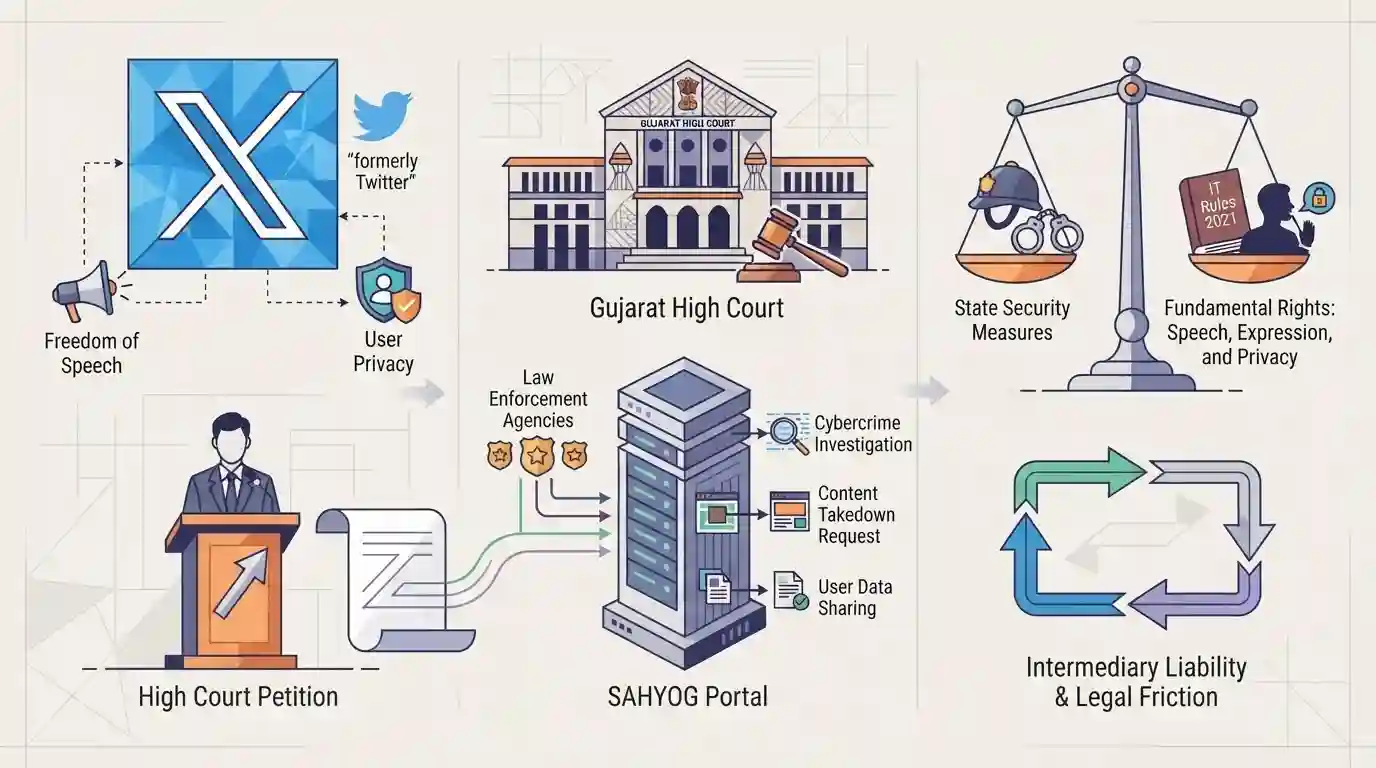
Social media intermediary X (formerly Twitter) moved the Gujarat High Court to seek the modification of an order directing it to onboard the Centre's SAHYOG portal. The SAHYOG portal is a centralized platform intended to streamline communication between law enforcement agencies and intermediaries regarding cybercrime investigations, content takedown requests, and user data sharing under the Information Technology Act. The petition underscores the ongoing legal and regulatory friction surrounding intermediary liability, the IT Rules 2021, and the balancing of state security measures with fundamental rights such as freedom of speech, expression, and privacy.
Key Points
- Social media platform X (formerly Twitter) approached the Gujarat High Court seeking a modification of a prior directive mandating its onboarding onto the Union Government's SAHYOG portal.
- The SAHYOG portal functions as a centralized mechanism for Indian law enforcement agencies to issue legal requests, such as content takedowns and user data requisition, directly to digital intermediaries.
- The legal challenge highlights the persistent tension between enforcing intermediary liability and compliance under the IT Rules, 2021, versus protecting user privacy and freedom of expression.
- Intermediaries frequently advocate for stringent procedural safeguards to prevent arbitrary state surveillance and ensure that takedown requests adhere strictly to constitutional provisions.
Important Terms
SAHYOG Portal

A centralized platform launched by the Ministry of Home Affairs in 2024 to automate and streamline the issuance of content takedown notices to digital intermediaries under the IT Act.
UPSC context
Important for GS Papers 2 & 3. Tests knowledge of digital governance, intermediary liability, and free speech regulation.
Information Technology Act, 2000
India's primary legislation governing cybercrime, electronic commerce, and digital content. It establishes legal frameworks for electronic transactions, government content-blocking powers, and intermediary liability.
UPSC context
Crucial for GS Papers 2 & 3. Evaluates understanding of statutory mechanisms managing cyberspace and data protection.
Information Technology (Intermediary Guidelines and Digital Media Ethics Code) Rules, 2021
Rules mandating strict due diligence for digital intermediaries, requiring swift unlawful content removal and robust grievance redressal mechanisms to retain their safe harbour protections.
UPSC context
Significant for GS Paper 2. Explores platform accountability, government regulation, and their impact on fundamental rights.
Section 69A of IT Act
A provision empowering the Central Government to block public access to online information to protect national security, public order, and India's sovereignty.
UPSC context
Key for GS Papers 2 & 3. Tests procedural safeguards and constitutional limits on state censorship and online blocking.
Ministry of Home Affairs
The nodal Union ministry responsible for India's internal security. It manages the Indian Cyber Crime Coordination Centre and oversees the SAHYOG portal for cybercrime enforcement.
UPSC context
Relevant for GS Paper 3 (Internal Security). Tests the institutional framework managing cyber threats and law enforcement coordination.
Prelims Trap
Safe harbour protection under Section 79 of the IT Act grants absolute immunity to social media intermediaries.
Safe harbour is strictly conditional. Platforms lose this immunity if they fail to observe 'due diligence' (such as IT Rules 2021 compliance) or ignore lawful government takedown notices.
Static Concepts Connected
What is the 'Safe Harbour' provision for digital intermediaries under the IT Act?
- Section 79 Immunity: It shields online intermediaries from legal liability for third-party user content hosted on their platforms.
- Conditional Protection: The immunity is revoked if platforms actively modify the content or fail to remove unlawful material upon receiving actual knowledge via court orders or government notices.
- IT Rules 2021: Significant social media intermediaries must appoint resident grievance and compliance officers to retain safe harbour protections.
What is the mandate of the Indian Cyber Crime Coordination Centre (I4C)?
- Nodal Agency: Established under the Ministry of Home Affairs to act as the primary nodal point for coordinating the fight against cybercrime in India.
- Key Initiatives: It operates the National Cyber Crime Reporting Portal and coordinates with intermediaries via the SAHYOG portal to streamline content takedowns and data sharing.
Cross-Topic Patterns
State Security vs. Right to Privacy
Mandatory data sharing via platforms like SAHYOG triggers the proportionality test established in the Puttaswamy judgment, balancing internal security imperatives (GS3) with fundamental privacy rights (GS2).
Delegated Legislation & Shreya Singhal
The friction over IT Rules 2021 and portal onboarding reflects ongoing debates over delegated legislation, directly testing the procedural safeguards upheld in the landmark Shreya Singhal case.

Expect a Prelims question testing the conditional nature of Section 79 'safe harbour' alongside MHA's I4C and SAHYOG portal mandates.
Linked PYQs · 3
Linked PYQs · 3
- 2024GPSC_PRELIMSGS1
Landmark judgments and the findings by Hon'ble courts are mentioned below. Evaluate the pairs: 1. Minerva Mills v. Union of India: The power of the Parliament to amend the Constitution is limited by the Constitution. 2. Ahmed Khan v. Shah Bano Begum: Extended Section 125 of the Criminal Procedure Code to provide maintenance to a divorced Muslim woman. 3. Shreya Singhal v. Union of India: The Hon'ble Supreme Court of India struck down Section 66A of the Information Technology Act (IT Act), which violated freedom of speech and expression, declaring it to be unconstitutional. Which of the statements given above are correct?
- 2024GPSC_PRELIMSGS1
The fundamental right of "Freedom of speech and expression" has been interpreted by the law courts to include which of the following rights? 1. Right to know about government activities. 2. Freedom of silence. 3. Right to strike 4. Right against imposition of pre-censorship on a newspaper. Select the correct answer code:
- 2020GPSC_PRELIMSGS1
Which of the following Articles provides the right of access to the Internet?
