Gujarat High Court Rules on Zero Turnover GST Cancellation
Source:a2ztaxcorp ↗
Why It Matters
The ruling is vital for understanding administrative accountability under tax laws, protecting taxpayers' rights, and defining the legal limits of GST authorities when handling low or zero-turnover business entities.
Summary
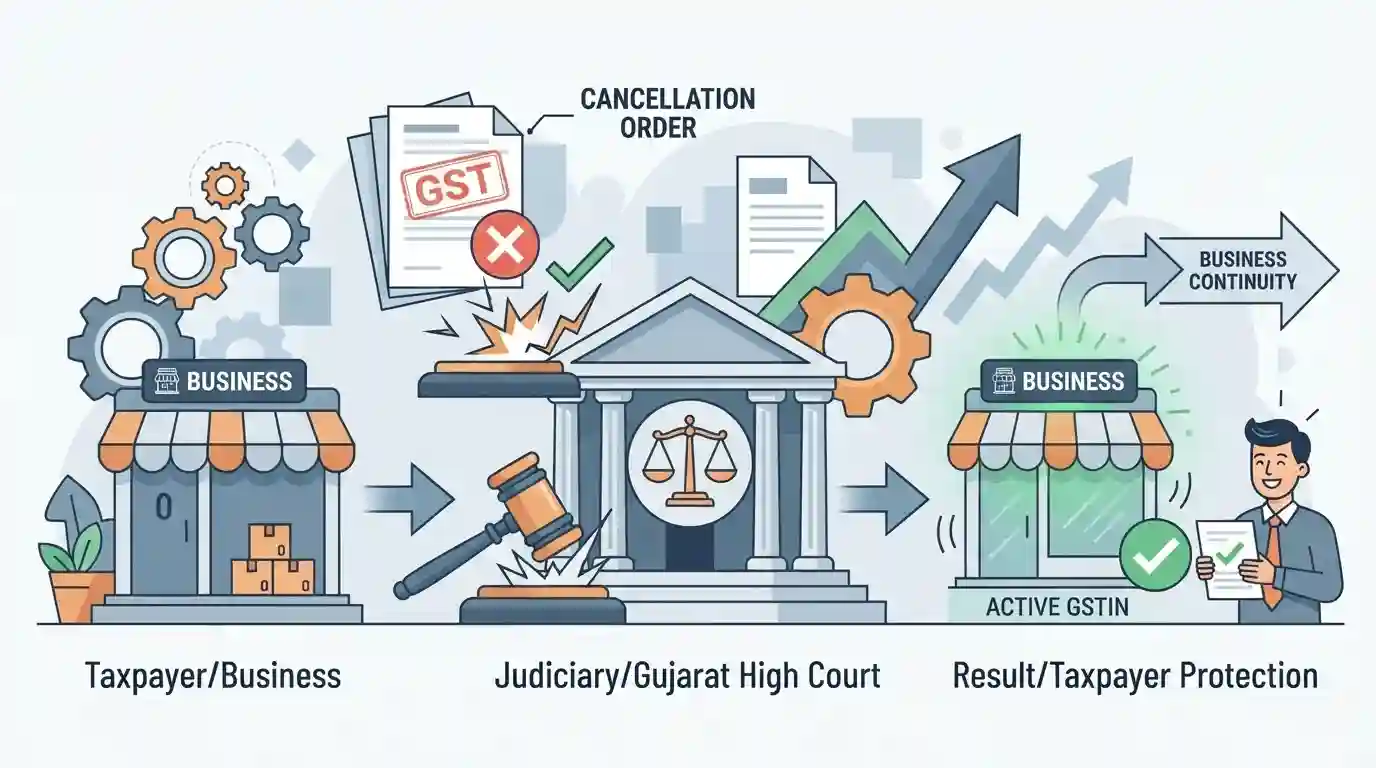
The Gujarat High Court recently quashed the cancellation of a GST registration that was triggered entirely due to zero-turnover filings. The court held that non-operational status or temporary zero business transactions alone do not justify the cancellation of a GSTIN by tax authorities, safeguarding taxpayers from arbitrary administrative actions.
Key Points
- The Gujarat High Court ruled that GST registration cannot be cancelled solely on the grounds of zero turnover or lack of business activity filings.
- The court emphasized that filing NIL returns or reporting zero turnover does not constitute a violation substantial enough to warrant the extreme measure of cancelling a registration under the GST framework without proper inquiry.
- This ruling protects businesses undergoing temporary lulls or startup phases from arbitrary cancellation of their tax identifications by authorities.
Important Terms
Central Goods and Services Tax (CGST) Act

The central legislation governing the levy, collection, and administration of intra-state Goods and Services Tax in India, providing statutory frameworks for registration, returns, and cancellation under Section 29.
UPSC context
Important for GS Paper III (Indian Economy - Taxation and GST Reforms), testing provisions relating to indirect taxation and compliance mechanisms.
State Goods and Services Tax (SGST) Act
State-level legislation enacted by individual states to complement the national GST framework for levying and collecting intra-state goods and services tax uniformly.
UPSC context
Important for GS Paper III (Indian Economy - Taxation), testing the cooperative federalism and dual-GST structure in India.
Gujarat High Court
The constitutional court of Gujarat exercising writ jurisdiction under Article 226 to review administrative and tax-related actions by state authorities for arbitrariness and violation of natural justice.
UPSC context
Important for GS Paper II (Polity and Governance - Judiciary and Writ Jurisdiction), testing the judicial review powers over executive actions.
Goods and Services Tax (GST) Department
The administrative machinery responsible for implementing GST laws, verifying taxpayer compliance, and executing enforcement actions such as registration cancellation and audits.
UPSC context
Important for GS Paper II/III (Polity and Governance - Executive enforcement & Economy - Tax administration), testing administrative overreach.
Static Concepts Connected
What are the grounds and revocation procedures for GST registration cancellation under Section 29 of the CGST Act?
- Statutory Grounds: Section 29 permits cancellation for fraud, willful suppression, continuous non-filing of returns, or violation of anti-profiteering provisions.
- Natural Justice: Tax authorities cannot cancel registrations arbitrarily without serving a show-cause notice and providing a reasonable opportunity of being heard.
- Revocation Window: A registered person whose registration is cancelled can apply for revocation of cancellation within thirty days of the order.
Cross-Topic Patterns
Judicial Review vs. Tax Administration Overreach
High Court interventions under Article 226 demonstrate the judiciary's role in curbing administrative overreach by tax authorities during economic slow-downs.
GST Compliance for Startups and Lulls
Startups and merchant exporters facing temporary demand shocks or incubation lulls are shielded from arbitrary compliance disenfranchisement.

GST registration cancellation grounds under Section 29 + High Court writ jurisdiction under Art 226 frequently appear in legal/polity MCQs.
Linked PYQs · 2
Linked PYQs · 2
- 2025GPSC_PRELIMSGS1
Which of the following statements about Judicial Review in India are correct? 1. Judicial Review is derived from Article 13 of the Indian Constitution. 2. The Supreme Court and High Courts have the power to review both Constitutional Amendments and laws. 3. The Keshavananda Bharati Case (1973) established that the basic structure of the constitution cannot be amended. 4. Judicial Review in India is broader than in the United States, as it allows for the review of Constitutional Amendments. Select the correct answer using the codes below:
- 2026GPSC_PRELIMSGS1
Consider the following Assertion and Reason: Assertion (A): The Supreme Court of India has the power of judicial review. Reason (R): Articles 13, 32 and 226 collectively form the constitutional basis of judicial review in India. Which of the following is correct with respect to the above?
