Gujarat High Court Artificial Intelligence Policy for Judiciary
Source:Indian Express ↗
Why It Matters
It addresses the critical balance between leveraging technology for administrative efficiency (e-courts) and preserving the ethical and constitutional sanctity of human judgment in the judiciary, while also highlighting the practical application of the DPDP Act, 2023.
Summary
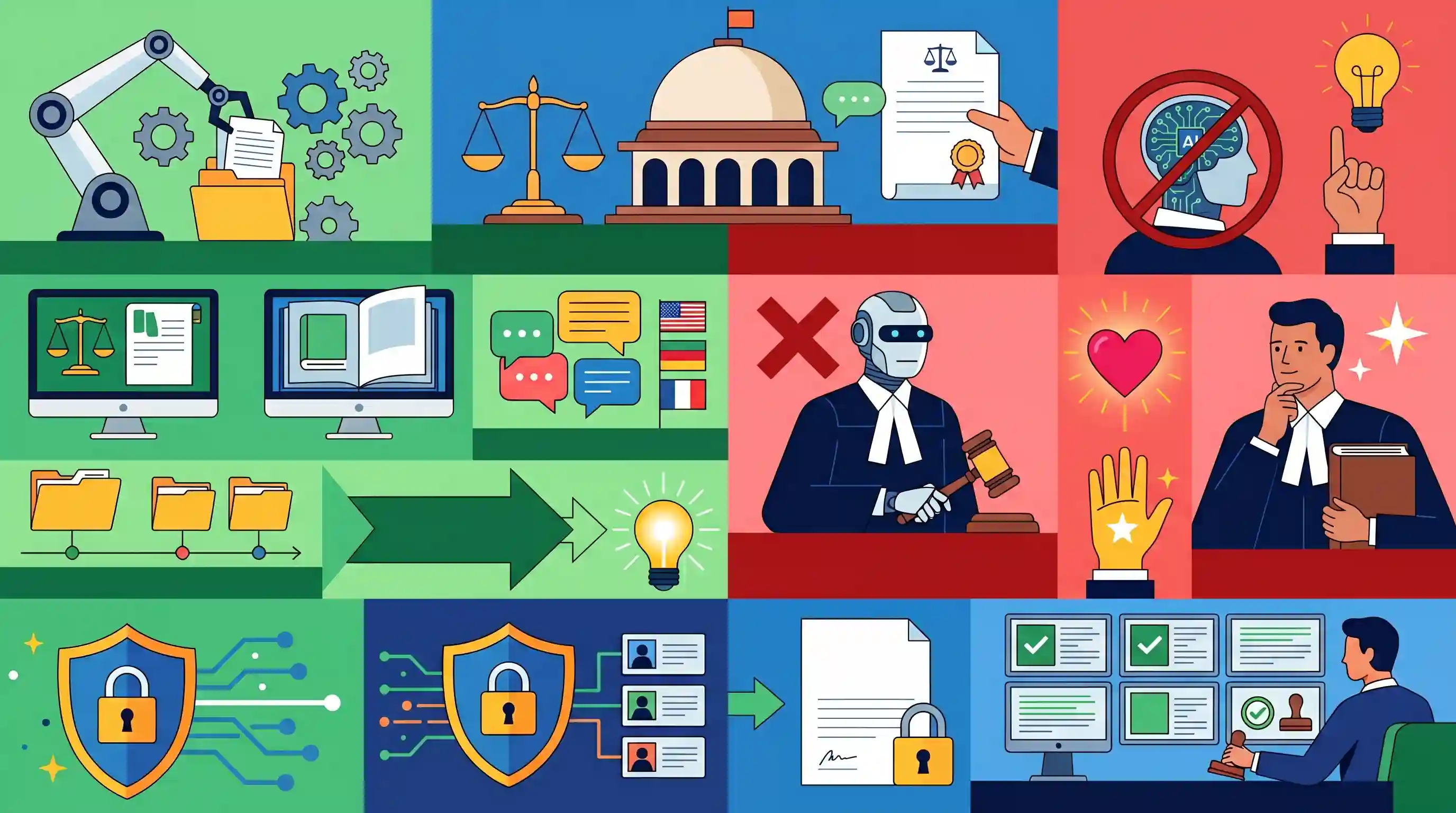
The Gujarat High Court has released a 'Policy On Use Of Artificial Intelligence In Judicial and Court Administration', clearly defining the boundaries of technology in the justice delivery system. The policy allows the deployment of AI tools to improve productivity in administrative tasks, legal research, case management, and translation. However, it strictly prohibits the use of AI in core adjudication—such as judicial decision-making, reasoning, and judgment preparation. Emphasizing that justice must be administered by accountable humans guided by conscience and constitutional values, the policy also mandates compliance with the Digital Personal Data Protection Act, 2023, to safeguard litigant data and maintain institutional accountability through strict human supervision.
Key Points
- The Gujarat High Court introduced a policy regulating the use of Artificial Intelligence (AI) in judicial and court administration.
- AI is strictly prohibited from being used in any form of judicial decision-making, reasoning, or judgment preparation, which remain exclusively human domains.
- AI tools are permitted for administrative tasks, legal research support, drafting assistance, language translation, and case management to enhance productivity.
- The policy requires human supervision and verification for all AI-assisted work to prevent hidden biases, unverifiable outputs, and erosion of public confidence.
- The integration of AI must comply with the Digital Personal Data Protection Act, 2023, to ensure the confidentiality of litigant data and court records.
Important Terms
Policy On Use Of AI In Judicial and Court Administration

Comprehensive framework by Gujarat HC (2026) permitting AI for administrative tasks (translation, research) but strictly banning it for core judicial reasoning, judgment drafting, and sentencing to ensure human-led justice.
UPSC context
GS-II: Governance & Judiciary. Tests understanding of technological integration vs. judicial ethics and the e-Courts project phase III.
Digital Personal Data Protection Act, 2023
India's primary legislation regulating digital personal data processing. It establishes the rights of individuals (Data Principals) and obligations of entities (Data Fiduciaries), overseen by the Data Protection Board.
UPSC context
GS-II: Fundamental Rights (Privacy) & Governance. Crucial for understanding data sovereignty and the Puttaswamy judgment implementation.
Judicial Independence
A constitutional principle ensuring that the judiciary remains free from external influence or technological automation in decision-making, preserving the 'conscience' and accountability of human judges.
UPSC context
GS-II: Indian Constitution. Examines the 'Basic Structure' and the necessity of human agency in upholding constitutional values.
Data Principal
The individual whose personal data is being processed. Under the DPDP Act 2023, they hold rights to access, correction, and grievance redressal regarding their digital information.
UPSC context
GS-II & GS-III: Governance & Economy. Tests knowledge of stakeholder roles in India's digital legal framework.
Data Fiduciary
Any person or entity (including courts/government) that determines the purpose and means of processing personal data, bearing primary responsibility for data security and compliance.
UPSC context
GS-II: Governance. Relevant for accountability mechanisms in public and private data management.
SUPACE & SUVAS
SUPACE (Supreme Court Portal for Assistance in Court Efficiency) and SUVAS (Vidhik Anuvaad Software) are AI tools for legal research and regional language translation, respectively.
UPSC context
GS-II: e-Governance. Specific examples of 'assistive' AI in the Indian higher judiciary to reduce case pendency.
Human-Centric Adjudication
The legal philosophy that justice must be delivered by humans guided by reason and values, rather than algorithms, to maintain public trust and ethical accountability.
UPSC context
GS-IV: Ethics & Technology. Explores the ethical limits of AI in public service and justice delivery.
Prelims Trap
AI portals like SUPACE and SUVAS are authorized to draft judgments and assist judges in core judicial decision-making.
AI is strictly prohibited from core adjudication. SUPACE is solely for research and data extraction, while SUVAS translates judgments. Neither can draft judgments.
Static Concepts Connected
What are the major Artificial Intelligence initiatives of the Indian Supreme Court?
- SUVAS: Supreme Court Vidhik Anuvaad Software translates judgments from English into vernacular languages to enhance grassroots access to justice.
- SUPACE: Supreme Court Portal for Assistance in Court's Efficiency is an AI tool for legal research, case management, and data processing, but not decision-making.
How does algorithmic bias affect AI integration in governance?
- Replication of Prejudice: AI systems learn from historical data, which may contain societal prejudices, leading to automated discriminatory outcomes against marginalized groups.
- AI Hallucinations: AI can generate fictitious legal citations or false facts, making human oversight essential to prevent miscarriages of justice.
- Lack of Accountability: Algorithmic opacity (black-box models) violates the principles of natural justice and administrative transparency required in public decision-making.
Cross-Topic Patterns
GS2 e-Courts + GS4 Ethical Governance
The transition to AI in courts bridges GS2 justice delivery with GS4 ethical concerns, specifically addressing algorithmic bias and AI 'hallucinations' in public administration.
Right to Privacy + DPDP Implementation
The prohibition against feeding litigant data into public AI models directly enforces the Puttaswamy privacy judgment and operationalizes the DPDP Act 2023 within judicial infrastructure.

Expect a 2026 GS2 Prelims question confusing SUPACE/SUVAS capabilities, or a Mains question on balancing e-Courts with algorithmic bias.
Linked PYQs · 4
Linked PYQs · 4
- 2024MainsGS4
The application of Artificial Intelligence as a dependable source of input for administrative rational decision-making is a debatable issue. Critically examine the statement from the ethical point of view.
- 2024MainsGS2
e-governance is not just about the routine application of digital technology in service delivery process. It is as much about multifarious interactions for ensuring transparency and accountability. In this context evaluate the role of the 'Interactive Service Model' of e-governance.
- 2025MainsGS2
e-governance projects have a built-in bias towards technology and back-end integration than user-centric designs. Examine.
- 2024MainsGS2
Right to privacy is intrinsic to life and personal liberty and is inherently protected under Article 21 of the constitution. Explain. In this reference discuss the law relating to D.N.A. testing of child in the womb to establish its paternity.
