Judicial intervention against artificial intelligence deepfakes
Source:Indian Express ↗
Why It Matters
Deepfakes present a novel and severe threat to electoral integrity and public trust in institutions. For UPSC aspirants, this highlights the intersection of GS2 (Judiciary's role via PILs, protecting constitutional authorities) and GS3 (challenges of AI, cyber security, and social media regulation).
Summary
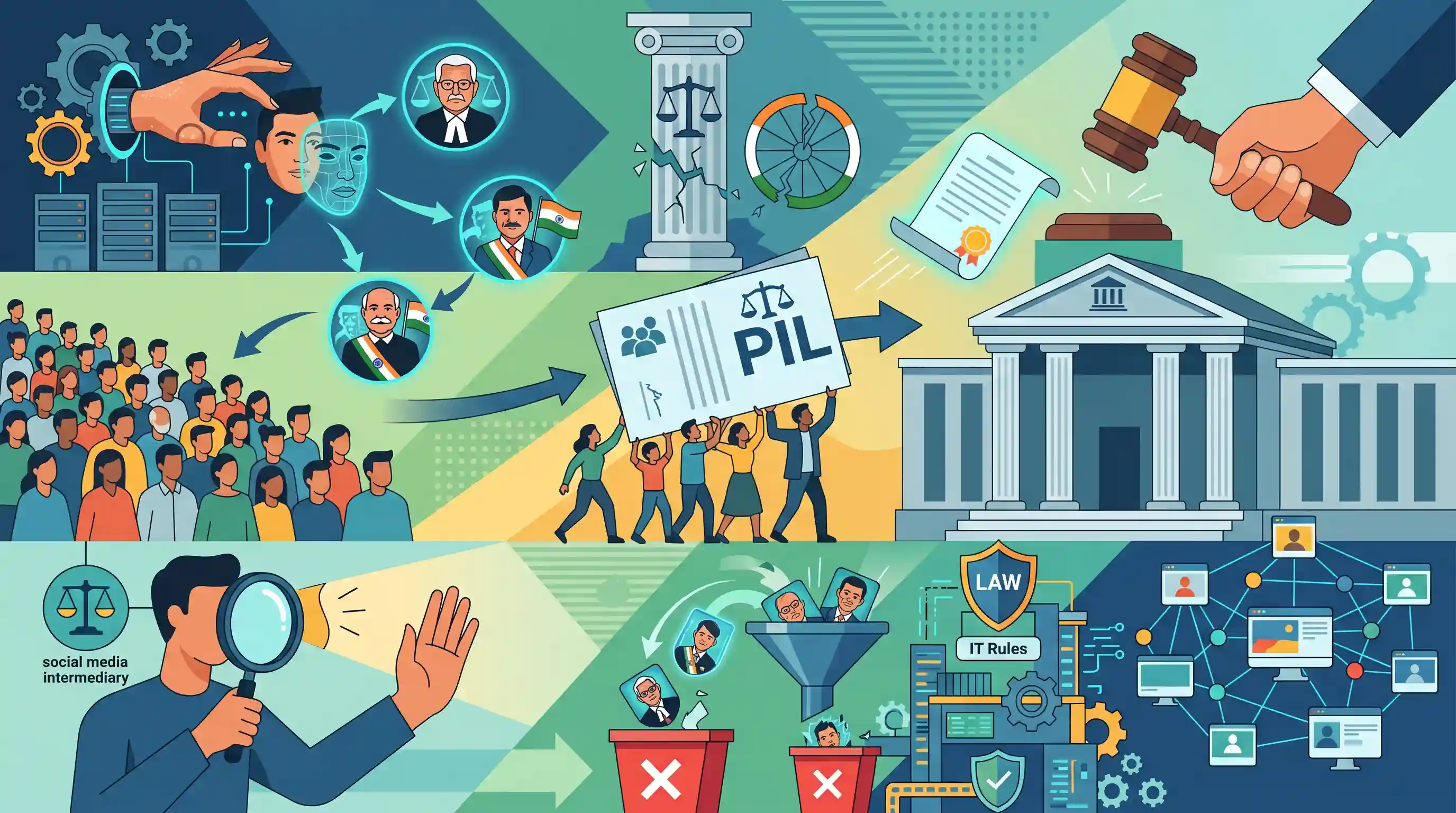
The Gujarat High Court has issued notices concerning a Public Interest Litigation (PIL) that demands a stringent crackdown on AI-generated deepfakes aimed at constitutional authorities. The petition stresses that such malicious digital manipulations undermine public trust and pose a critical threat to democratic processes. This judicial intervention highlights the pressing need for effective regulatory frameworks, such as the IT Rules 2021, and greater accountability for social media intermediaries in curbing the spread of AI-driven misinformation.
Key Points
- The Gujarat High Court issued notices in response to a Public Interest Litigation (PIL) seeking strict action against the proliferation of AI-generated deepfakes targeting constitutional authorities.
- The PIL argues that deepfakes compromise public trust in democratic institutions and can manipulate public perception, posing a severe threat to democratic integrity.
- The case underscores the growing reliance on the judiciary to push the executive for better regulation of emerging technologies and social media platforms.
- The issue highlights the urgent need for robust enforcement of existing cyber laws, such as the IT Rules 2021, and the potential need for specific AI regulations.
Important Terms
Deepfakes

Synthetic media created using Artificial Intelligence to convincingly replace a person's likeness. It poses significant risks to privacy, electoral integrity, and public trust.
UPSC context
GS Paper 3 (Science & Tech/Internal Security). Relevant for discussing ethics in AI and emerging cyber threats to democracy.
IT Rules, 2021
Statutory regulations under the IT Act, 2000, governing social media and digital news, requiring platforms to follow due diligence and provide grievance redressal.
UPSC context
GS Paper 2 (Governance). Essential for understanding digital regulation, platform accountability, and user rights in India.
Significant Social Media Intermediary (SSMI)
Social media platforms with over 5 million registered users in India, mandated to appoint specific compliance officers and ensure stricter content moderation.
UPSC context
GS Paper 2 (Governance). Crucial for discussions on the regulation of Big Tech and digital sovereignty.
Public Interest Litigation (PIL)
A legal mechanism allowing any citizen to file a petition in the High Court or Supreme Court for the protection of public or social welfare.
UPSC context
GS Paper 2 (Judiciary). Tests knowledge of judicial activism and the expansion of legal standing (locus standi).
Constitutional Authorities
High-level offices established directly by the Constitution (e.g., President, Judiciary, ECI), whose reputation and impartiality are fundamental to the functioning of Indian democracy.
UPSC context
GS Paper 2 (Polity). Relevant for understanding institutional integrity and the separation of powers.
Intermediary Liability
The legal responsibility of digital platforms for user-posted content; platforms enjoy 'Safe Harbour' protection if they comply with government-mandated due diligence.
UPSC context
GS Paper 3 (Internal Security/Cyber Law). Key for analyzing the balance between free speech and platform accountability.
Ministry of Electronics and Information Technology (MeitY)
The nodal Union ministry responsible for India's IT policy, electronics manufacturing, and internet governance, including the enforcement of cyber laws.
UPSC context
GS Paper 2 (Government Policies). Important for digital India initiatives and the executive's role in cyber regulation.
Prelims Trap
"Under Section 79 of the IT Act, social media platforms enjoy absolute immunity from liability for user-generated deepfakes."
Safe harbour is conditional, not absolute. It is forfeited if the intermediary fails to observe due diligence or ignores government/court takedown orders under the IT Rules 2021.
Static Concepts Connected
What is the 'Safe Harbour' protection for intermediaries in India?
- Section 79: Shields digital intermediaries from legal liability for third-party information hosted by them, provided they act strictly as neutral facilitators.
- Conditional immunity: Protection is forfeited if the platform initiates the transmission, selects the receivers, or modifies the information being transmitted.
- IT Rules 2021: Mandates rapid grievance redressal and the removal of morphed/impersonating content; failure to comply strips platforms of this legal immunity.
How do Generative Adversarial Networks (GANs) create deepfakes?
- Dual networks: Employs two neural networks: a 'Generator' that creates fake synthetic media, and a 'Discriminator' that attempts to detect the fakes.
- Continuous learning: The generator iteratively improves its outputs through adversarial training until it successfully fools the discriminator, yielding highly realistic deepfakes.
Cross-Topic Patterns
Deepfakes and Electoral Integrity
The proliferation of synthetic political media directly challenges the Election Commission's Article 324 mandate, linking tech regulation with the enforcement of the Model Code of Conduct during elections.
PILs filling tech legislative vacuums
Reliance on PILs to mandate AI crackdowns highlights the tension between judicial intervention and separation of powers when parliamentary frameworks lag behind rapid technological advancements.

Expect a 2026 Prelims multi-statement question combining the tech mechanism of GANs with the legal conditions for Section 79 safe harbour.
Linked PYQs · 4
Linked PYQs · 4
- 2024MainsGS3
Social media and encrypting messaging services pose a serious security challenge. What measures have been adopted at various levels to address the security implications of social media? Also suggest any other remedies to address the problem.
- 2020MainsGS2
Judicial Legislation is antithetical to the doctrine of separation of powers as envisaged in the Indian Constitution. In this context justify the filing of large number of public interest petitions praying for issuing guidelines to executive authorities.
- 2023MainsGS3
Introduce the concept of Artificial Intelligence (AI). How does Al help clinical diagnosis? Do you perceive any threat to privacy of the individual in the use of Al in healthcare?
- 2020PrelimsGS1
With the present state of development, Artificial Intelligence can effectively do which of the following? 1. Bring down electricity consumption in industrial units 2. Create meaningful short stories and songs 3. Disease diagnosis 4. Text-to-Speech Conversion 5. Wireless transmission of electrical energy Select the correct answer using the code given below:
