Gujarat High Court Bars Artificial Intelligence in Judgments
Source:The Hindu ↗
Why It Matters
Highlights the ethical and practical limitations of using emerging technologies like AI in governance and the judiciary. It provides a critical case study for GS2 (Judiciary/E-governance) and GS3 (Science and Tech/Cybersecurity) on balancing technological efficiency with institutional accountability, bias mitigation, and data privacy.
Summary
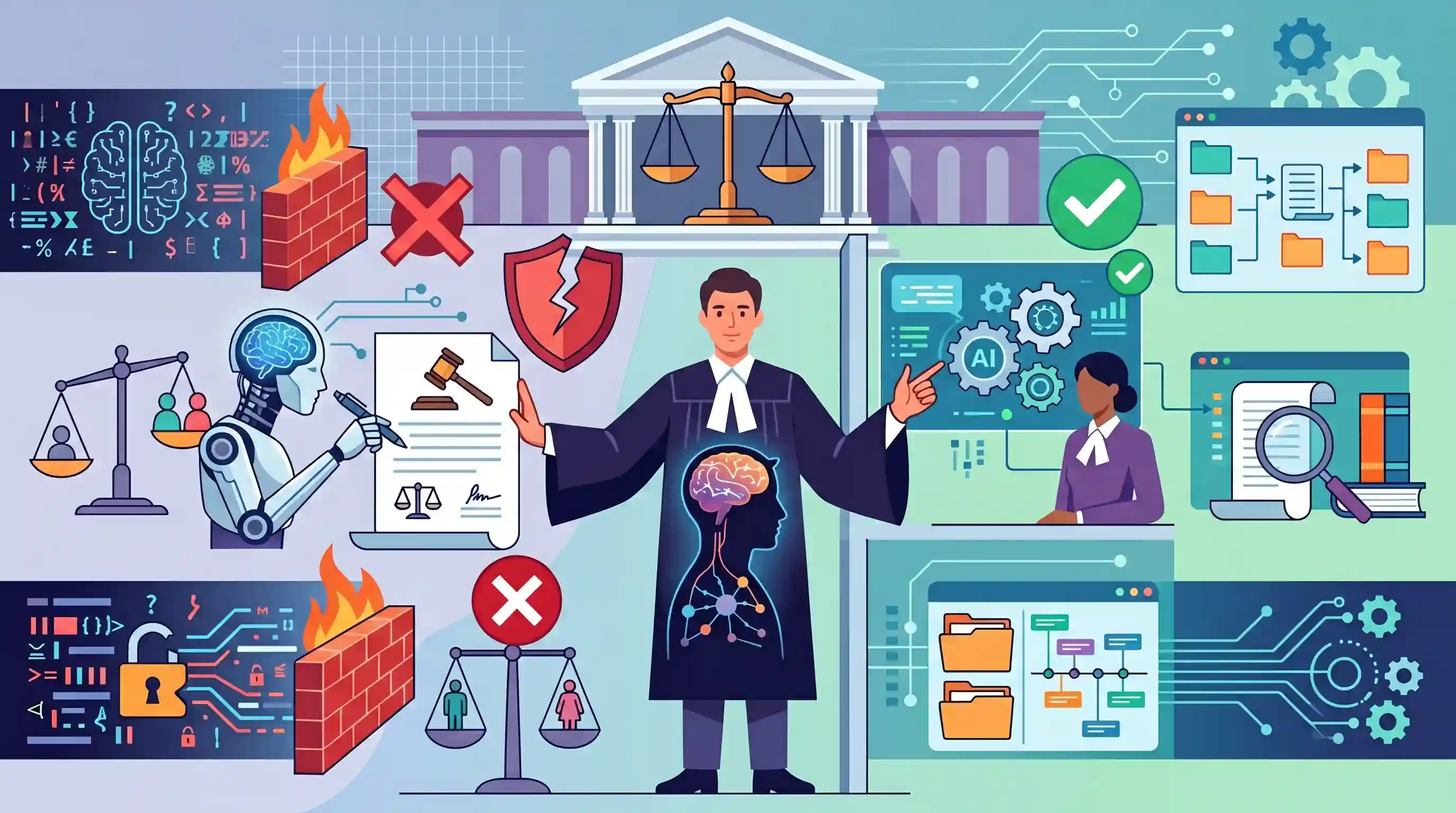
The Gujarat High Court has unveiled a comprehensive AI policy that strictly bars the use of Artificial Intelligence in decision-making, judgment drafting, or any substantive adjudicatory process. While acknowledging the potential of AI to improve productivity and case management, the policy explicitly restricts its role to administrative tasks, legal research, and IT automation. The guardrails are designed to prevent issues like AI hallucinations, bias, and confidentiality breaches, ensuring that human reasoning and judicial independence remain central to the justice delivery system.
Key Points
- The Gujarat High Court issued a policy prohibiting the use of AI for judicial decision-making, reasoning, bail sentencing, or drafting judgments.
- The ban aims to mitigate risks such as AI hallucinations, bias, breaches of confidentiality, and the erosion of judicial independence.
- Feeding sensitive personal data, pending case details, or privileged legal strategies into AI tools is strictly forbidden.
- AI is permitted only for administrative tasks, legal research, IT code generation, and case allocation, provided there is strict human verification against primary sources.
- The policy emphasizes that human supremacy in justice delivery must be reaffirmed and a judge is personally responsible for every order issued under their name.
Important Terms
Gujarat High Court AI Policy

Guidelines released in April 2026 by the Gujarat High Court prohibiting AI use in judicial decision-making and judgment drafting, while allowing it for administrative and research tasks.
UPSC context
GS Paper 2: Judiciary and E-Governance. Tests understanding of technological guardrails in the justice system.
e-Courts Project
A pan-India mission-mode project transforming the judiciary through ICT; Phase III focuses on AI-driven efficiency, digital-first courts, and reducing case pendency.
UPSC context
GS Paper 2: Governance/Judiciary. Key for answers on judicial reforms and digital public infrastructure.
SUPACE
An AI-driven portal (Supreme Court Portal for Assistance in Court’s Efficiency) designed to assist judges with legal research and data processing without replacing human discretion.
UPSC context
GS Paper 2 & 3: Science and Technology in Governance. Example of AI as a decision-support tool.
SUVAS
The Supreme Court Vidhik Anuvaad Software, an AI tool used to translate judicial documents into regional languages to improve legal accessibility for citizens.
UPSC context
GS Paper 2: Social Justice/Governance. Relevant for discussions on inclusivity and the right to information.
Judicial Independence
The core constitutional principle ensuring judges decide cases without external influence; the Gujarat HC policy defends this by barring autonomous AI reasoning.
UPSC context
GS Paper 2: Constitution and Polity. Central to the 'Basic Structure' doctrine and judicial accountability.
AI Hallucination
A phenomenon where Artificial Intelligence generates false, fabricated, or nonsensical information; cited as a primary risk to the integrity of judicial orders.
UPSC context
GS Paper 3: Science and Technology/Ethics. Important for analyzing the limitations of AI in critical governance sectors.
Prelims Trap
"AI portals like SUPACE are utilized by the Indian judiciary to autonomously draft judgments and decide bail applications."
SUPACE is strictly an assistance tool for legal research and data extraction. The Indian judiciary does not permit AI for core adjudicatory functions or drafting.
Static Concepts Connected
What are the key AI and Tech initiatives of the Supreme Court?
- SUPACE: An AI-assisted legal research tool for data mining and fact extraction, strictly meant for assistance and not for judicial decision-making.
- SUVAS: An AI-powered translation tool utilized to translate Supreme Court judgments from English into regional languages to improve access to justice.
- FASTER: A digital system launched to ensure the fast and secure electronic transmission of judicial orders (like bail) to enforcement authorities.
What are the primary technical risks of Generative AI in governance?
- AI Hallucinations: The generation of completely fabricated or false information (such as inventing fake case citations) which the AI presents confidently as factual.
- Algorithmic Bias: Systematic and repeatable errors that create unfair outcomes, often inherited from historically biased training data, threatening judicial fairness.
- Data Privacy Risks: Feeding confidential state or citizen data into public AI models risks severe security breaches, violating institutional privilege and individual privacy.
Cross-Topic Patterns
Tech Ethics & Human-in-the-loop
The HC's "human supremacy" mandate directly links to GS4 Tech Ethics, illustrating the necessity of human accountability and "human-in-the-loop" design in algorithmic governance.
E-Courts Phase III & DPDP Act
The prohibition on feeding pending case details into AI models aligns with citizen data protection norms and privacy guardrails under the DPDP Act 2023.

Expect a Prelims question differentiating SC's SUPACE/SUVAS functions from prohibited autonomous AI decision-making in the judiciary.
Linked PYQs · 3
Linked PYQs · 3
- 2023MainsGS2
“Constitutionally guaranteed judicial independence is a prerequisite of democracy.” Comment.
- 2023MainsGS3
Introduce the concept of Artificial Intelligence (AI). How does Al help clinical diagnosis? Do you perceive any threat to privacy of the individual in the use of Al in healthcare?
- 2025MainsGS2
e-governance projects have a built-in bias towards technology and back-end integration than user-centric designs. Examine.
