Gujarat GST Revenue Surges Past National Average in Financial Year
Source:Indian Express ↗
Why It Matters
Highlights the effectiveness of amnesty schemes in reducing tax litigation and recovering blocked public revenue. It also provides a case study on robust state-level resource mobilization and fiscal health within India's cooperative federalism framework post-GST implementation.
Summary
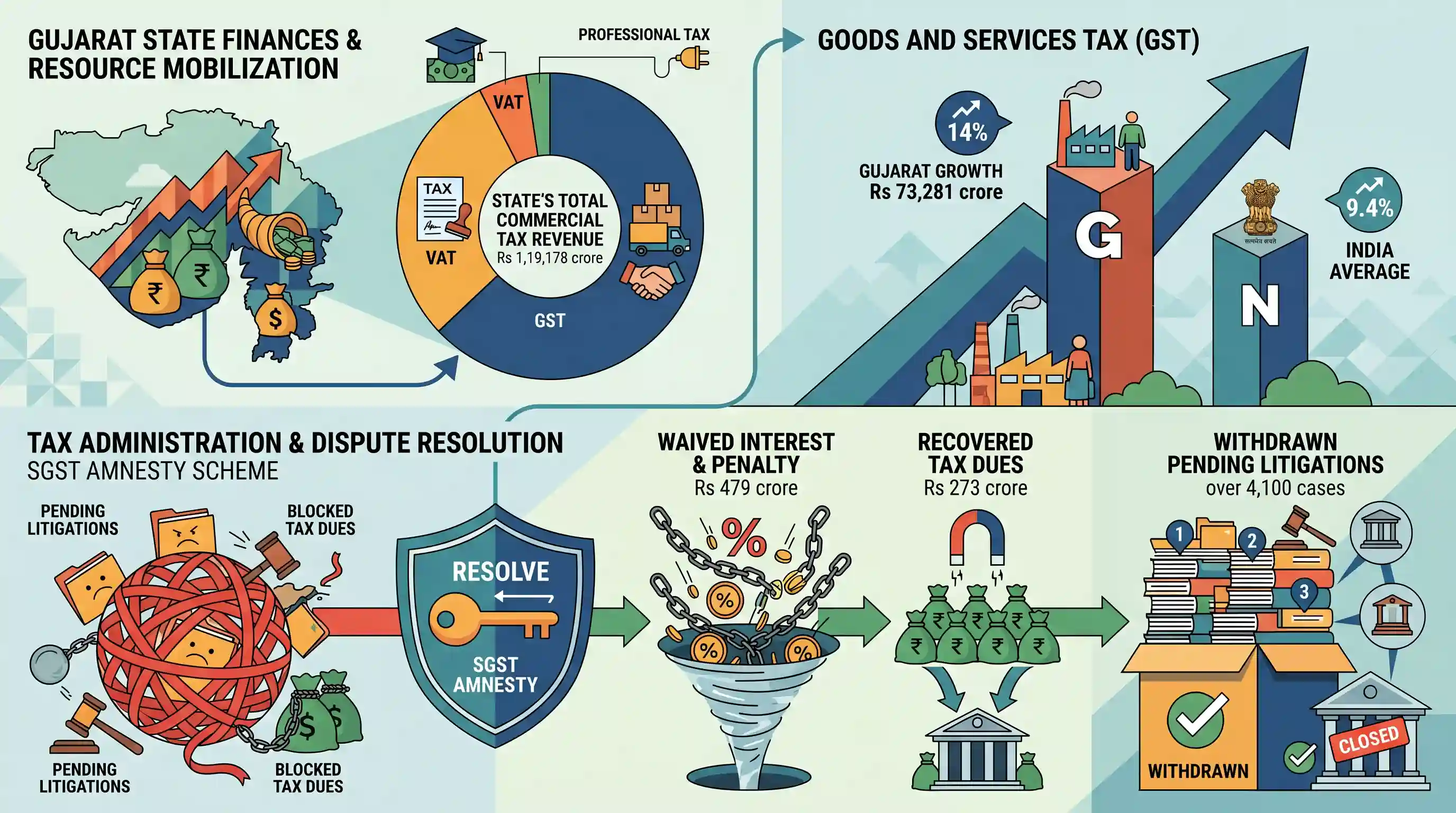
Gujarat's Goods and Services Tax (GST) collections for the financial year 2024-25 have surged by 14% to reach Rs 73,281 crore, notably exceeding the national GST growth average of 9.4%. The state's overall commercial tax revenue—including VAT, professional tax, and electricity duty—totaled Rs 1,19,178 crore. Concurrently, Gujarat's SGST Amnesty Scheme achieved significant success in resolving legacy tax disputes. By incentivizing taxpayers with interest and penalty waivers totaling Rs 479 crore, the state recovered Rs 273 crore in blocked tax dues and facilitated the withdrawal of over 4,100 pending litigations from tribunals and courts.
Key Points
- Gujarat recorded a 14% growth in its GST revenue for FY 2024-25, collecting Rs 73,281 crore, significantly outpacing the national average growth rate of 9.4%.
- The state's total tax revenue, encompassing GST, VAT, electricity duty, and professional tax, reached Rs 1,19,178 crore for the fiscal year.
- The SGST Amnesty Scheme yielded highly positive results, successfully prompting taxpayers to withdraw 4,120 dispute applications pending at various appellate and judicial levels.
- Through the amnesty scheme, the state recovered Rs 273 crore in principal tax dues while waiving Rs 479 crore in interest and penalties, effectively reducing tax litigation.
Important Terms
Goods and Services Tax (GST)

A comprehensive, multi-stage, destination-based indirect tax levied on the supply of goods and services. It unified the Indian market by subsuming various central and state taxes like excise duty and VAT.
UPSC context
GS III (Indian Economy). Tests understanding of indirect tax reforms, resource mobilization, and the "one nation, one tax" concept.
State Goods and Services Tax (SGST)
The component of the dual GST model levied and collected by state governments on intra-state transactions of goods and services, governed by the respective State GST Acts.
UPSC context
GS III (State Finances). Tests knowledge of fiscal federalism and the division of taxing powers.
SGST Amnesty Scheme
A fiscal measure offering limited-time relief—specifically waivers on interest and penalties—to taxpayers for settling past disputes. It aims to reduce litigation backlogs and recover blocked revenue.
UPSC context
GS III (Resource Mobilization). Tests knowledge of tax administration and dispute resolution mechanisms.
Resource Mobilization
The process of identifying and utilizing financial, human, and natural assets to achieve developmental goals. For governments, it primarily involves generating revenue through taxation and public borrowing.
UPSC context
GS III (Indian Economy). Core syllabus topic testing how states fund development and infrastructure.
GST Council
A constitutional body (Article 279A) chaired by the Union Finance Minister that makes recommendations on tax rates and procedures, facilitating cooperative federalism between the Centre and States.
UPSC context
GS II (Constitutional Bodies). Tests understanding of cooperative federalism in fiscal decision-making.
Prelims Trap
"Under the GST regime, states lack the authority to launch independent amnesty schemes for State GST (SGST) disputes."
India's Dual GST model empowers states to manage SGST independently, allowing state governments to deploy localized amnesty schemes for legacy regional disputes.
Static Concepts Connected
Which major state and central taxes remain outside the purview of GST?
- Petroleum & Alcohol: Five petroleum products (crude oil, diesel, petrol, natural gas, ATF) and alcoholic liquor for human consumption still attract State VAT/Excise.
- Customs Duties: Basic Customs Duty (BCD) continues to be levied on imports, though Integrated GST (IGST) is applied alongside it.
- State-specific Levies: Taxes like electricity duty, professional tax, property tax, and stamp duty were not subsumed and remain exclusive state revenue sources.
How does Article 246A structure India's Dual GST framework?
- Concurrent Legislative Power: It grants concurrent powers to both Parliament and State Legislatures to make laws regarding GST imposed by the Union or by such State.
- Simultaneous Levy: Both the Centre and States simultaneously levy tax on a common base for intra-state supplies (Central GST and State GST).
- Inter-state Exclusive Power: Parliament retains exclusive power to legislate GST on inter-state trade or commerce (Integrated GST).
Cross-Topic Patterns
Tax amnesties and judicial backlog decongestion
State SGST amnesties mimic the Centre's 'Sabka Vishwas' scheme, highlighting a broader governance trend of using incentivized tax recovery to simultaneously mobilize resources and decongest overburdened tribunals.
Post-2022 State fiscal resilience and CapEx
With the end of the Centre's guaranteed 14% GST compensation shortfall in June 2022, robust double-digit SGST growth has become a critical indicator for evaluating state-level capital expenditure capabilities.

Expect a Prelims 2026 statement differentiating taxes subsumed in GST vs those retained by states (like electricity duty and alcohol VAT).
Linked PYQs · 4
Linked PYQs · 4
- 2019MainsGS3
Enumerate the indirect taxes which have been subsumed in the Goods and Services Tax (GST) in India. Also, comment on the revenue implications of the GST introduced in India since July 2017.
- 2020MainsGS3
Explain the rationale behind the Goods and Services Tax (Compensation to States) Act of 2017. How has COVID-19 impacted the GST compensation fund and created new federal tensions?
- 2013MainsGS3
Discuss the rationale for introducing Goods and Services Tax (GST) in India. Bring out critically the reasons for the delay in roll out for its regime.
- 2017PrelimsGS1
What is/are the most likely advantages of implementing 'Goods and Services Tax (GST)'? 1. It will replace multiple taxes collected by multiple authorities and will thus create a single market in India. 2. It will drastically reduce the 'Current Account Deficit' of India and will enable it to increase its foreign exchange reserves. 3. It will enormously increase the growth and size of economy of India and will enable it to overtake China in the near future. Select the correct answer using the code given below:
